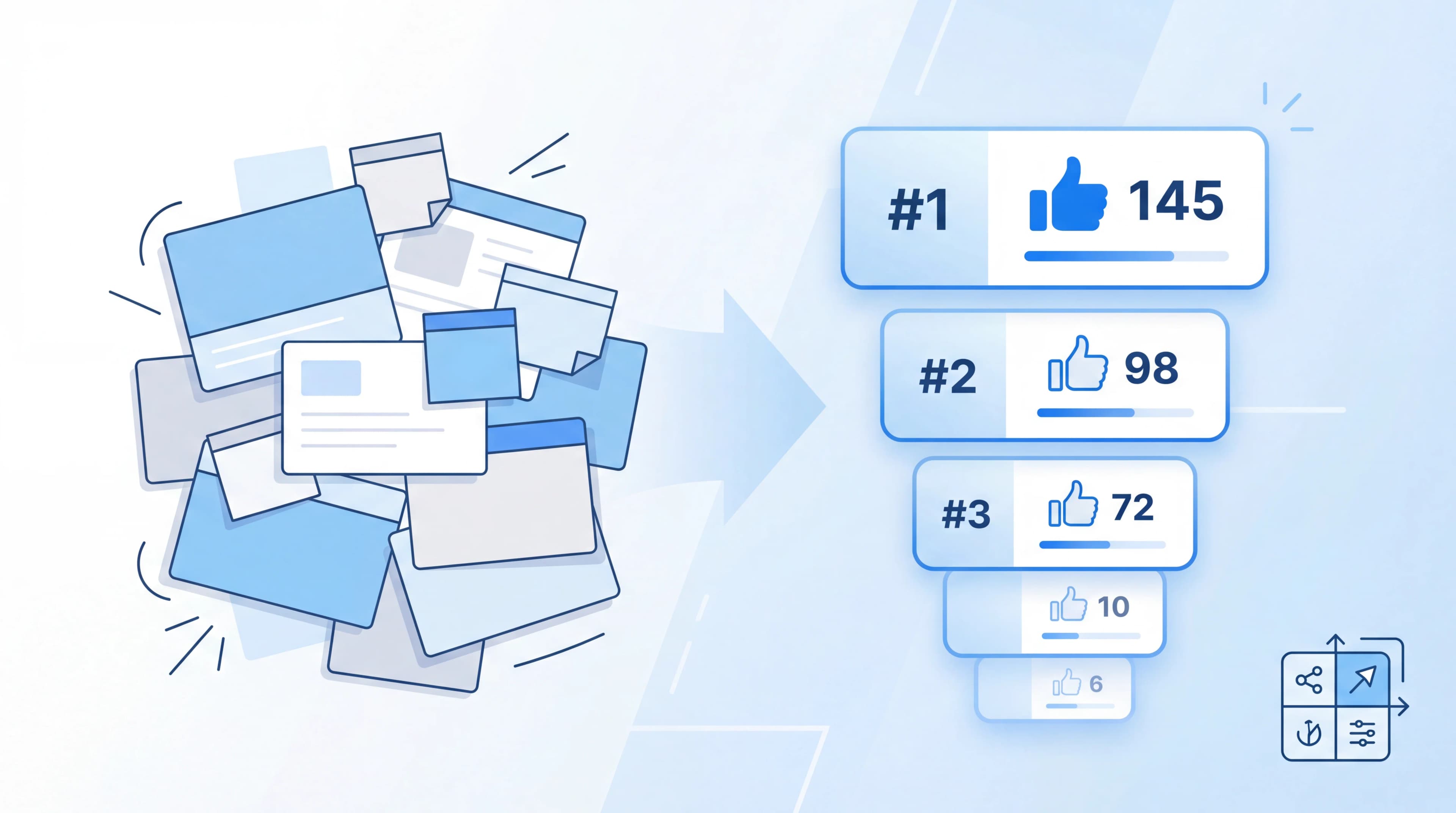
Every product team faces the same problem: more feature requests than capacity to build them. The question isn't whether to prioritize. It's whether your prioritization is based on data or on who talks the loudest in the planning meeting.
How to prioritize feature requests comes down to two things: quantifying demand so you know what users actually want, and applying a framework so effort matches impact. Most teams skip the first part and jump straight to frameworks, which means they're scoring features with guessed impact numbers. That's not prioritization. That's organized guessing.
This guide covers how to turn raw feature requests into a ranked, actionable backlog using real user data.
Why Teams Fail to Prioritize Feature Requests
Three patterns cause prioritization to fail:
Equal weight for unequal signals. A feature request from your largest customer and a feature request from a trial user who signed up yesterday sit in the same backlog with the same priority. Without demand quantification, every request looks equally important.
HiPPO decisions. The Highest Paid Person's Opinion wins. When there's no data to counter it, the executive who "just knows" what users want overrides the backlog. Sometimes they're right. Often they're not. Either way, it's not a repeatable process.
Framework without input data. Teams adopt RICE or MoSCoW, fill in scores based on gut feeling, and call it data-driven. But if the "Impact" score in RICE is someone's guess rather than actual user demand data, the framework adds process without adding signal.
Step 1: Centralize and Quantify Requests
Before you can prioritize, you need all requests in one place with demand data attached.
Set up feedback boards where users submit and vote on feature requests. Every request accumulates votes from other users who want the same thing. This transforms your backlog from a list of equal-weight items into a demand-ranked queue.
What voting gives you that raw feedback doesn't:
- Demand magnitude. A request with 120 votes versus one with 3 votes. That's a 40x difference in expressed demand that you'd never see in a flat list.
- Demand velocity. A new request that gets 50 votes in a week signals urgency. An old request with 50 votes accumulated over a year signals a persistent but not urgent need.
- Duplicate elimination. Instead of 15 variations of "add Slack integration," one entry with 15 votes. Your backlog stays clean.
Start every prioritization conversation from the vote-ranked view. Not as the final answer, but as the starting input that grounds the discussion in data.
Step 2: Apply a Prioritization Framework
Voting data tells you what users want. A framework helps you weigh that against what your team can deliver. The two most practical frameworks for feature requests:
RICE Scoring
RICE was developed by Intercom as a scoring method for product prioritization. It evaluates features on four dimensions:
| Dimension | What it measures | Where to get the data |
|---|---|---|
| Reach | How many users will this affect? | Vote count + user segment data |
| Impact | How much will it move the needle? | Vote count + qualitative feedback |
| Confidence | How sure are you about reach and impact? | Number of distinct voters, comment quality |
| Effort | How much dev time does it need? | Engineering estimate |
Score = (Reach x Impact x Confidence) / Effort
The key insight: voting data fills in Reach and Impact with real numbers instead of guesses. A feature with 120 votes from paying users has a measurably higher Reach and Impact than one with 5 votes from trial users. You don't need to debate it.
MoSCoW Method
Simpler than RICE. Categorize every request as:
- Must have. High votes + blocks core workflows. Build this sprint.
- Should have. High votes + improves existing workflows. Plan for next sprint.
- Could have. Moderate votes + nice-to-have. Backlog, revisit quarterly.
- Won't have (now). Low votes or misaligned with strategy. Acknowledge, don't build.
MoSCoW works well for teams that find RICE scoring too heavy. The vote count provides the demand signal; the team applies strategic judgment on top.
When to Use Which
Use RICE when you need to compare 10+ competing requests and want a numerical ranking. Use MoSCoW when you have fewer requests or when the priority tiers are more useful than exact rankings. Both work. Both are better than no framework.
Step 3: Add Strategic Filters
User demand isn't the only input. Layer these filters on top of your vote-ranked, framework-scored list:
Strategic alignment. Does this feature move you toward your product vision? A highly-voted feature that takes you in the wrong direction is still the wrong feature. Acknowledge the demand, explain why you're not building it, and suggest alternatives.
Segment weighting. Votes from paying customers might matter more than votes from free users, depending on your business model. If 80% of votes come from free users but 80% of revenue comes from a segment requesting something different, factor that in.
Quick wins. A feature with 40 votes and 2 days of effort might deliver more sprint value than a feature with 100 votes and 2 months of effort. The RICE formula captures this, but it's worth calling out explicitly: small, high-demand features compound.
Technical dependencies. Sometimes feature B requires feature A. Regardless of votes, A comes first. Map dependencies before locking the sprint. Atlassian's guide to feature prioritization covers dependency mapping in more detail.
Step 4: Communicate Your Priorities
Prioritization only works if users know what's happening. After each planning cycle:
Update your roadmap. Move prioritized requests to "Next" or "In Progress" on your roadmap. Users who voted for those features see the status change. In Feeqd, this happens on the public roadmap where anyone can check progress.
Address what you're not building. The hardest part of prioritization is saying no. When a feature request has votes but won't be built, update the status with a brief explanation. "We've decided not to pursue this because [reason]" is better than silence. Users respect transparency more than they resent rejection.
Share the reasoning. "We're building CSV export (120 votes) before API webhooks (85 votes) because export unblocks 3 integration partners" gives users confidence that the process is rational, even if their request wasn't chosen this cycle.
Step 5: Review and Calibrate
After two or three cycles, review whether your prioritization is producing good outcomes:
- Adoption vs votes. Do high-voted features get high adoption after launch? If yes, votes are a reliable demand signal. If not, investigate why (maybe voters wanted something different from what you built).
- Framework accuracy. Did your RICE scores predict actual outcomes? Adjust your scoring calibration based on what shipped well and what didn't.
- Backlog health. Are old requests accumulating votes without ever getting prioritized? That's a sign your capacity doesn't match demand in that area. Either scale up or explicitly deprioritize with communication.
Track these patterns over time. Good prioritization isn't a one-time decision. It's a system that improves as you learn which signals predict success. Read about how to announce features once they ship to complete the cycle.
Common Mistakes
Prioritizing only by vote count. Votes measure demand, not impact. A feature with 200 votes that takes 6 months might be less valuable than 5 features with 30 votes each that take a week each. Always combine demand data with effort estimates.
Ignoring low-vote requests from key segments. If your top 3 enterprise customers each request the same feature but only have 3 votes total, that might still be your highest-revenue priority. Segment context matters.
Re-prioritizing every sprint. Some features need multiple sprints to build. If you re-rank everything every two weeks, large features never get started. Lock committed features and only re-prioritize the uncommitted backlog.
Treating all frameworks as permanent. Start with MoSCoW if you're new to structured prioritization. Graduate to RICE when your backlog grows beyond 20-30 items. Switch if something isn't working. The framework serves you, not the other way around.
FAQ
What are the 4 D's of prioritization?
The 4 D's are Do (high priority, act now), Defer (important but not urgent, schedule for later), Delegate (someone else can handle it), and Delete (low value, remove from backlog). For feature requests, "Delete" translates to marking a request as "Won't do" with a clear explanation to voters, rather than letting it sit in the backlog indefinitely.
How to prioritize product features?
Start by quantifying demand through user voting so you know which features users actually want. Then apply a framework like RICE (Reach, Impact, Confidence, Effort) or MoSCoW to weigh demand against effort and strategy. The combination of real demand data plus structured evaluation beats both pure gut feeling and frameworks filled with guessed numbers.
What is the RICE framework for feature prioritization?
RICE scores features by multiplying Reach (users affected), Impact (how much it helps), and Confidence (how sure you are), then dividing by Effort (dev time). The result is a comparable score across features. The key is using real data for Reach and Impact: vote counts from feedback boards provide actual demand numbers instead of subjective estimates.
How do you say no to a feature request?
Acknowledge the request, explain why it's not being built now, and be specific about the reason (strategic misalignment, insufficient demand, technical constraints). Update the feedback entry status so the requester sees you considered it. "We reviewed this and decided to focus on X instead because [reason]" is better than silence. Users who feel heard stay engaged even when their request is declined.
Get started with Feeqd for free
Let your users tell you exactly what to build next
Collect feedback, let users vote, and ship what actually matters. All in one simple tool that takes minutes to set up.
Sign up for free