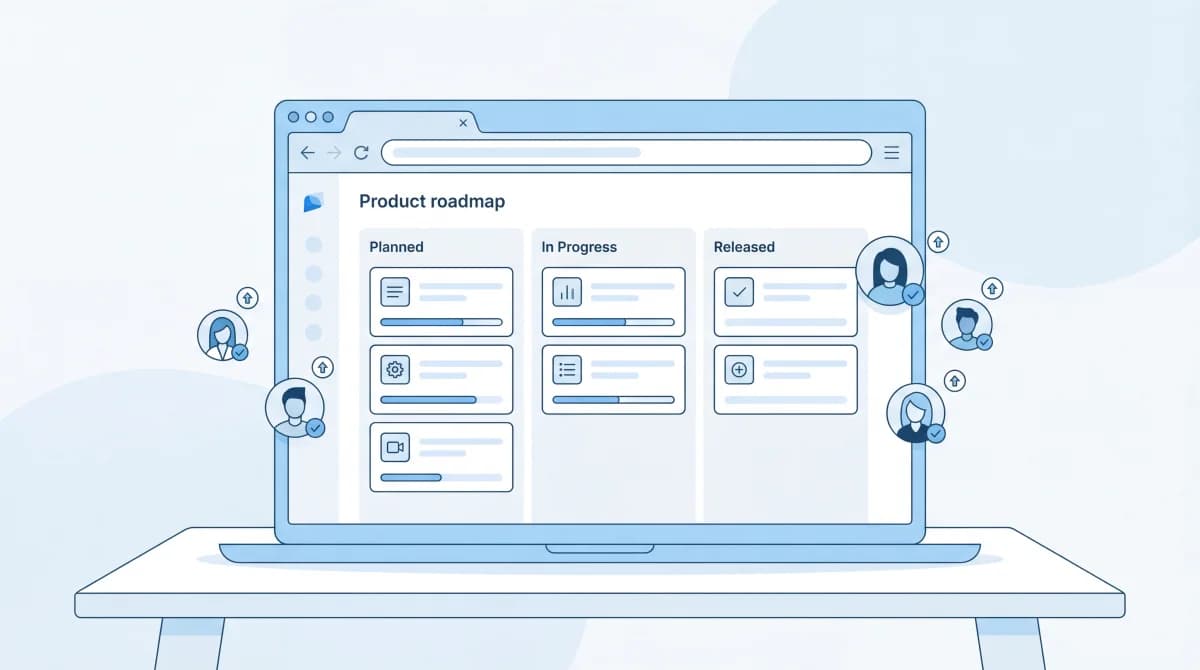
Most product roadmaps are locked behind internal wikis, visible only to the team building the product. Users submit feedback, vote on features, and then wait in silence, never knowing whether their request was heard, rejected, or scheduled for next quarter.
A public product roadmap flips this dynamic. It makes your plans visible to customers, prospects, and anyone who cares about where your product is headed. And the teams that do it consistently find that transparency is not a risk. It's a competitive advantage.
I was hesitant to make Feeqd's roadmap public. The concern was that competitors would see our plans or that users would hold us to every item. What actually happened: users started checking the roadmap weekly, voting patterns became more intentional, and "what are you building next?" support tickets dropped to near zero. The transparency became a trust signal that prospects mentioned during sales conversations.
What Is a Public Product Roadmap?
A public product roadmap is an externally visible plan that shows what your team is building, what's coming next, and what's already shipped. Unlike internal roadmaps designed for sprint planning, a public roadmap is designed for your users and community.
It typically includes:
- Current work: features actively being built
- Upcoming plans: what's next in the pipeline
- Completed items: what you've shipped recently
- User demand signals: vote counts or request frequency (optional but powerful)
What it should NOT include: internal timelines, resource allocation details, competitive strategy, or unvalidated ideas that might never ship.
Why Public Roadmaps Work
They build trust through transparency
When users can see that you're actively building, they trust you more. This is especially true for SaaS products where users are paying monthly and evaluating whether to stay. A public roadmap says "we're listening and we're building" without you having to send a single email.
According to research from Pragmatic Institute, product teams that share roadmaps externally report measurably higher customer satisfaction. The mechanism is simple: uncertainty breeds frustration. When users know what's coming, they wait more patiently.
They reduce support load
"When is feature X coming?" is one of the most common support questions for product teams. A public roadmap answers this question preemptively. Users can check the roadmap instead of opening a ticket. When we made Feeqd's roadmap public, support questions about upcoming features dropped by roughly 70% in the first month because the answer was already visible.
They attract prospects
A public roadmap is a signal to prospects that your product is alive and evolving. When someone evaluates your product against a competitor, seeing an active roadmap with recent completions and upcoming features tells them you're not abandonware. Several of our early users mentioned the public roadmap as a factor in choosing Feeqd over alternatives.
They improve feedback quality
When users can see what you're already planning, they submit more targeted feedback. Instead of requesting features that are already in progress, they vote on existing items or suggest genuinely new ideas. The public roadmap acts as context for the feedback process, reducing duplicates and increasing signal quality.
They create accountability (in a good way)
A public roadmap keeps your team focused. When users can see your priorities, you're less likely to get sidetracked by internal pet projects or low-impact work. The accountability isn't about being held to specific dates. It's about being honest about what matters.
What to Share (and What to Keep Private)
The biggest fear about public roadmaps is oversharing. Here's a practical framework:
Share publicly
- Feature names and descriptions: what you're building, in user-facing language
- Status: Now (building), Next (planned), Later (considering), Completed (shipped)
- Vote counts: how many users want each feature (builds social proof)
- High-level themes: "We're focusing on mobile experience this quarter"
Keep private
- Specific dates: "Shipping March 15" creates a promise you might break. Use "Now/Next/Later" instead of dates.
- Resource allocation: "2 engineers working on this" is internal detail that doesn't help users
- Competitive strategy: don't telegraph moves that competitors can counter
- Rejected ideas: marking items as "Won't Do" can frustrate users. Simply leave them in a lower-priority bucket.
- Revenue projections or pricing changes: business-sensitive information
The now-next-later framework works perfectly for public roadmaps because it communicates priority without committing to deadlines.
How to Set Up a Public Product Roadmap
Step 1: Choose your format
A Kanban board with status columns (Pending, Next, In Progress, Completed) is the most common format for public roadmaps. It's visual, scannable, and naturally communicates progress as items move from left to right.
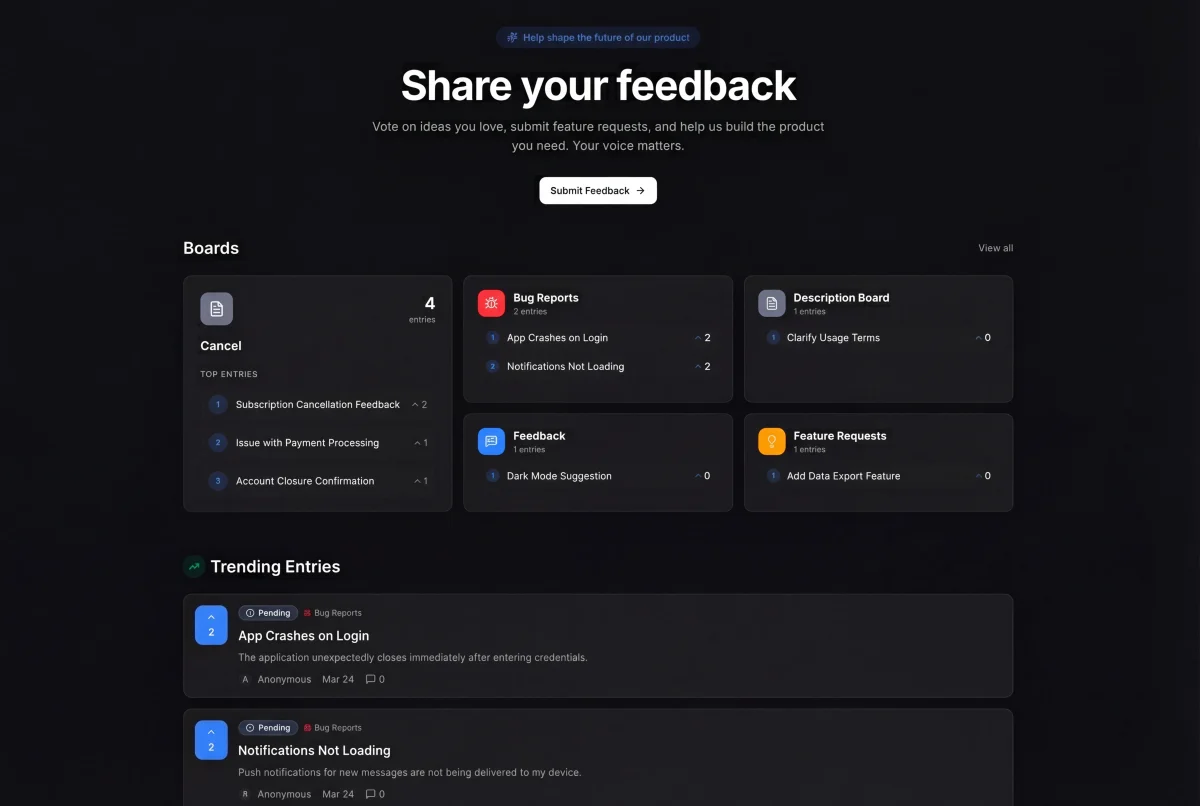
In Feeqd, every workspace can share a public roadmap on its custom subdomain (yourcompany.feeqd.com). Users see items with vote counts and status badges without needing to log in.
Step 2: Populate with feedback-backed items
Don't put random features on your public roadmap. Every item should trace back to either user feedback (votes, requests) or a clear business goal. When users see vote counts next to roadmap items, they understand why certain features are prioritized. This context prevents the "why are you building X instead of Y?" questions.
Step 3: Set a review cadence
Update your public roadmap at least weekly. Move items through stages as work progresses. Add new items when they're committed. The worst thing you can do is launch a public roadmap and let it go stale. A roadmap that hasn't changed in a month signals neglect, not stability.
Step 4: Connect it to your feedback system
The most powerful public roadmaps are connected to a feedback management system where users can submit requests and vote. The roadmap becomes the output of your feedback process, not a separate artifact. Users see the full loop: request → vote → roadmap → shipped.
In Feeqd, roadmap items link back to their source feedback entries. Users who voted for a feature can see it progress through the roadmap in real time.
Companies That Do Public Roadmaps Well
GitHub publishes their public roadmap as a GitHub repository, organized by quarter. It's the most visible example of a public product roadmap in tech, and it fits their audience (developers who already use GitHub). Each item includes a description, target timeframe, and linked issues, making it both a communication tool and a development tracker.
Linear shares a public roadmap that shows what they're building and recently shipped. It's become a trust signal for their developer-focused audience.
Canny practices what they preach by maintaining a public roadmap powered by their own tool. Users vote on features and see status updates.
The common pattern: all three companies use their public roadmap as both a communication tool and a community engagement mechanism. Users don't just read the roadmap. They participate in shaping it.
Public Roadmap vs Internal Roadmap
Not sure whether to go public? Here's how the two approaches compare:
| Aspect | Public Roadmap | Internal Roadmap |
|---|---|---|
| Audience | Customers, prospects, community | Product team, engineering, leadership |
| Detail level | High-level (features, status) | Granular (tasks, sprints, assignments) |
| Date commitments | Avoid (use Now/Next/Later) | Acceptable (sprint-level planning) |
| Format | Kanban board, Now/Next/Later | Timeline, Gantt, sprint board |
| Update frequency | Weekly minimum | Daily/per-sprint |
| Risk | Overpromising, competitor visibility | Goes stale if only PM maintains it |
Most teams benefit from having both: an internal roadmap for sprint planning and a public roadmap for user-facing communication. They're different views of the same priorities, not separate documents. In Feeqd, you can create multiple roadmaps from the same feedback data, one for your team and one for your users.
When a Public Roadmap Can Backfire
Public roadmaps aren't for every company or every stage. Be cautious if:
- You're pre-product-market-fit: your roadmap will change so often that publishing it creates confusion rather than clarity. Wait until you have a stable direction.
- You're in a highly competitive market with copycat risk: if competitors actively clone your features, a public roadmap gives them a preview. This is rare but real for some categories.
- You can't commit to updating it: a stale public roadmap is worse than no public roadmap. If you can't maintain it weekly, don't launch it.
For most SaaS teams past the early stage, the benefits of transparency far outweigh these risks. The trust, reduced support load, and feedback quality improvements compound over time.
FAQ
What tools can you use for a public product roadmap?
Dedicated tools like Feeqd, Canny, and Linear offer built-in public roadmap features with voting and status tracking. You can also use general tools like Trello (public boards), Notion (shared pages), or GitHub (public repository). The advantage of dedicated tools is that they connect your roadmap to user feedback and voting data automatically.
Should startups have a public roadmap?
Yes, once you have product-market fit and a stable direction. Before PMF, your roadmap changes too frequently to be useful publicly. After PMF, a public roadmap builds trust with early users, attracts prospects, and reduces "what's coming?" support tickets. Start simple with a Kanban view showing 10-15 items.
How often should you update a public roadmap?
At least weekly. Move items through stages as work progresses, add new committed features, and mark completed items. If you can't commit to weekly updates, connect your roadmap to a tool that updates automatically when feedback entries change status. A stale roadmap signals neglect.
What's the difference between a public roadmap and a changelog?
A roadmap looks forward (what you're planning to build). A changelog looks backward (what you've already shipped). The best teams use both: the public roadmap shows what's coming, and the changelog announces what's done. Together, they create a complete picture of product momentum.
Get started with Feeqd for free
Let your users tell you exactly what to build next
Collect feedback, let users vote, and ship what actually matters. All in one simple tool that takes minutes to set up.
Sign up for free