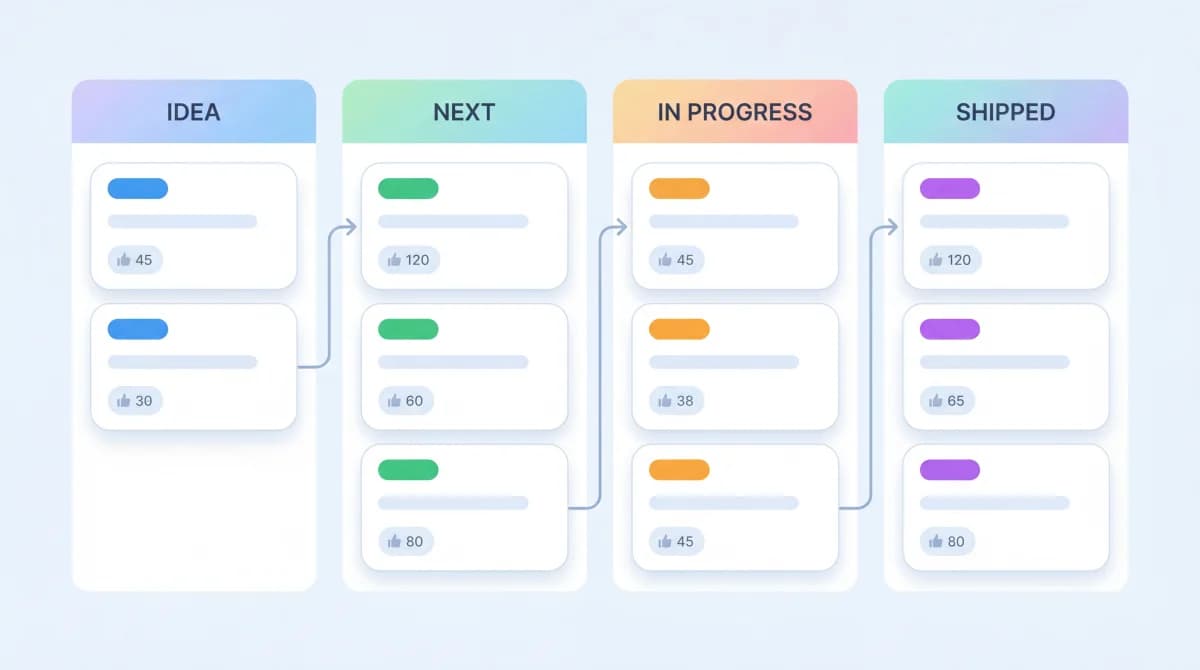
A product roadmap that lives in a slide deck gets outdated the week it's created. A roadmap that lives in a dedicated tool stays current, shareable, and connected to the work your team actually does.
Product roadmap software helps you plan what to build, communicate priorities to stakeholders, and track progress from idea to shipped feature. But most roadmap tools focus on one thing: making pretty timelines for executive presentations.
The roadmap tools that actually drive better product decisions are the ones that connect to the source of truth: what your users want. I've spent the last two years building Feeqd around this idea. Our first roadmap was a Notion page that nobody looked at. When we connected it to our feedback boards and made it public, everything changed: users started checking the roadmap weekly, voting patterns shifted, and our prioritization conversations went from opinion-based to data-based. This guide covers what I've learned about choosing, building, and maintaining a product roadmap that reflects real user demand.
Best Product Roadmap Software Compared
If you're evaluating tools, here's a comparison of the main product roadmap software options in 2026.
| Tool | Best For | Free Option | Feedback Integration | Views | Starting Price |
|---|---|---|---|---|---|
| Feeqd | Feedback-driven roadmaps | Yes (free plan) | Built-in (voting boards) | Kanban, List | Free / $19/mo |
| ProductPlan | Strategic planning | No | Limited | Timeline, Kanban | Custom pricing |
| Aha! | Enterprise roadmapping | Free trial | Aha! Ideas (separate) | Timeline, Kanban, List | $59/mo |
| Jira | Dev team tracking | Free tier | Jira Product Discovery | Board, Timeline | Free / $8.15/mo |
| Productboard | All-in-one product management | Free trial | Built-in portal | Timeline, Kanban | $19/mo |
| Tempo | Portfolio roadmaps | Free trial | Limited | Timeline, Swimlane | $10/mo |
| airfocus | Prioritization frameworks | Free trial | Feedback module | Timeline, Kanban | $19/mo |
| monday.com | General project management | Free tier (2 seats) | Forms | Timeline, Kanban, Gantt | Free / $9/mo |
| Trello | Simple Kanban boards | Free tier | Power-Ups | Board | Free / $5/mo |
Feeqd: best for feedback-driven roadmaps
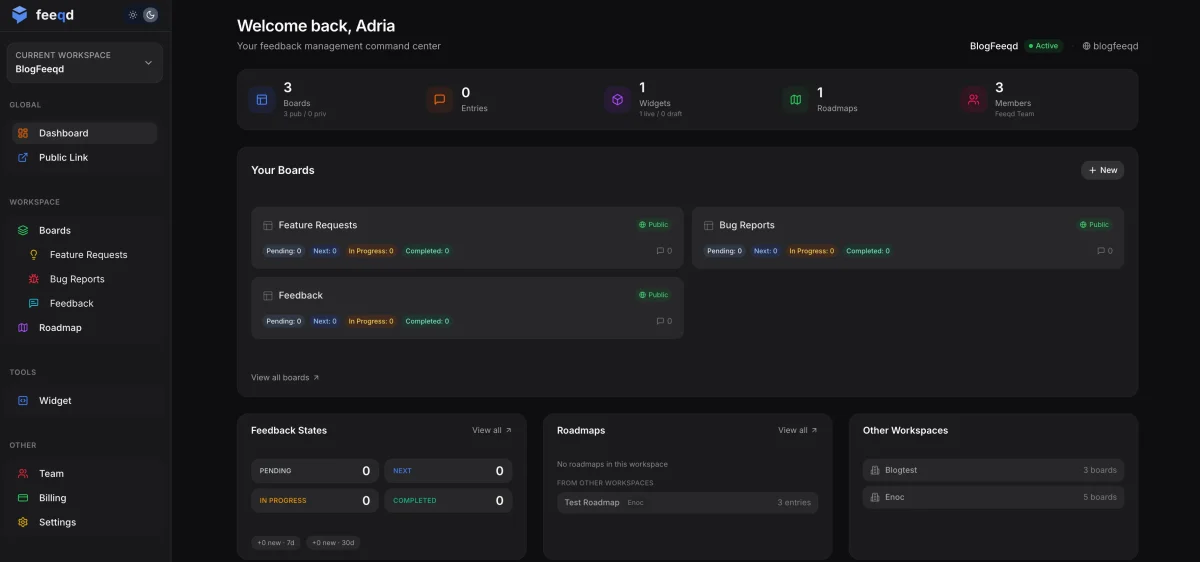
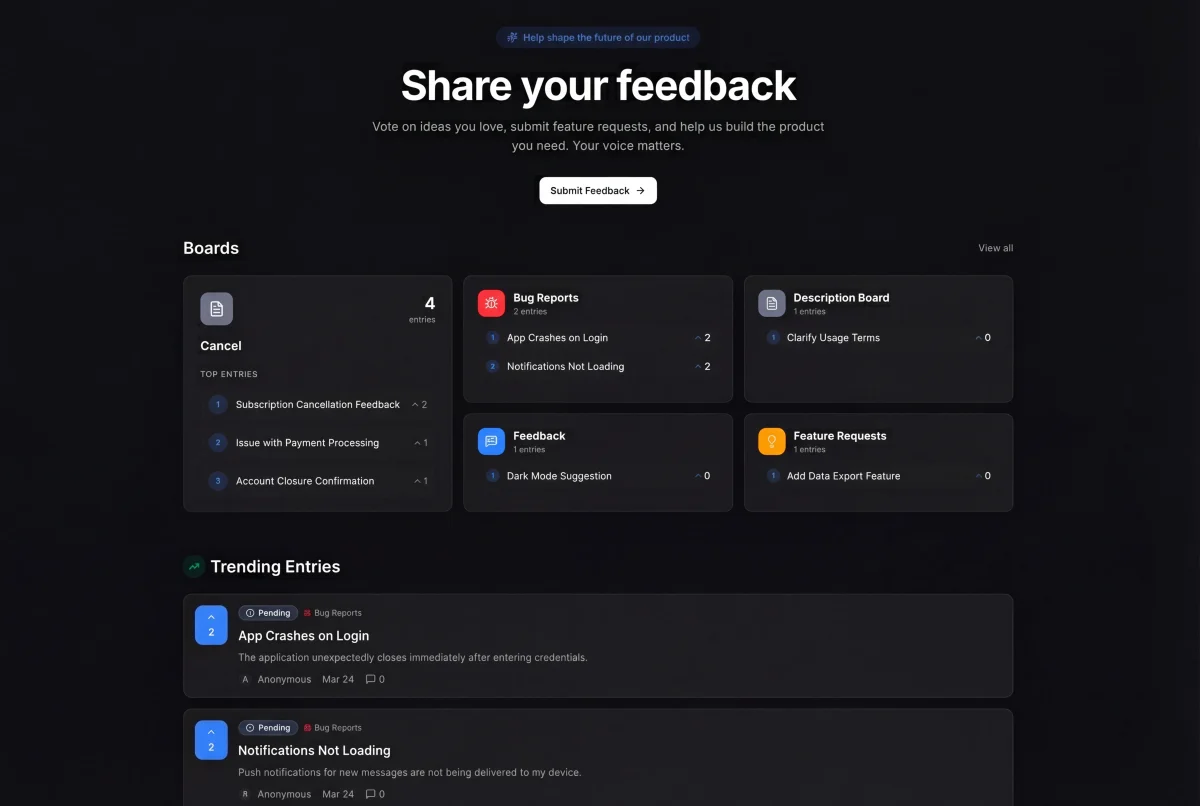
Feeqd takes a different approach from traditional roadmap tools. Instead of starting with a blank timeline, your roadmap items come from feedback boards where users submit and vote on feature requests. You see exactly how many users want each feature before adding it to your roadmap.
The Kanban view organizes items into four columns (Pending, Next, In Progress, Completed) and the list view works as a sortable table. Each roadmap item links back to its original feedback entry, preserving the vote count and user context. Public roadmaps let your users see what's coming, which closes the feedback loop automatically.
Free plan includes 1 roadmap, 3 feedback boards, and 60 entries.
ProductPlan: best for strategic planning
ProductPlan is purpose-built for creating polished, presentation-ready roadmaps. Its drag-and-drop timeline view is one of the cleanest in the market, and it's designed for PMs who need to communicate strategy to executives and stakeholders. ProductPlan's "Parking Lot" feature for ideas that aren't ready for the roadmap is a nice touch for managing incoming requests without cluttering the main view.
The tradeoff is that ProductPlan focuses on visualization, not feedback collection. You'll need a separate tool to gather and prioritize user input, then manually transfer priorities into your roadmap.
Aha!: best for enterprise teams
Aha! positions itself as the "world's #1 roadmap software" and backs it up with 40+ integrations and a million-plus users. It covers the full product management lifecycle: strategy, roadmapping, feedback (via Aha! Ideas), and release management. The Notebooks feature lets PMs write strategy docs directly in the roadmap context, which keeps everything connected.
The downside is complexity. Aha! can feel heavy for smaller teams, and the pricing ($59/user/month) reflects its enterprise positioning.
Jira: best for development tracking
Most development teams already use Jira, and its built-in roadmap feature (Timeline view) works well for tracking sprints and releases. Jira Product Discovery adds a layer of idea collection and prioritization. The advantage is zero onboarding if your team already lives in Jira.
Jira's roadmap works best when your audience is engineering. The Timeline view only shows issues assigned to sprints, not higher-level themes or strategy. For customer-facing or executive roadmaps, the interface is too granular and technical.
Productboard: best for all-in-one product management
Productboard bundles feedback collection, prioritization, and roadmapping into one platform. Its customer feedback portal captures input, and the prioritization matrix helps score features. The roadmap view then pulls from your prioritized backlog.
The pricing starts at $19/maker/month, and the learning curve is steeper than simpler tools. Best for mid-size teams that want feedback and roadmapping in a single platform but don't need Aha!'s enterprise feature depth.
When to use a general PM tool vs. a dedicated roadmap tool
General project management tools (Jira, Asana, monday.com, Trello) all have roadmap features. They work well enough if your team already uses them and your roadmap needs are simple. But they lack the feedback connection, public sharing, and stakeholder-tailored views that dedicated roadmap tools provide.
If your roadmap is primarily for internal sprint planning, a PM tool is fine. If you need to share roadmaps publicly, connect them to user feedback, or present to non-technical stakeholders, a dedicated tool is worth it.
Free product roadmap software
If you're looking for product roadmap software with a genuine free tier (not just a 14-day trial), here are your real options:
- Feeqd (free plan): 1 roadmap, 3 boards, 60 entries, public sharing. Best if you want feedback-driven roadmapping.
- Jira (free for 10 users): Timeline view with sprint-based roadmapping. Best if your team already uses Jira.
- Trello (free tier): Basic Kanban boards. Works for simple roadmaps but lacks timeline views and feedback integration.
- monday.com (free for 2 seats): Limited but functional. Good for solo founders or tiny teams.
The "free" related searches in Google are heavily searched because most roadmap tools are expensive. If budget is a constraint, start with one of these and upgrade only when you hit real limits.
What Is Product Roadmap Software?
Product roadmap software is a tool that helps product teams plan, visualize, and communicate what they're building and when. It replaces spreadsheets, slide decks, and Notion pages with a structured system that stays current and shareable. For a deeper look at what a product roadmap is conceptually (definition, components, types, and the feedback-driven framework), see our what is a product roadmap guide.
A good product roadmap tool provides:
- Visual layouts: Kanban boards, timelines, and list views that make priorities clear at a glance
- Status tracking: move items through stages so your team and stakeholders know where things stand
- Sharing options: public roadmaps for customers, filtered views for executives, detailed views for engineering
- Prioritization support: scoring frameworks, voting data, or custom fields that help decide what comes first
- Integration: connections to development tools (Jira, GitHub) and feedback channels
The key distinction between roadmap software and project management tools is the audience. Project management tracks tasks for the team doing the work. Roadmap software communicates plans to everyone who needs to know: executives, customers, investors, and the team itself.
Why Product Roadmap Software Matters
Alignment across teams
Without a shared roadmap, every team has a different idea of what's being built next. Engineering thinks the API refactor is the priority. Sales promised a customer that feature X ships next month. The CEO saw a competitor announce something and wants a response. A visible, maintained roadmap gives everyone one source of truth.
Better prioritization decisions
When your roadmap connects to user feedback, you prioritize based on real demand instead of internal politics. A feature with 200 votes from paying users is a stronger signal than an executive's hunch. The best product roadmap software surfaces these signals and helps you make tradeoffs explicitly.
This is the core workflow we built Feeqd around: users submit feedback, vote on what matters most, and the highest-demand items flow naturally into your product roadmap. The prioritization happens before the roadmap, not after. When we started using this approach ourselves, the first thing we noticed was that our "urgent" items and our "most voted" items were rarely the same. That gap is the difference between building for internal pressure and building for users.
Customer trust through transparency
Public roadmaps are one of the most underused growth tools in SaaS. According to Pragmatic Institute's annual survey, product teams that share roadmaps externally report higher customer satisfaction and lower churn. When customers can see what you're building and when, they're more likely to stick around, even if their specific request isn't next. Transparency builds trust, and trust reduces churn.
Types of Product Roadmap Software
Timeline-based roadmap tools
Traditional tools focused on Gantt-style timelines and date-based planning. Best for teams that need to communicate delivery dates to stakeholders.
Examples: ProductPlan, Aha!, Tempo (formerly Roadmunk)
Best for: executive presentations, release planning, teams with fixed delivery schedules.
Kanban roadmap tools
Board-style tools that organize features by status (Planned, In Progress, Done) rather than dates. More flexible than timelines and better suited for agile teams that avoid committing to specific dates.
Examples: Feeqd, Trello, Jira
Best for: agile teams, public-facing roadmaps, teams that prefer "what's next" over "when exactly."
Feedback-driven roadmap tools
Tools where the roadmap is directly connected to user feedback, voting, and feature request data. The roadmap isn't a standalone artifact; it's the output of a feedback-to-roadmap workflow.
Examples: Feeqd, Productboard, Canny
Best for: product teams that want data-driven prioritization, SaaS companies with active user communities.
All-in-one product management platforms
Platforms that bundle roadmapping with strategy, feedback, analytics, and release management. These offer the most features but come with higher complexity and cost.
Examples: Aha!, Productboard, airfocus
Best for: larger product teams that want everything in one place and can afford the learning curve.
How to Choose Product Roadmap Software
Start with your audience
Who will see your roadmap? If it's only your development team, a tool like Jira might be enough. If you need to share with customers, investors, or executives, you need public sharing and view customization.
Consider the feedback connection
The most common regret teams have after choosing a roadmap tool is that it's disconnected from user feedback. They end up maintaining two systems: one for collecting what users want, and another for planning what to build. A tool that integrates feedback directly saves you from this problem.
Evaluate the free tier honestly
"Free trial" and "free plan" are very different. A 14-day trial tells you if the UI is nice. A real free plan tells you if the workflow actually fits your team. Look for tools where the free tier is functional enough to run a real workflow, not just a demo.
Feeqd's free plan includes 1 workspace, 3 boards, 60 entries, and 1 roadmap. Enough to test whether feedback-driven roadmapping works for your team before paying anything.
Don't over-buy for your team size
A solo founder or 3-person team doesn't need Aha!'s enterprise feature set. Start with the simplest tool that solves your problem and upgrade when complexity becomes a bottleneck, not before.
Best Practices for Product Roadmaps
For a detailed step-by-step process, see our guide on how to create a product roadmap. If you're considering making your roadmap visible to users, read why public product roadmaps build trust. For a feedback-first approach, see how to build a feedback-driven roadmap. Need inspiration? See our 9 product roadmap examples. Early-stage? See our startup roadmap guide.
Keep your roadmap alive
A roadmap that's updated quarterly is a slide deck, not a roadmap. Update it at least weekly as priorities shift, items move through stages, and new feedback comes in. The best roadmap tools make this easy by connecting directly to your backlog and feedback.
Use "now, next, later" instead of dates
Unless you have a contractual delivery date, avoid putting specific dates on roadmap items. The now-next-later framework communicates priority without creating false promises. "We're building this next" is more honest and more useful than "shipping March 15th" when March 15th is a guess.
Share your roadmap publicly
Making your roadmap public feels risky, but the benefits outweigh the risk. Users see you're actively building. Prospects see momentum. And the accountability of a public roadmap keeps your team focused on what matters.
In Feeqd, every workspace can share a public roadmap on its custom subdomain (yourcompany.feeqd.com/r/roadmap-name), visible to anyone without login.
Let user data inform priorities
Instead of building what the loudest stakeholder wants, use voting data from your feedback boards. When you can show that 150 users voted for a feature, the prioritization conversation becomes a lot easier, both with your team and with executives who want "their" feature next. Combining vote data with frameworks like RICE scoring gives you a defensible, data-backed prioritization process.
Common Mistakes to Avoid
Treating the roadmap as a commitment
A roadmap is a plan, not a contract. Things change: market shifts, technical constraints, new data from users. Teams that treat every roadmap item as a binding promise end up either shipping the wrong things or never changing the plan. Build in flexibility and communicate that the roadmap reflects current priorities, not guarantees.
Building the roadmap in isolation
If your roadmap isn't connected to user feedback, you're planning in a vacuum. The most common failure mode is a PM who builds a roadmap based on competitor analysis and stakeholder meetings, without ever checking what actual users are asking for. Tracking feedback impact in your roadmap process fixes this.
Over-investing in the visual format
Some teams spend more time making their roadmap look beautiful than making sure it contains the right items. A simple Kanban board with the right priorities beats a polished timeline with the wrong ones. Focus on substance first, presentation second.
Ignoring the "completed" column
Your roadmap shouldn't only show what's planned. Showing completed items is how you demonstrate velocity to stakeholders and close the loop with users who requested those features. It's also how your team sees progress, which matters for morale.
Never updating it
The fastest way to kill trust in a roadmap is to leave it stale. If the last update was two months ago, stakeholders and users stop checking it, and you lose the alignment benefit entirely. If you can't commit to weekly updates, connect your roadmap to a tool that updates automatically as feedback entries change status.
FAQ
What is a software product roadmap?
A software product roadmap is a strategic document that outlines the planned features, improvements, and milestones for a software product over time. It communicates what the team is building, why it matters, and roughly when it will be available. Modern roadmaps live in dedicated tools rather than slide decks, making them dynamic and always current.
What software can I use to create a roadmap?
You can create a roadmap with dedicated tools like Feeqd, ProductPlan, or Aha!, or with general project management tools like Jira, Asana, or Trello. For simple needs, even a Kanban board in Notion or Google Sheets works. The right choice depends on your audience (internal vs. public), team size, and whether you need feedback integration.
Can ChatGPT create a roadmap?
ChatGPT can help you draft roadmap content (prioritize a list of features, create a now-next-later framework, write descriptions), but it can't replace roadmap software. It doesn't provide visual layouts, status tracking, team collaboration, or user voting. Think of it as a brainstorming assistant, not a roadmap tool. The real work of roadmapping requires live data from users and ongoing updates that a static AI conversation can't maintain.
Does Microsoft have a roadmapping tool?
Microsoft doesn't offer a dedicated product roadmap tool. However, you can create basic roadmaps using Microsoft Planner (Kanban boards), Microsoft Project (Gantt timelines), or PowerPoint (for static presentations). Teams that already use the Microsoft ecosystem often pair these with a dedicated roadmap tool for public sharing and feedback integration, since Microsoft's tools are designed for internal project management rather than product roadmapping.
Is there free product roadmap software?
Yes. Feeqd offers a free plan with 1 roadmap, 3 boards, and 60 entries. Jira has a free tier for up to 10 users that includes timeline-based roadmaps. Trello's free tier works for simple Kanban roadmaps. monday.com is free for 2 seats. Most other dedicated roadmap tools (ProductPlan, Aha!, airfocus) only offer time-limited free trials, not permanent free plans.
Get started with Feeqd for free
Let your users tell you exactly what to build next
Collect feedback, let users vote, and ship what actually matters. All in one simple tool that takes minutes to set up.
Sign up for free