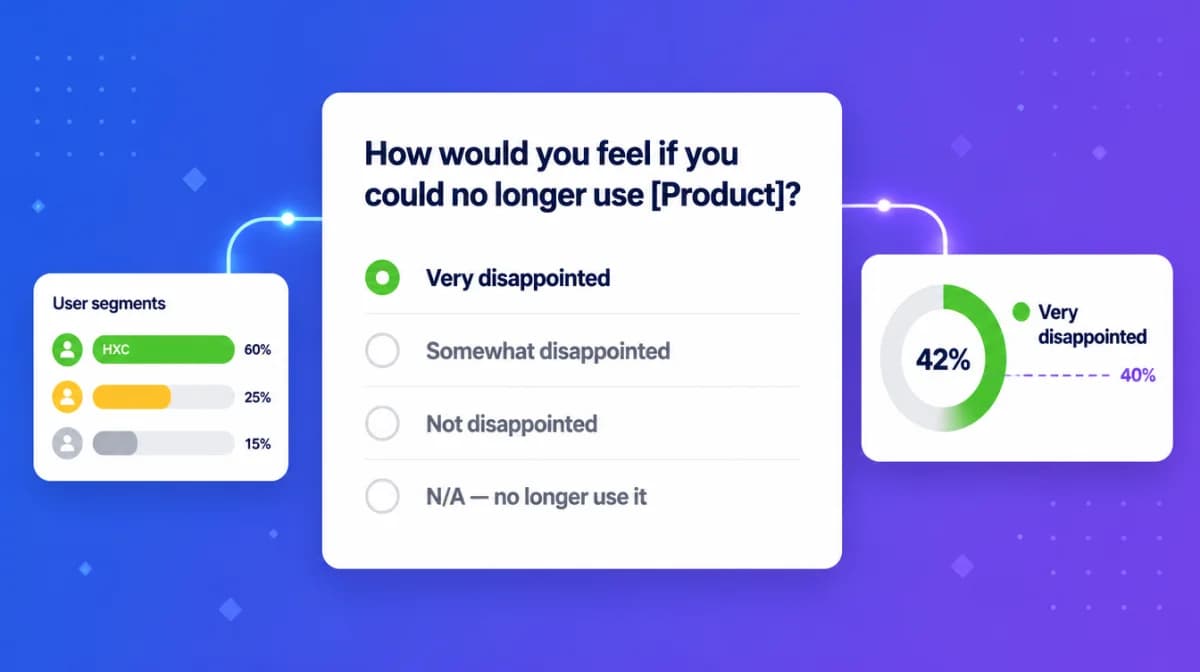
A product market fit survey measures whether your product is on track for product market fit by asking your active users one core question: how would you feel if you could no longer use the product. The most-cited version is the Sean Ellis test, where a "very disappointed" rate of 40% or higher is the threshold associated with strong PMF. This guide gives you the four questions, the 40% rule explained honestly, the response-segmentation playbook, and how to deliver the survey in 2026 without bolting Typeform onto your stack.
Key takeaways
- The 4 questions of the Sean Ellis test are fixed; don't reword them or your score becomes incomparable to prior runs and to public benchmarks.
- The 40% threshold is directional, not a verdict. A 35% score with a clear "very disappointed" cohort and rising trend beats a 45% from a noisy sample.
- Sample on active users only (last 30 days), with at least 40 responses for direction and 100+ for structural decisions.
- Re-run every 6 to 8 weeks while you work the somewhat-disappointed friction list, mirroring Superhuman's 22% to 58% trajectory over a year.
After two years running Feeqd and watching dozens of founders run this survey on their own products, the part that goes wrong is almost never the question wording. It's everything around it: who you sample, where you ship the survey, and what you do with the "very disappointed" cohort once you have it. Most teams collect 30 responses, see a 22% disappointed rate, panic, and pivot. That's the wrong move on too small a sample with no segmentation.
What Is a Product Market Fit Survey?
A product market fit survey is a short questionnaire designed to surface whether the people using your product see it as essential. The canonical version, popularized by Sean Ellis (the growth marketer who coined "growth hacking"), uses one main question and three short follow-ups. The metric you care about is the Sean Ellis score: the percentage of respondents who say they would be "very disappointed" if they could no longer use the product.
Ellis observed that startups consistently above 40% on that question tended to scale; those below 40% almost always ran into growth ceilings later. The 40% rule is a heuristic, not a law. It's directional. A 35% score with great segment-level signal can be more actionable than a 45% score from a noisy sample.
It is not a substitute for revenue, retention, or qualitative interviews. It's a fast, repeatable signal you can run on a 6-week cadence to spot direction changes early. The survey is most useful for early-stage products with at least a few hundred active users, when retention curves are still too noisy to read and you need a faster signal than 90-day cohort analysis.
The 4 Questions in the Sean Ellis Product Market Fit Survey
These are the four questions, in this order, exactly as Ellis published them. Don't reword them. The wording has been validated across thousands of products, and changing it makes your score not comparable to your earlier runs or to public benchmarks.
Question 1 (the core PMF question):
How would you feel if you could no longer use [Product]?
- Very disappointed
- Somewhat disappointed
- Not disappointed (it isn't really that useful)
- N/A, I no longer use [Product]
This is the only question that produces the Sean Ellis score. The "N/A" option is critical: it filters out churned users so they don't dilute your "not disappointed" bucket and make your product look worse than it is.
Question 2 (segmentation):
What type of people do you think would most benefit from [Product]?
This open-text question helps you identify your ideal customer profile by listening to who your existing happy users think you're for. Compare answers from the "very disappointed" cohort to your current marketing positioning. Mismatch here is one of the most common findings.
Question 3 (the value the user actually gets):
What is the main benefit you receive from [Product]?
Read this only from the "very disappointed" cohort. Their language becomes your landing-page copy, your onboarding hero text, and your sales talk track. If five "very disappointed" users describe a benefit you don't lead with on your site, you have a positioning gap.
Question 4 (the friction that's blocking growth):
How can we improve [Product] for you?
Read this from all cohorts but weight the "somewhat disappointed" responses heavily. Those are users who get partial value and would become "very disappointed" if you closed the gap. That's your highest-leverage roadmap input.
The 40% Rule for a Product Market Fit Survey, Explained Honestly
The 40% benchmark is the number that gets quoted everywhere, and it's the number that gets misused everywhere. Here's the version that actually helps you decide.
Above 40% very disappointed: strong PMF signal. Focus shifts from product-market fit to channel-product fit (acquisition) and retention optimization. You're now solving for growth.
25% to 40%: not yet PMF, but the trajectory is what matters. If you ran the survey six weeks ago at 18% and you're now at 32%, that's a positive trend. Keep iterating on the disappointed cohort's friction list. If you've been at 28% for three quarters with no movement, you have a structural product issue, not a tweaking issue.
Below 25%: you're early. The signal isn't strong enough to base bet-the-company decisions on yet. Run more user interviews than survey rounds at this stage. The survey will give you a misleadingly precise number on weak signal.
Two caveats nobody mentions. First, if you have fewer than 40 responses to the core question, the score is statistical noise. You need at least 40 to read the number with any confidence, and ideally 100 plus. Second, the score is sensitive to who you sample. Active users only (last 30 days), not your full email list. Trialists and free-tier signups distort the score downward because they haven't yet experienced the product as a regular workflow tool.
Superhuman's v2 Framework: How to Use the Survey to Get to PMF
The Sean Ellis test is the measurement instrument. Rahul Vohra's Superhuman framework, published in First Round Review in 2018, is the playbook for what to do with the data. It's the part of the methodology that most teams skip and most teams need.
The Superhuman process in four steps:
- Run the survey on active users. Same four questions, same wording.
- Segment by "very disappointed" cohort. Pull only the users who answered "very disappointed" in question 1. This is your high-expectation customer (HXC) sample.
- Cluster the HXC's answers to questions 2 and 3. Look for the dominant ICP description and the dominant benefit phrasing. Vohra found Superhuman's HXCs were heavy email users who valued speed above all. That clustered language drove product, marketing, and onboarding decisions.
- Build the "what's stopping you" list from somewhat-disappointed users. Cluster their answers to question 4. Each cluster is a roadmap candidate. Ship the top one or two, then re-run the survey 6 to 8 weeks later.
The mechanic that makes this work is a feedback loop, not a one-shot measurement. Vohra ran the survey on a 6-week cadence and watched the score climb from 22% to 58% over a year by systematically working through the somewhat-disappointed friction list (First Round Review, 2018). Most founders run it once, get a number they don't like, and put it down.
How to Deliver a Product Market Fit Survey: 4 Channels Compared
The channel you ship the survey through changes the response rate, the response quality, and the bias in your sample. Here's how the realistic options compare for an early-stage SaaS.
| Channel | Typical response rate | Bias profile | Best for |
|---|---|---|---|
| In-app widget (always-on) | 8 to 25% of active sessions | Self-selection toward engaged users | Continuous signal, post-PMF tracking |
| In-app modal (one-time prompt) | 15 to 35% | Slight skew to power users still online | First survey, founder still validating |
| Email blast to active users | 4 to 12% | Skews toward heavy email users | Large enough base (1000 plus active users) |
| Typeform / Google Forms link in email | 2 to 8% | Heaviest selection bias, lowest signal | Not recommended for PMF survey |
Response-rate ranges above are operator observations across SaaS teams I've worked with at Feeqd; published benchmarks vary, but the relative order (in-app modal > in-app widget > email > linked form) is consistent across Nielsen Norman Group's research on survey friction and Superhuman's published process.
The in-app modal is the highest-quality option for the first run because you get a clean cohort, a high response rate, and you control the timing (trigger only after a real session, not on first login). Once you've run the first one and want to track movement over time, switch to a continuous in-app widget so the survey runs in the background on a sample of sessions.
The reason an in-app delivery beats a Typeform link is friction. Every channel hop drops 30 to 50% of respondents. A user clicking a button inside your product is two seconds away from the survey. A user opening an email, clicking through to Typeform, and waiting for the page to load is 30 seconds away. That gap is enough to lose the most candid responses, which are usually the most disappointed ones.
If you want to run the survey through an in-app widget without building one, that's exactly what tools like Feeqd's feedback widget are for. You configure four blocks (radio + text input + text input + text input), embed two lines of script, and the survey runs always-on or as a one-time modal depending on your trigger config. No Typeform redirect, no email blast, no copy-pasting responses into a spreadsheet. The same widget works for ongoing feedback collection after the PMF survey ends, so it stays useful.
How to Segment and Read the Responses
Once you have at least 40 responses, the analysis runs in three passes.
Pass 1: calculate the Sean Ellis score. Count "very disappointed" divided by total non-N/A responses. That's your headline number. Compare to your previous runs and to your trajectory.
Pass 2: segment by the very-disappointed cohort. Pull every response from users who answered "very disappointed" and read their answers to questions 2, 3, and 4 in isolation. Cluster the answers into 3 to 5 themes. Look for repeated phrasing, because that phrasing is the language your most loyal users use to describe your product.
Pass 3: read the somewhat-disappointed cohort. These users get partial value. Their answers to question 4 are your highest-leverage roadmap input because closing one of their friction points moves them into "very disappointed." Cluster their answers and rank by frequency. Ship the top one or two themes in the next 6 to 8 weeks.
If you also operate a public feedback board, cross-reference these survey themes against your top-voted feature requests. When a theme appears in both, you have very high confidence in the priority. When it appears in only the survey or only the board, treat it as a candidate but not a slam dunk.
What to Do With a Score Below 40%
A low score isn't a verdict. It's a starting point. Two questions to answer before you decide what to do.
Are you measuring the right users? If your survey ran on your full email list (trialists, dormant accounts, free-tier signups who never came back), your score is artificially low. Re-run on users active in the last 30 days. A common pattern is the score doubling when you tighten the active-user definition.
What does the segmented data show? A 28% overall score with a clear "very disappointed" cluster of 50 power users in a specific niche is not the same as a 28% score with no cluster. The first is a positioning problem (you have PMF in a segment you're not marketing to). The second is a product problem.
If after segmentation you still have a low score and no clear high-expectation cohort, the playbook is interview, not iterate. Talk to 10 users in the somewhat-disappointed bucket. Ask what would have to change for them to become very disappointed at the thought of losing the product. The signal from those conversations beats anything another survey round will produce.
Common Mistakes Running a Product Market Fit Survey
The same five mistakes show up across most teams running this for the first time.
Surveying inactive users. Including users who haven't opened the product in 60 days drags the score down. Always filter to last-30-days active before sending.
Reading the headline score in isolation. A 38% score with strong segment-level signal is more actionable than a 45% score from a generic sample. Always read the cohort breakdown, not just the percentage.
Running it once. A single data point tells you the current state. The trend across three runs tells you whether you're getting closer or further. Run on a 6 to 8 week cadence.
Ignoring the somewhat-disappointed cohort. Most teams obsess over the very-disappointed cluster (their happy users) and never read what the partially-satisfied users want. The somewhat-disappointed bucket is where your next 10 percentage points come from.
Pivoting on a 40-response sample. Statistical noise at small N looks like signal. Wait until you have 100 responses minimum before making structural product decisions on the data.
FAQ
What is a product-market fit survey?
A product market fit survey is a 4-question survey used to measure whether users see your product as essential. The most-cited version, the Sean Ellis test, asks how users would feel if they could no longer use the product, with options ranging from "very disappointed" to "not disappointed." The headline metric is the percentage of users in the "very disappointed" bucket. A score of 40% or higher is the conventional threshold for strong product market fit, though the trend across multiple runs matters more than any single number.
What is the 40% rule for product-market fit?
The 40% rule, popularized by Sean Ellis, says that products where at least 40% of active users would be "very disappointed" if they could no longer use the product tend to scale successfully. Below 40%, founders typically encounter growth ceilings that no amount of marketing can overcome. The rule is a heuristic, not a hard law: 35% with rising trajectory and clear segment signal is healthier than 45% from a noisy sample. Use it to direct attention, not to make pivot-or-stay decisions on a single data point.
How to evaluate product-market fit?
Evaluate product market fit using a combination of signals: the Sean Ellis survey score, retention curves (do cohort retention rates flatten rather than decay), organic referral rate, and revenue retention for paying tiers. The survey is the fastest signal but not the only one. Retention curves are the highest-confidence signal but require months of data. Most product teams benefit from running the survey every 6 to 8 weeks alongside cohort retention monitoring, treating divergences between the two as questions to investigate rather than data to average.
What are the 4 types of market surveys?
Generally, market research surveys are grouped into four types: customer satisfaction (CSAT), Net Promoter Score (NPS), product market fit (the Sean Ellis test), and customer effort score (CES). Each measures something different and runs on a different cadence. CSAT runs after specific interactions; NPS runs quarterly to measure relationship-level loyalty; the PMF survey runs every 6 to 8 weeks to track product fit progress; CES runs after support or onboarding to measure friction. Our NPS vs CSAT comparison covers when to use each metric.
How many responses do I need for a valid PMF survey score?
Aim for at least 40 responses to read the score directionally and at least 100 for confident structural decisions. Below 40 responses, the percentage swings dramatically with each new answer and produces noise. The denominator that matters is "non-N/A responses" only. Exclude the users who selected "N/A, I no longer use the product" because their inclusion would inflate the disappointed-rate denominator without measuring active fit.
Run Your Product Market Fit Survey, Read It, Run It Again
The product market fit survey is one of the most useful diagnostic tools an early-stage product team has, but only when you treat it as a recurring instrument rather than a one-shot judgment. Run it on active users, ship it in-app where the friction is lowest, segment by cohort before reading any score, and re-run every 6 to 8 weeks while you work the somewhat-disappointed list. The survey is one signal in a broader user feedback collection program, not a replacement for retention curves or qualitative interviews.
If you want to run the survey through an embedded widget rather than bolting Typeform onto your stack, the four-question PMF format works as a single Feeqd widget tab (radio + 3 text inputs) and the same setup keeps collecting feedback after your PMF run ends so you don't have to rebuild the channel.
Get started with Feeqd for free
Let your users tell you exactly what to build next
Collect feedback, let users vote, and ship what actually matters. All in one simple tool that takes minutes to set up.
Sign up for free