
A feature voting board is the simplest way to answer the question every product team struggles with: "what should we build next?"
Instead of guessing, debating in meetings, or following the loudest stakeholder, you give users a board where they can see existing feature requests and vote on the ones they care about. The most wanted features rise to the top. Your team gets a prioritized backlog based on real demand, not opinions.
I built Feeqd, a feature request tracking tool, around this concept because after years of managing feature requests in spreadsheets, I realized the missing piece was always the same: quantified demand. A spreadsheet tells you someone wants dark mode. A feature voting board tells you 147 people want dark mode, 89 want API improvements, and 12 want a mobile app. That changes every prioritization conversation.
Feature Voting Board Tools Compared
If you're looking for a tool, here's how the main options compare:
| Tool | Free Plan | Public Board | Custom Subdomain | Roadmap Integration | Starting Price |
|---|---|---|---|---|---|
| Feeqd | 3 boards, 60 entries | Yes | Yes (acme.feeqd.com) | Built-in Kanban | Free / $19/mo |
| Canny | 1 board, 100 tracked users | Yes | No | Via changelog | Free / $99/mo |
| Feature Upvote | No | Yes | No | No | $49/mo |
| Fider | Open source | Yes | Self-hosted | No | Free (self-host) |
| Nolt | No | Yes | No | No | $29/mo |
| Productboard | Free trial | Feedback portal | No | Built-in | $19/mo |
Feeqd combines voting boards with a Kanban roadmap in one tool. Users vote on your board, and you move top-voted items to your product roadmap with one click. Each workspace gets a custom subdomain (yourcompany.feeqd.com) for branded public boards.
Canny has the deepest integration ecosystem (Jira, Intercom, Salesforce). Its free tier is limited to 1 board and 100 tracked users, but the paid plans ($99/mo) unlock advanced analytics and automations.
Fider is the best self-hosted, open source option. Full data ownership, zero cost, but requires engineering resources to deploy and maintain.
Feature Upvote focuses purely on voting with no extras. Clean interface, simple pricing, no learning curve.
What Is a Feature Voting Board?
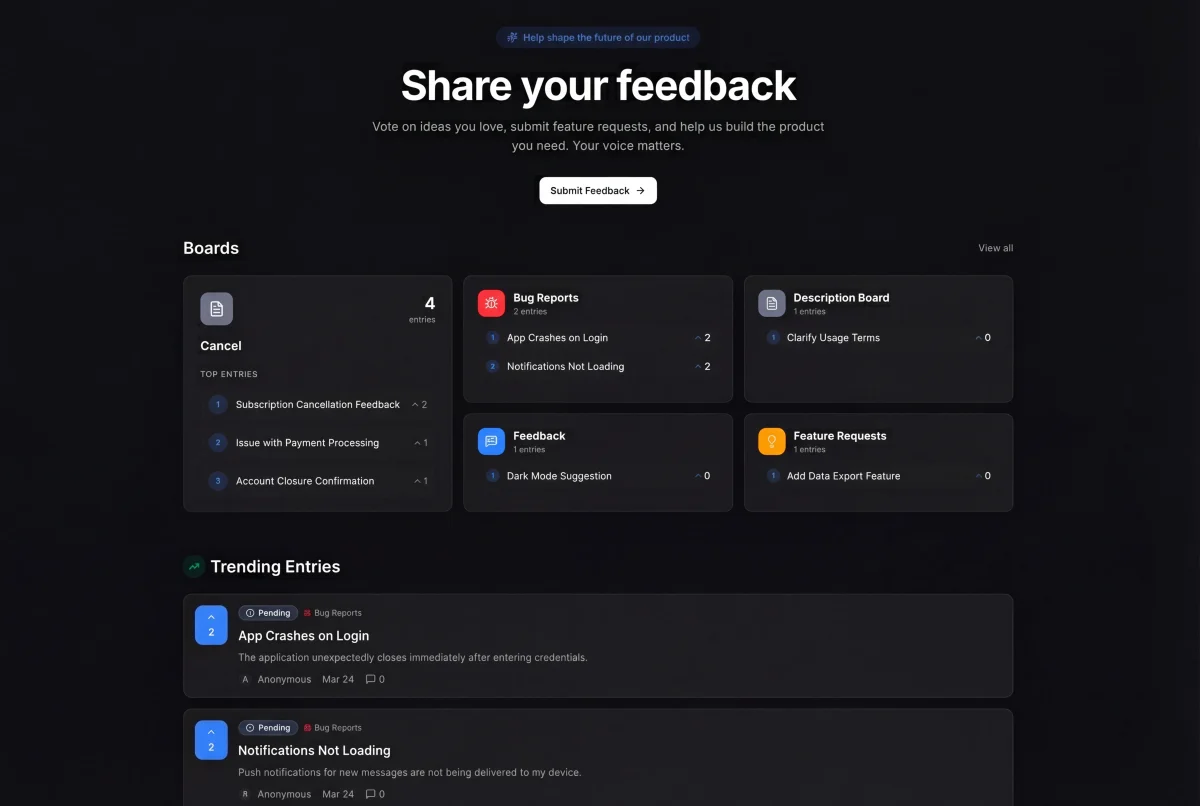
A feature voting board is a public or private page where users can submit feature requests, browse existing ones, and upvote the features they want most. Each request shows its vote count, creating a transparent, community-driven ranking of priorities.
The core components:
- Submission form: users describe the feature they want (ideally using a feature request template)
- Request list: all submitted features, browsable and searchable
- Upvote button: one click to add your vote to an existing request
- Vote count: visible number showing how many users want each feature
- Status labels: Pending, Next, In Progress, Completed, so users know where things stand
The key insight is that voting boards solve two problems simultaneously: collection (users submit requests) and prioritization (votes surface demand). Most feedback systems solve only one.
Why Feature Voting Boards Work
Self-prioritizing backlog
Traditional feature request tracking requires someone (usually a PM) to manually evaluate, score, and rank every request. With a voting board, users do the initial prioritization for you. The features with the most votes are, by definition, the ones the most users want. This doesn't replace PM judgment, but it gives you a data-backed starting point instead of a blank slate.
Automatic deduplication
Without voting, every user who wants dark mode submits a separate request. With voting, the first user submits the request, and the next 146 users vote on it instead of creating duplicates. When we launched Feeqd's public voting board, duplicate requests dropped by roughly 60% in the first month.
User engagement and retention
Users who vote on a feature feel invested in the outcome. When that feature moves to "In Progress" and eventually "Completed," they feel heard. This closes the feedback loop automatically. According to Pendo's research, product teams that involve users in prioritization see measurably higher engagement.
Transparent decision-making
When your board is public, users can see why certain features are prioritized over others. "Dark mode has 147 votes and is In Progress" is a more satisfying answer than "we're working on it" or silence. This transparency builds trust, even with users whose requests aren't being built yet.
How to Set Up a Feature Voting Board
Step 1: Create your board
Set up a board dedicated to feature requests. Keep it separate from bug reports and general feedback. In Feeqd, you create a "Feature Requests" board type, which comes pre-configured with voting enabled and the right status workflow.
Step 2: Seed with existing requests
Don't launch an empty board. Add 10-15 feature requests you've already received through email, support, or Slack. This gives new visitors something to vote on immediately and shows the board is active.
Step 3: Make it public
A public board gets more participation than a private one. Users who can see what others are requesting submit higher-quality requests and vote more actively. Share the board link in your app (sidebar, help menu), in your email signatures, and in support conversations.
Step 4: Enable status updates
Configure your status workflow (Pending, Next, In Progress, Completed) so users can see progress. Each status change is a communication opportunity that builds trust and keeps voters engaged.
Step 5: Connect to your roadmap
The voting board's highest value is when it feeds into your roadmap. Move top-voted items to your product roadmap regularly. This creates a visible pipeline: request > vote > roadmap > shipped.
Feature Voting Best Practices
Treat votes as one signal, not the only signal
Vote counts tell you what users want. They don't tell you what's strategically important, technically feasible, or revenue-impactful. A feature with 10 votes from enterprise customers paying $500/month might matter more than one with 100 votes from free users. Use votes as input to your prioritization framework, not as the framework itself.
Make voting frictionless
Every extra step between "I want this" and "voted" loses participants. One-click upvoting without requiring login is ideal for public boards. If you require authentication, offer Google OAuth or SSO to minimize friction.
Segment your voters
If your tool supports it, track which plan each voter is on. Filtering votes by "paid users only" or "enterprise accounts" gives you a very different priority list than total vote count. Both views are valuable.
Close the loop publicly
When a voted feature ships, mark it as Completed on the board. This is the single most important thing you can do for long-term board engagement. Users who see their votes lead to shipped features become your most active participants. Read our full guide on how to announce new features to voters.
Don't let the board go stale
Review new submissions weekly. Update statuses as work progresses. A board with 50 requests and zero status updates feels like a graveyard. Regular activity signals that voting matters and that the board is actively monitored.
Where Feature Voting Can Go Wrong
Popularity contest bias
The most voted feature isn't always the most important one. High-vote features tend to be consumer-facing ("dark mode," "mobile app") while critical infrastructure or enterprise features ("SAML SSO," "audit logs") get fewer votes but may have higher revenue impact. Balance vote data with strategic context.
Scope creep from voter expectations
Users who vote expect their feature to be built eventually. Be clear in your board description that voting informs priorities but doesn't guarantee delivery. Use "Considering" or "Under Review" status labels instead of "Planned" for items that aren't committed. As Mind the Product notes, managing expectations is just as important as managing the backlog itself.
Gaming and duplicate accounts
On public boards, occasionally users create multiple accounts to inflate votes. This is rare but real. Tools with authentication requirements (email verification, OAuth) reduce this risk. For most SaaS products, the occasional inflated vote is far less costly than the friction of heavy-handed anti-gaming measures.
FAQ
What is a feature voting board?
A feature voting board is a page where users submit product feature requests and vote on existing ones. Each request displays its vote count, creating a transparent, community-ranked priority list. It replaces manual feedback collection (email, Slack, spreadsheets) with a self-organizing system where the most wanted features naturally rise to the top.
Is there a free feature voting board?
Yes. Feeqd offers a free plan with 3 boards, 60 entries, and public voting with custom subdomains. Fider is open source and free to self-host with no limits. Canny has a limited free tier (1 board, 100 tracked users). For most teams evaluating whether voting boards work, a free plan provides enough capacity to test the workflow before committing to a paid tool.
What is the best free feature voting board tool?
For a permanently free option, Feeqd and Fider are the strongest choices. Feeqd's free plan includes public voting, custom subdomains, and roadmap integration. Fider gives you full data ownership with self-hosting. Canny's free tier is more limited but works if you only need one board. See our full feature request tracking tool comparison for a deeper breakdown.
How is a feature voting board different from a survey?
A survey captures feedback at a single point in time: you ask questions, users respond, and the data is static. A voting board is continuous: users submit and vote whenever they want, priorities shift as new votes arrive, and status updates close the feedback loop. Surveys measure satisfaction. Voting boards measure demand.
Get started with Feeqd for free
Let your users tell you exactly what to build next
Collect feedback, let users vote, and ship what actually matters. All in one simple tool that takes minutes to set up.
Sign up for free