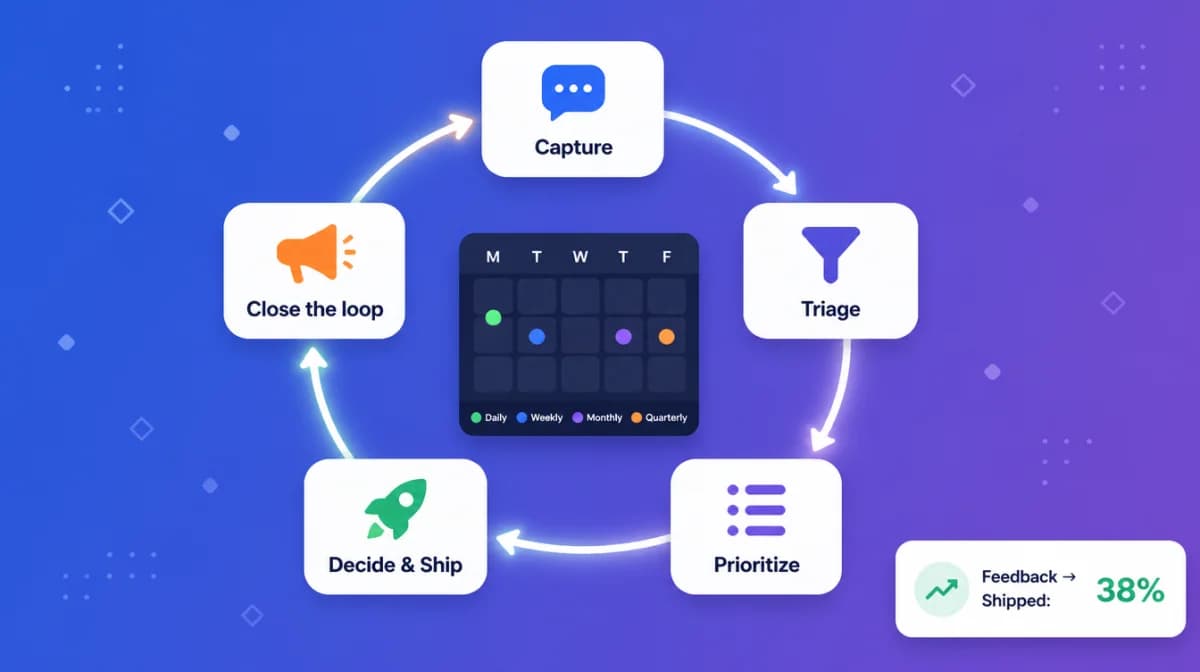
A customer feedback strategy is not a list of channels or a survey schedule. It's the operating system that decides what gets collected, who reads it, how often, and how it makes its way into the roadmap. Most teams have collection mechanics in place (a widget, a board, an NPS email) and still don't have a strategy. The result is the classic failure mode: feedback piles up, nobody reviews it on a real cadence, and engineering ships from the loudest customer or the founder's last meeting.
Key takeaways
- Strategy ≠ collection. Channels are the plumbing; strategy is the operating system around them (ownership, cadence, KPIs, OKR connection).
- 5 components of a working program: capture surface, triage layer, prioritization engine, decision-and-handoff loop, closing layer.
- 4 cadences with named owners: daily 15-min triage, weekly 60-min review, monthly 90-min theme review, quarterly half-day strategic review.
- 4 KPIs that prove the program works: feedback-to-shipped ratio (aim 30%+), time-to-status-change for high-vote items (under 30 days), response rate by channel, coverage of strategic themes.
- Bridge to roadmap via a quarterly review that runs 2 to 3 weeks before OKR drafting.
After two years running Feeqd and watching dozens of product teams operate (or fail to operate) their feedback programs, the gap is almost always at the operating-system level, not at collection. This guide is about the operating system: the components, the cadences, the roles, the metrics that prove the program works, and the anti-patterns that quietly kill it.
If you want the mechanics of where feedback comes from (widget, boards, surveys, support, interviews), our pillar guide on user feedback collection covers all six channels with setup steps. This piece picks up where that one ends: you have signals coming in, now what.
Strategy vs Collection: Why the Distinction Matters
Collection is the plumbing. Strategy is the operating contract: who owns the pipe, how often it gets reviewed, what the team is committing to do with whatever comes through, and how the team measures whether the program is working.
Without strategy, collection produces noise. A widget that gets 200 entries a month is worse than no widget if nobody triages, dedupes, or routes those entries. The board fills with stale requests. Users see no movement. They stop submitting. Six months later you delete the widget and conclude "feedback didn't work for us."
Strategy answers five questions before you scale collection:
- What kind of feedback are we explicitly trying to capture? (And what are we deferring?)
- Who reads it, and on what cadence?
- How does a piece of feedback move from inbox to shipped, with clear handoffs?
- What metrics tell us the program is healthy or sick?
- How does the program plug into quarterly planning, not run in parallel to it?
A team that can answer those five in two sentences each has a strategy. A team that can't is collecting feedback and hoping.
The 5 Components of a Customer Feedback Operating System
Every healthy feedback program I've seen runs on the same five components, regardless of company size or stack.
1. Capture surface. The set of channels you commit to running and reading. Pick two or three for early-stage and don't add more until those are operating cleanly. Widget plus board plus support is enough for most under-100-employee SaaS. See our breakdown of the types of customer feedback for which signals each surface produces.
2. Triage layer. The process by which raw entries become categorized, deduped, and prioritized items. This is where most programs break. Triage needs an owner and a cadence. Without both, the inbox grows and the team drowns.
3. Prioritization engine. The mechanism for ranking what to ship next. Vote counts plus business context (revenue at risk, strategic fit, effort) is the most resilient combination. Pure spreadsheet scoring like RICE (Reach, Impact, Confidence, Effort), as documented by Intercom, or Itamar Gilad's ICE framework is fine if used as input to the engine, not as the engine itself.
4. Decision-and-handoff loop. The contract between PM and engineering: when something moves from "candidate" to "queued for build" to "in progress" to "shipped," who updates the board, what the customer sees, and how status syncs. This is where most programs leak users: entries sit at "candidate" forever and the user never sees movement.
5. Closing layer. The communication back to the customer once you ship. Public roadmap status updates, release notes, in-app announcements, direct emails to the original requesters. Without this, the loop is open and your response rate to future feedback collapses. Our guide on how to close the feedback loop covers the mechanics.
A program with all five components running at any quality beats a program with three components running well. Closing alone, even if your other components are mediocre, will keep users submitting and trusting the channel.
Cadences: The Schedule That Makes the Strategy Real
A feedback strategy without cadence is wishful. Every component needs a cadence assigned to it, owned by a real person. Without it, "we'll review feedback regularly" becomes "we look at it when an exec asks."
| Cadence | What happens | Owner | Time investment |
|---|---|---|---|
| Daily (15 min) | Triage new entries: dedupe, categorize, route urgent items | Rotating PM or product ops | 15 min/day |
| Weekly (30-60 min) | Review top-voted board items, top support themes, update statuses | Product manager | 60 min/week |
| Monthly (60-90 min) | Theme-level review across channels: what clusters are emerging, what's dropped off | PM + design + eng lead | 90 min/month |
| Quarterly (half-day) | Strategic input to roadmap planning, retire stale items, NPS read | Whole product team + leadership | 4 hours/quarter |
The daily triage is the single most important cadence. It's also the easiest to skip because each individual day feels low-stakes. The compound cost shows up in week three when 200 untriaged entries are sitting on the board. Make daily triage somebody's job, not "everyone's job," because everyone's job is nobody's job.
Weekly is where prioritization happens. Walk the top 20 board items by vote count and recent activity. Mark which ones are queued for the upcoming sprint, which are gathering data, which are declined and need a public response. Spending 60 minutes a week here prevents the multi-hour quarterly fire drill.
Quarterly is where the strategy meets the roadmap. The themes you've been tracking monthly become the input for next quarter's OKRs and roadmap commitments. If your feedback program isn't influencing quarterly planning, it's not a strategy yet. It's data collection.
Who Owns What: Roles in a Feedback Program
The single biggest predictor of program health is whether each component has a named owner. "The team owns it" guarantees nobody owns it.
A working ownership map for a 5 to 50-person product org:
- Product manager: owns the prioritization engine and the decision-and-handoff loop. The PM is accountable for translating feedback signal into roadmap items and for the contract with engineering.
- Product ops or rotating PM: owns the daily triage. If you don't have product ops, rotate weekly among PMs so no single person carries the full triage load.
- Customer support / CS: owns the support-derived feedback channel. They see patterns nobody else sees because they read tickets all day. CS is also the early-warning system for trending issues.
- Engineering lead: owns the closing layer for shipped items (release notes accuracy, in-app announcements, public roadmap status updates).
- Founder or product lead: owns the quarterly review and the strategic narrative. They translate cluster patterns into the "what's our next bet" decision.
If you're a 2 to 5 person team, the founder owns triage, prioritization, and closing. Don't pretend the structure is more distributed than it is. Write it down, even if it all points to one person, because the real failure mode at small teams is "we'll get to it" with no calendar block.
Larger orgs add a research or insights team that runs the qualitative side (interviews, segmentation studies) on top of this baseline. Their output feeds the monthly and quarterly cadences as theme-level analysis. They don't replace the operational triage, because those are different jobs that get conflated in many companies.
KPIs That Show the Program Is Working
The four metrics below are the ones I've found most useful for proving (or diagnosing) a feedback program. Track them quarterly at minimum.
Feedback-to-shipped ratio. Of features shipped this quarter, what percentage trace back to a specific feedback entry or theme? If this is consistently above 30%, feedback is influencing the roadmap. Below 15%, your program is collection theater. Our guide on tracking feedback impact walks through how to instrument this without building reporting infrastructure.
Time-to-status-change for high-vote items. For board items with 10+ votes, how long do they sit at "candidate" before moving to "planned," "in progress," "shipped," or "declined"? A median above 60 days means users see a black box. They submit, nothing visible happens, they stop trusting the channel. Aim for under 30 days for top-voted items.
Response rate by channel. Widget submissions per active user, board entries per registered user, NPS response rate, support tag rate. If any of these are decaying quarter over quarter, you have either a collection problem (the surface stopped working) or a closing problem (users gave up because nothing happened with their last submission).
Coverage of strategic themes. For each major customer segment or product area, how many feedback entries did you receive this quarter? A segment with zero entries isn't necessarily quiet. It might be ignored by your collection surfaces. Coverage gaps tell you where to add channels or campaigns.
A common mistake is tracking volume metrics (total submissions) without quality metrics. Total submissions can grow while feedback-to-shipped ratio collapses because triage is broken. Volume alone tells you the front of the funnel works; the four metrics above tell you the whole pipe works.
Connecting Feedback Strategy to OKRs and Quarterly Planning
The reason most feedback programs run in parallel to roadmap planning instead of feeding into it is that nobody bridges the two artifacts. Bridging is mostly a calendar problem.
The bridge in practice: the quarterly feedback review (the 4-hour cadence) happens 2 to 3 weeks before quarterly planning. The output is a one-page document with the top 5 to 10 themes, each tagged with vote count, segment hits, and revenue/strategic context. That document becomes one of three or four inputs to OKR drafting alongside competitive analysis, north-star metric trends, and strategic bets the leadership team is considering.
If you don't have OKRs (Objectives and Key Results), originally codified at Intel by Andy Grove and popularized by John Doerr, the same logic applies to whatever quarterly artifact you do have: roadmap commits, big rocks, north-star initiatives. The point is that feedback themes are an explicit input, not background context.
What this looks like operationally: each quarterly OKR or roadmap commit gets tagged "feedback-derived," "strategy-derived," or "blend." Aim for roughly half the work to be feedback-derived in steady-state product development. Less than 25% means you're flying on intuition; more than 75% means you're not betting on anything users haven't already articulated, which limits ambition.
This is also where the public roadmap comes back in. Once OKRs are set, items derived from feedback get linked back to their original board entries, so users who submitted them can see the path from their request to the quarterly commit. That single linkage does more for user trust than any "thanks for your feedback" auto-reply.
Anti-Patterns That Quietly Kill the Program
Five failure modes show up in roughly this order across teams that struggle.
Collection without action. A widget collecting 500 entries a month with nobody triaging. Users learn the channel is a black hole and stop submitting. The fix isn't more collection; it's stopping new collection until triage runs.
Vocal-minority steering. One paying customer asks for a feature loudly, the team ships it, the rest of the base never wanted it. This usually correlates with no feature voting board or a board nobody reads. Voting plus segment-level review is the antidote.
Survey overload without strategy. Running NPS, CSAT, CES, and PMF surveys at quarterly cadence with no plan for the qualitative responses. Three pages of unread open-text feedback is collection theater. Cut to one or two surveys with explicit cadences and explicit owners.
Roadmap-feedback drift. Feedback themes are tracked monthly but the roadmap is set in a different room without referencing them. Six quarters later, the feedback report and the roadmap have nothing to do with each other. The fix is the bridge calendar above: quarterly feedback review feeds quarterly planning, every quarter.
Closing-layer rot. The team ships features but stops updating the board, posting release notes, or notifying requesters. Internally everything works; externally users see no signal that their feedback mattered. Response rates decay slowly over 2 to 3 quarters and the program looks dead even though shipping is happening. The fix is a written closing-layer playbook (board status changes, release notes cadence, direct emails to original requesters). Our guide on closing the feedback loop covers each piece in detail.
If you're auditing your own program, walk these five. Most teams have at least two of them at any given time. Naming them is half the fix.
FAQ
What is a customer feedback strategy?
A customer feedback strategy is the operating contract that defines what feedback your team commits to capturing, who owns each step (collection, triage, prioritization, decisions, closing), how often each step runs, and how the program connects to roadmap planning. It is distinct from collection mechanics: collection is the channels you run, strategy is the operating system around them. Without a strategy, even good collection produces noise that nobody acts on.
How is a feedback strategy different from feedback collection?
Collection is the plumbing: the widget, the board, the surveys, the support tagging. Strategy is the operating system that decides what to do with what flows through the plumbing: who reads it, on what cadence, how it gets prioritized, and how it connects to the roadmap. Most teams have collection in place and lack strategy, which is why feedback piles up unactioned. Our user feedback collection guide covers the channels; this piece covers the strategy that wraps around them.
What metrics should I track for a customer feedback program?
The four most useful metrics are: feedback-to-shipped ratio (percent of shipped features tracing back to feedback entries; aim for 30%+), time-to-status-change for high-vote items (median days from "candidate" to next status; aim for under 30), response rate by channel quarter-over-quarter, and coverage of strategic themes (entries per major segment or product area). Volume metrics alone are misleading because volume can grow while triage breaks.
Who owns the customer feedback program at a startup?
At a 2 to 10 person team, the founder or first product hire owns it end-to-end and writes that down explicitly so it doesn't become "everyone's job." At 10 to 50, a product manager owns prioritization and the handoff to engineering, customer support owns the support-derived signal, and a rotating PM or product ops role owns the daily triage. At 50+, you typically add a research or insights function that runs the qualitative analysis layered on top of the operational triage. The constant across sizes is named ownership for each component.
How often should I review customer feedback?
Run four cadences in parallel: daily 15-minute triage (categorize and route new entries), weekly 60-minute review (walk the top 20 board items, update statuses), monthly 90-minute theme review (cluster patterns across channels), and quarterly half-day strategic review (feed into OKR or roadmap planning). Skipping the daily triage is the most common failure point because each missed day feels low-stakes; the compound cost shows up in untriaged backlogs three weeks later.
How do I connect customer feedback to product roadmap planning?
Run the quarterly feedback review 2 to 3 weeks before quarterly planning, output a one-page summary of the top 5 to 10 themes tagged with vote counts and segment hits, and treat that document as an explicit input to OKR or roadmap drafting. Tag each quarterly commit as feedback-derived, strategy-derived, or blend, and aim for roughly half feedback-derived in steady state. Link shipped items back to their originating board entries so users see the path from their request to the commit. The bridge is mostly a calendar discipline, not a tooling problem.
A Customer Feedback Strategy That Survives Quarter Two
The teams I've watched run the cleanest feedback programs aren't the ones with the fanciest tools or the deepest research budgets. They're the ones who picked two collection channels, named an owner for each component, ran the daily and weekly cadences without skipping, and connected the quarterly review to actual roadmap planning. A customer feedback strategy that survives past quarter two is mostly named ownership and unbroken cadence, not tooling. Everything else is decoration.
If you want the operational layer (board, widget, public roadmap, status updates) running on one stack rather than four glued together, the same boards that take user submissions feed the public roadmap that closes the loop, so the strategy you write down has a tool that doesn't fight you on cadence day.
Get started with Feeqd for free
Let your users tell you exactly what to build next
Collect feedback, let users vote, and ship what actually matters. All in one simple tool that takes minutes to set up.
Sign up for free