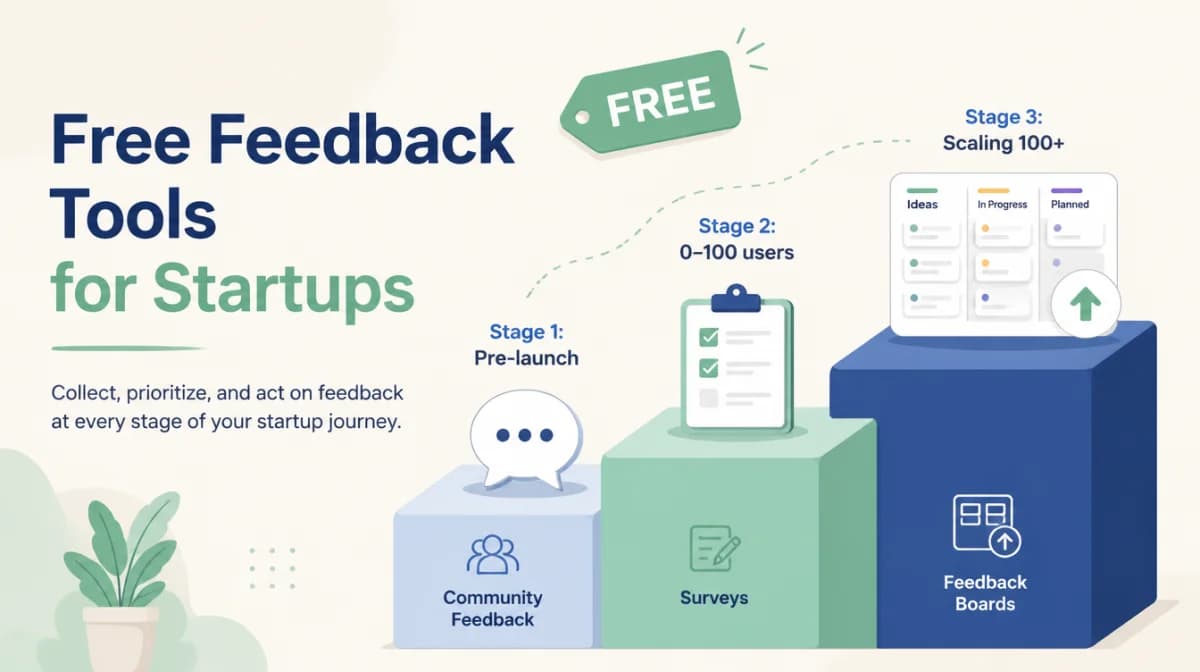
Most lists of free feedback tools for startups are flat directories: 12 SaaS tools, generic descriptions, "best for everyone." That is rarely the right way to pick one. The right tool for a pre-launch idea you are still validating is not the right tool for 100 paying users telling you what to build next. The "free tier" that looks generous on paper might give you nothing usable for your actual stage.
I run Feeqd, a feedback management tool with a real free plan, so I have a stake in this conversation. I will be upfront about where Feeqd fits and where another tool (or no tool at all) is the better answer for your stage. For the broader topic of how to set up user feedback collection across channels, the pillar guide goes deeper.
This guide groups 12 free tools into the three stages most startups move through:
- Pre-launch validation (you have an idea, maybe a landing page; no real users)
- Early users 0-100 (you shipped something; feedback is trickling in over email and DMs)
- Scaling 100+ users (feedback is now a flood; you need to organize, vote, prioritize)
Each stage has different tools, different free tier dynamics, and different signals that you have outgrown free.
Quick comparison: 12 free feedback tools by stage
| Stage | Tool | Type | What's free | Best for |
|---|---|---|---|---|
| Pre-launch | Community | 100% free | Brutal honest validation | |
| Pre-launch | Indie Hackers | Community | 100% free | Founder-to-founder feedback |
| Pre-launch | BetaList | Listing | Free signup | Waitlist + early-validator audience |
| Pre-launch | Product Hunt | Launch platform | 100% free | Launch-day feedback + Hunters network |
| Early users | Google Forms | Form builder | Unlimited | Zero-friction surveys |
| Early users | Tally | Form builder | Unlimited forms + responses | Polished surveys without paying |
| Early users | Microsoft Forms | Form builder | Free with M365 | Office-first teams |
| Scaling | Feeqd | Feedback management | 3 boards, 100 entries, widget, custom subdomain | Bootstrapped product teams |
| Scaling | Sleekplan Indie | Multi-module | Free forever, 1 seat, Board + Changelog | Solo founders shipping changelogs |
| Scaling | Featurebase Free | Feedback management | 1 seat, limited | Trying before buying paid |
| Scaling | UserJot Free | Feedback management | Basic features | Lightweight Canny-style alternative |
| Scaling | Fider | Open source | Free, self-hosted | Devs who want full control |
Stage 1: Pre-launch validation (no users yet)
Stage 1 free feedback tools: Reddit, Indie Hackers, BetaList, and Product Hunt. All four are 100% free and used to validate ideas before any product exists.
Before you ship anything, the goal is to find out whether the idea is worth building. The wrong move at this stage is paying for SaaS feedback tools, putting up a board, and watching crickets. The right move is going where founders, builders, and early adopters already hang out and asking them directly.
1. Reddit (free)
Reddit is the most honest feedback channel for early-stage startups, and it is 100% free. The relevant subreddits depend on your category, but four cover most cases:
- r/SaaS for B2B SaaS validation. Founders will tell you bluntly if your pitch lands or your pricing is wrong.
- r/startup_ideas for raw idea critique before you build.
- r/EntrepreneurRideAlong for builder-stage feedback.
- Your category subreddit (r/marketing, r/devops, r/personalfinance) for end-user feedback.
The trade is brutality for honesty. Reddit will not coddle you. It also will not pretend to like your idea to be polite, which Twitter, your friends, and your accelerator cohort often do.
Free tier reality: posting is free, but Reddit will down-rank or remove anything that smells like promotion. Read the sub rules, lurk for a week, comment on others' posts before you post your own. The cost is your time and your ego, not money.
2. Indie Hackers (free)
Indie Hackers is a founder community focused on bootstrapped and small-team SaaS. The signal-to-noise is higher than Reddit because the audience is mostly other builders who have shipped something themselves. Post your idea or MVP and ask for honest feedback; you will usually get 5-15 substantive replies within 48 hours.
Free tier reality: every feature is free. Pay only if you want to advertise.
3. BetaList (free signup)
BetaList is a curated listing for pre-launch products. Submit your landing page; if accepted, BetaList sends a wave of early adopters who specifically signed up to discover and try new products. The audience is small (a few hundred to a few thousand depending on category), but they are pre-disposed to give feedback.
Free tier reality: free submission, but the editorial backlog is months long. Paid promotion ($129+) skips the queue. For pure validation, free works; for launch timing, the paid path may be worth it.
4. Product Hunt (free)
Product Hunt is best known as a launch platform, but the upcoming page and discussions are valuable validation surfaces before you ship. Post your idea in the right topic; engage with Makers and Hunters; you will surface comments that double as user research.
Free tier reality: every feature is free. Paid promotion exists but is rarely worth it for pre-launch validation.
If your stage is "I have an idea but no product," stop here. None of the tools below will help until you have something real for people to react to.
Stage 2: Early users 0-100 (feedback is trickling in)
Stage 2 free feedback tools: Google Forms, Tally, and Microsoft Forms. All three offer unlimited free responses and are used to capture structured feedback from your first 100 users.
You shipped. A handful of people are using the product. Feedback comes in over email, Twitter DMs, support chats, and the occasional bug report. The risk at this stage is over-engineering: setting up a public board with voting when you have 12 users is theater, not signal.
What you actually need is a friction-free way to capture structured feedback when someone is willing to give it. That is what form-builders are for.
5. Google Forms (free, unlimited)
Google Forms is the lowest-friction way to ask for feedback. Free, unlimited, integrated with Google Sheets for analysis, and trusted enough that respondents complete it without thinking. The UX is dated, but for early-stage feedback that is a feature, not a bug: it signals "this is a quick research question, not a sales funnel."
Free tier reality: truly unlimited. The only limits are responses per form per day on extremely high-volume use cases (rare for startups).
6. Tally (free, unlimited forms + responses)
Tally is the modern alternative to Typeform with a generous free tier. Unlimited forms, unlimited responses, conditional logic, custom branding. The reason to pick Tally over Google Forms is response rate; Tally's interaction feels closer to a polished product, which matters when you are asking customers (not strangers) to fill it out.
Free tier reality: unlimited core features. Premium features (file uploads larger than 10MB, advanced integrations, custom domains) require an upgrade.
7. Microsoft Forms (free with M365)
If your team is on Microsoft 365, Microsoft Forms is included. It is functionally similar to Google Forms with tighter Excel and Teams integration. Pick it if your audience uses Outlook calendars and Teams; otherwise default to Google Forms or Tally.
Signals you have outgrown Stage 2:
- You are getting more than 5 feedback items per week and losing track in spreadsheets.
- The same feature request keeps coming in and you want to know how many people want it.
- You want users to see what is being built next so they stop asking you the same questions.
When those signals appear, move to Stage 3.
Stage 3: Scaling to 100+ users (organize, vote, prioritize)
Stage 3 free feedback tools: Feeqd Free, Sleekplan Indie, Featurebase Free, UserJot Free, and Fider (open source). All five offer permanent free tiers used to organize, vote on, and prioritize feedback once volume exceeds inbox-scale.
At this stage, feedback is no longer a trickle. It is dozens of items per week from real customers, and the question is no longer "what do they think" but "what do we build first." Public feedback boards with voting are the right tool here, and free tiers across feedback management tools start to mean something.
8. Feeqd Free (boards + voting + roadmap + widget)
I built Feeqd's free plan for the moment your inbox stops scaling and you need to organize feedback into something users can vote on. It bundles the four pieces a Stage 3 startup actually needs: public boards, voting, a Kanban roadmap, and an embeddable feedback widget. The full free tier specs (3 boards, 100 entries, custom subdomain, no credit card) are documented in the free website feedback tool breakdown.
Free tier reality: the 100-entry cap is the realistic ceiling for active products; expect to hit it within 3-6 months at scale. The upgrade trigger is usually entry quota, not board count or seats.
Best for: bootstrapped startups at Stage 3 who want a complete feedback loop without paying upfront, and who value the widget plus public roadmap as part of the same tool.
9. Sleekplan Indie (free forever, 1 seat)
Sleekplan's Indie tier is genuinely free forever: 1 seat, 500K pageviews/month, Feedback Board and Changelog modules. The Roadmap, NPS, and CSAT modules require the Starter plan ($13/month), which is the cheapest paid tier on this list.
Free tier reality: a real free tier with no time limit. The 1-seat cap is the main constraint; the moment you need a teammate, you upgrade or move.
Best for: solo founders who care about shipping and announcing changes (changelog) more than a public roadmap.
10. Featurebase Free (1 seat, limited)
Featurebase ships a free plan with 1 seat and a limited set of core features. The free tier is positioned as a "try before paid" surface, not a long-term home. Most teams using Featurebase seriously land on the Growth plan ($29/seat/month) within weeks.
Free tier reality: restrictive. Useful for evaluation; not where most teams stay. If you qualify for the Featurebase Startup Program (founded under two years, fewer than six employees), the 86% off Professional puts the paid tier around $4/seat/month, which beats most paid alternatives.
Best for: teams evaluating Featurebase before committing or planning to upgrade quickly.
11. UserJot Free (basic features)
UserJot ships a free plan with basic feedback board features, positioned as a lightweight Canny-style alternative. It is similar in spirit to Feeqd's free plan but with fewer modules included.
Free tier reality: workable for very small teams; check exact limits at userjot.com/pricing before committing as they change occasionally.
Best for: small teams who want a clean Canny-style UI without paying.
12. Fider (open source, self-hosted)
Fider is the most mature open-source feedback tool. Go-based, MIT-licensed, public boards with voting. Free in software, but you pay in hosting (a small VPS at $5-10/month) and ongoing maintenance time. There is no widget, no public roadmap module, and no free SaaS hosted version.
Free tier reality: the software is free; the running cost is your time. Plan a half-day to spin it up plus regular updates. We covered open-source feedback tools in detail in the open source UserVoice alternative guide.
Best for: developers and security-conscious teams who must keep feedback data inside their own infrastructure.
When to upgrade off free
Free tiers exist to get you started. They become bottlenecks once any of these signals appear:
- More than 100 active feedback submitters per month. You are paying in time-spent-organizing what you would save with a paid plan.
- Need for integrations. Linking feedback to Linear, GitHub, Jira, Intercom, or Slack lives on paid tiers across all the major tools.
- Need for SSO or compliance. SOC 2, SAML SSO, and audit logs sit on Business or Enterprise plans only.
- More than one admin teammate. Almost every free plan caps admins at 1 seat.
- Custom domain at the root. Most free plans give a subdomain (Feeqd is one of the few that includes a custom subdomain on the free tier); a root custom domain (feedback.yourcompany.com) is paid across the board.
If three or more of these match, you are paying for the free plan in friction rather than dollars.
How to choose: a 3-question decision tree
The right free tool comes down to where you are in the startup lifecycle.
1. Do you have a product yet?
If no, stop reading and go to Stage 1: Reddit, Indie Hackers, BetaList, Product Hunt. None of the SaaS tools will help until you have something real.
2. Do you have under 100 users?
If yes, Stage 2 is enough. Google Forms or Tally for surveys, plus your inbox for incoming feedback. A public board with voting is theater at this stage; you do not have enough signal yet.
3. Do you have 100+ users and feedback is overwhelming?
Pick a Stage 3 tool. The default is Feeqd Free for the most-included free tier (boards, voting, roadmap, widget, custom subdomain). Sleekplan Indie if changelog matters more than roadmap. UserJot or Featurebase Free if you want to evaluate one of those before buying. Fider if you must self-host.
For a deeper comparison of the paid tier, see our guides on Canny alternatives, Featurebase alternatives, and UserVoice alternatives.
FAQ
How to get free feedback?
The cheapest path is communities, not tools. Reddit subreddits (r/SaaS, r/startup_ideas) and Indie Hackers give brutally honest feedback for free. Once you have a product and a small user base, layer on a Google Form or Tally survey to capture structured feedback. Once you have 100+ users, move to a feedback management tool with a real free plan like Feeqd or Sleekplan Indie for organization and voting.
Which AI is best for analyzing feedback?
For analyzing raw feedback (clustering similar requests, extracting themes), ChatGPT and Claude both work well at the free or cheap tier; paste 50-200 feedback items and ask for clustering. For built-in AI inside a feedback tool, Featurebase ships AI features (auto-categorization, summarization, translation) at the Growth tier and above. Most other feedback tools are catching up; expect AI clustering to become a standard feature across the category in 2026.
Is SurveyMonkey free for startups?
SurveyMonkey has a free tier, but it is restrictive: 10 questions per survey, 25 responses per month, no logic branching. For an early-stage startup, Google Forms and Tally both offer better free tiers (unlimited responses, more questions, conditional logic). SurveyMonkey makes sense once you are paying anyway and need their analytics depth, not as a free option.
What is the 80/20 rule for startup feedback?
Roughly 20% of features drive 80% of user value, and roughly 20% of users submit 80% of feedback. Voting boards are useful at scale because they let the silent 80% weigh in on what the vocal 20% asked for. If 50 users vote on a feature suggested by one customer, that is a much stronger signal than the original suggestion alone. The principle applies whether you use Feeqd, Canny, Featurebase, or any other voting-based tool.
What are the 7 stages of a startup, and where does feedback fit?
The 7 stages of a startup are: ideation, validation, MVP, product-market fit, scale, growth, and maturity. The 3 stages in this guide map loosely to the first five: pre-launch (ideation + validation), early users (MVP + early PMF), scaling (post-PMF growth). The tooling shift happens at PMF: before PMF, talk to people directly; after PMF, use voting boards to manage volume.
Is Feeqd's free plan really free, or is it a trial?
It is permanent free, not a trial. No credit card required, no time limit. The plan caps are real (3 boards, 100 entries, 1 admin seat, 1 roadmap), but there is no expiry. If you stay within the limits, you can run on the free plan indefinitely. Read more in our free website feedback tool breakdown.
Get started with Feeqd for free
Let your users tell you exactly what to build next
Collect feedback, let users vote, and ship what actually matters. All in one simple tool that takes minutes to set up.
Sign up for free