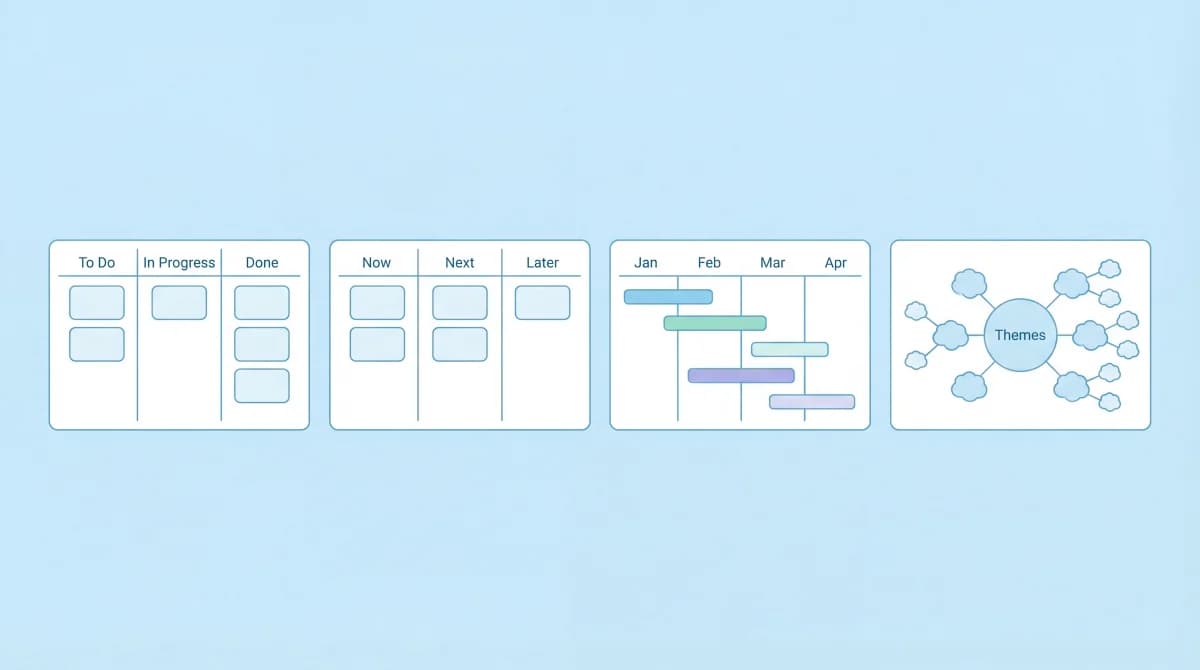
"Show me what a product roadmap actually looks like." It's the most common question I hear from teams building their first roadmap, and it's why real product roadmap examples beat generic theory every time. Templates look different depending on who you ask. And most roadmap articles talk about roadmaps without actually showing you one.
This guide fixes that. Nine product roadmap examples, each with a description of when to use it, who it's for, and what makes it work. No generic theory, just concrete formats you can copy.
I've built Feeqd, a product roadmap software used by product teams to turn user feedback into prioritized plans, and I've seen teams succeed and fail with every format here. A B2B SaaS team I worked with switched from timeline to Now/Next/Later after missing three deadlines in two quarters. The format itself matters less than whether it fits your team's workflow and your audience's expectations. Let's walk through them.
9 Product Roadmap Examples to Copy
Here's a quick comparison of the 9 formats before we dive into each one:
| # | Format | Best For | Time Horizon | Audience |
|---|---|---|---|---|
| 1 | Now / Next / Later | Agile teams, public sharing | Proximity-based | All audiences |
| 2 | Kanban | Status-based tracking | Flow-based | Internal + public |
| 3 | Timeline | Fixed release cycles | Specific dates | Enterprise, executives |
| 4 | Theme-based | Strategic alignment | Quarterly | Leadership, stakeholders |
| 5 | Release Plan | Version-based products | Per release | Users, support teams |
| 6 | Sprint Plan | Engineering coordination | 2-4 weeks | Engineering team |
| 7 | Portfolio | Multi-product companies | Quarterly | CPO, VP Product |
| 8 | Outcome-Based | OKR-driven teams | Metric-based | Leadership, strategy |
| 9 | Experiment / Discovery | Continuous discovery | Hypothesis-based | Internal only |
1. Now / Next / Later Roadmap
The most flexible format for agile teams. Items are grouped into three columns based on priority proximity, not specific dates.
Structure:
- Now: actively being built this sprint or month
- Next: committed, coming in the next 1-2 months
- Later: planned but not yet scheduled (this quarter or beyond)
When to use: teams that work in agile sprints, avoid date commitments, or share their roadmap publicly. This is the format most modern SaaS companies use for their public product roadmap, and the reasoning behind it is covered in our now-next-later roadmap guide.
Why it works: it communicates priority without creating false promises. "We're building this next" is more honest than "shipping March 15" when March 15 is a guess.
Example layout:
NOW                    NEXT                   LATER
-------------------    -------------------    -------------------
Dark mode (120 votes)  API v2 (85 votes)      Mobile app (45 votes)
Notifications (95)     SSO (60 votes)         Webhooks (30 votes)
Bulk actions (80)      Slack integration (55) Multi-language (20)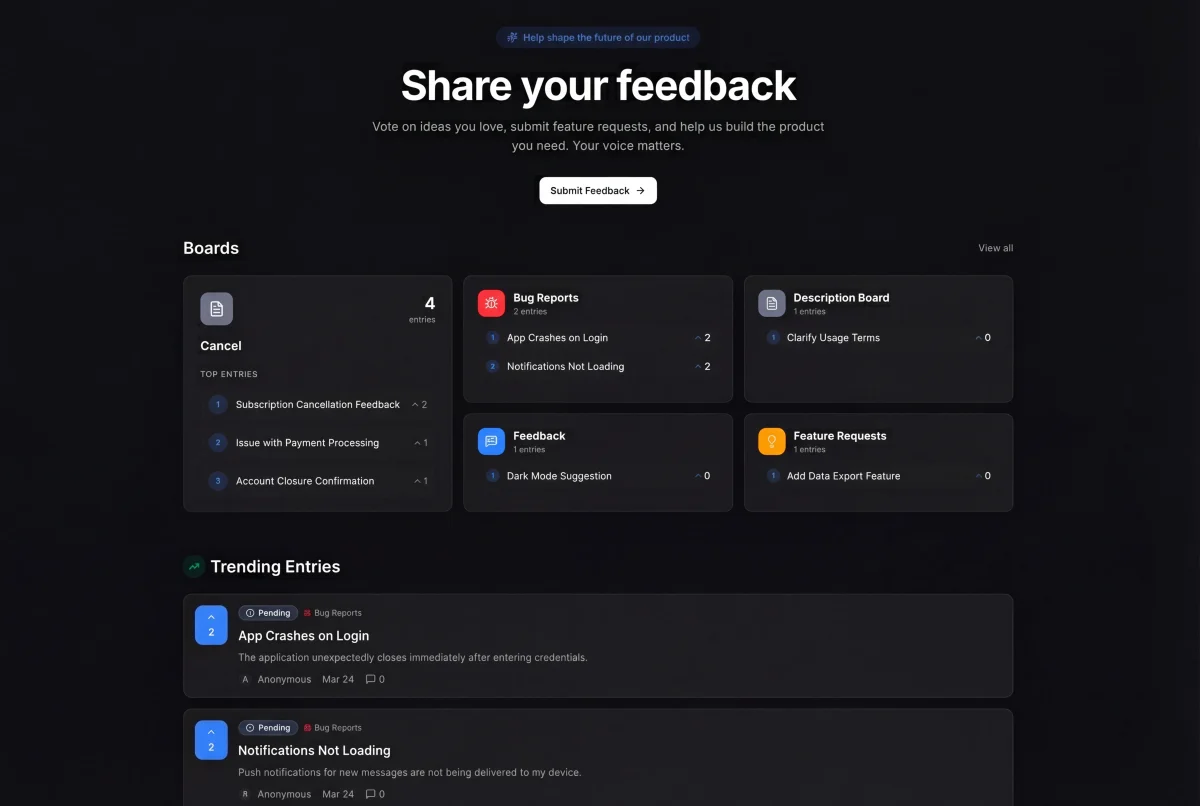
2. Kanban Roadmap
A board-style roadmap organized by status columns instead of dates. Items flow through stages as work progresses, just like a Kanban board for tasks.
Structure:
- Pending: submitted, not yet reviewed
- Next: accepted, planned for upcoming work
- In Progress: actively being built
- Completed: shipped and available
When to use: teams that prefer status-based tracking over date-based planning. Works well for public roadmaps because users understand the visual flow immediately.
Why it works: it shows momentum (items moving to Completed), transparency (everyone sees where work stands), and progress (cards moving right over time).
This is the format Feeqd uses by default because it maps naturally to our feedback-to-roadmap workflow. Each card on the Kanban roadmap links back to its source feedback entry, preserving the vote count.
3. Timeline Roadmap
The traditional date-based roadmap format. Features are plotted on a timeline with specific delivery windows (quarterly, monthly, or weekly).
Structure:
- Horizontal axis: time (Q1, Q2, Q3, Q4 or months)
- Items: feature bars spanning their delivery window
- Swimlanes: optional, one per team or product area
When to use: teams with fixed release cycles, enterprise customers who need specific dates, or when presenting to executives who expect a Gantt-style view.
Watch out for: timeline roadmaps create commitment expectations. If your team works in agile sprints with changing scope, timeline roadmaps can set you up for "missed dates" conversations. Use them only when you have high confidence in delivery dates.
Example:
        Q1             Q2             Q3             Q4
        |              |              |              |
Growth  [= Dark mode =][== SSO ====]
Retain                   [== Onboarding ==]
API                              [===== API v2 =====]
Mobile                                          [=== iOS app ===]
4. Theme-Based Roadmap
Organized by strategic themes rather than individual features. Each theme represents an outcome your team is pursuing.
Structure:
- Top-level: themes (e.g., "Activation," "Retention," "Expansion")
- Under each theme: features or initiatives that serve that theme
- Optional: measurable goals per theme
When to use: presenting to executives who care about strategy, aligning multiple teams around shared outcomes, or when features alone don't tell the story.
Why it works: it answers "why are we building this?" before "what are we building?" A feature list without themes is just a to-do list. A themed roadmap shows intent.
Example:
ACTIVATION (reduce time-to-value by 50%)
  - Onboarding flow redesign
  - Interactive product tour
  - Sample data loader

RETENTION (reduce churn by 20%)
  - Dark mode
  - Notification preferences
  - Weekly digest emails

EXPANSION (unlock enterprise segment)
  - SSO
  - Audit logs
  - Custom branding
5. Release Plan Roadmap
A version-based roadmap showing what features ship in each release. Common for products with defined release cycles (monthly, quarterly).
Structure:
- Top-level: releases (v2.1, v2.2, v3.0)
- Under each release: features included
- Dates: optional, often just "shipped" and "next release"
When to use: products with fixed release cadences, mobile apps shipping to app stores, or enterprise software with defined version upgrades.
Why it works: it connects roadmap items to shipped product versions, which makes communication with users straightforward. "This feature is in v2.3" is more concrete than "we're working on it."
6. Sprint Plan Roadmap
A short-term roadmap focused on the next 2-4 sprints. More granular than a quarterly roadmap, less granular than a daily task list.
Structure:
- Rows: sprints (Sprint 42, Sprint 43, Sprint 44)
- Columns: epics or features being worked on
- Status: planned, in progress, completed
When to use: internal team coordination, engineering planning, or when you need to answer "what's happening next week?" at a feature level.
Watch out for: sprint roadmaps are usually internal-only. They're too detailed for customers and too high-level for individual tasks. Keep a separate public roadmap for users.
7. Portfolio Roadmap
A high-level view of multiple products or product lines in one roadmap. Used by companies with multiple products or teams.
Structure:
- Rows: products or product lines
- Columns: time periods (Q1, Q2, Q3, Q4)
- Items: major initiatives per product
When to use: CPO or VP Product reviewing multiple teams, board presentations, strategic planning across a product portfolio.
Why it works: it provides a bird's-eye view of everything your organization is building, which is impossible to see from individual team roadmaps.
8. Outcome-Based Roadmap
The least common format but arguably the most strategic. Organized by user or business outcomes rather than features.
Structure:
- Sections: outcomes (e.g., "Users onboard in under 5 minutes")
- Under each outcome: potential features or experiments to achieve it
- Metric: how you'll measure success for each outcome
When to use: mature product teams, teams using OKRs, or when you want to decouple "what to build" from "why we're building it." This format is championed by product leaders like Marty Cagan at SVPG, who argues that outcome-based roadmaps produce better products than feature-based ones.
Why it works: it forces you to think about outcomes before solutions. The same outcome might be achievable through multiple feature paths, and the outcome-based roadmap lets you experiment without committing to specific features.
9. Experiment / Discovery Roadmap
A format built for teams running continuous discovery or experimentation. Instead of committed features, each item is a hypothesis or experiment with a specific learning goal.
Structure:
- Items: experiments or hypotheses (e.g., "Test if prospects want Slack integration")
- Status: Idea, Testing, Validated, Rejected
- Outcome: what you learned from running the experiment
When to use: teams practicing continuous discovery (Teresa Torres), early-stage products, or when you're more uncertain about what to build than how to build it.
Why it works: it normalizes the idea that not everything on the roadmap will ship. Some experiments will succeed and become features. Others will be rejected and removed. This format makes roadmap evolution feel natural instead of like a broken promise.
Watch out for: experiment roadmaps are harder to communicate externally. Customers want to know what's shipping, not what you're testing. Keep this format internal or use it alongside a more concrete public roadmap.
When I was early in building Feeqd, I tried to share our experiment roadmap publicly. Users got confused because they couldn't tell which items were promises versus guesses. I moved experiments internal after that and kept a separate Now/Next/Later roadmap for public communication. The separation worked much better.
How to Choose the Right Roadmap Format
Match the format to your audience
Different audiences need different formats:
- Internal engineering team: Kanban or sprint plan
- Executives: theme-based or portfolio
- Customers: Now/Next/Later or Kanban (public-friendly)
- Enterprise clients: timeline (they expect dates)
- Investors: theme-based or outcome-based (strategic narrative)
You don't have to pick just one. Many teams maintain multiple views of the same underlying data, each tailored to a specific audience.
Start simple, add complexity later
The best roadmap format for your first roadmap is the simplest one that communicates your priorities. Now/Next/Later or Kanban works for 90% of teams. Only move to timeline or portfolio views when you have a specific reason (enterprise deadlines, multiple products, strategic review).
Use a tool that supports multiple views
Dedicated product roadmap software lets you switch between views without rebuilding the data. In Feeqd, the same roadmap data can be viewed as Kanban or as a list. Other tools offer timeline views, theme grouping, and portfolio rollups.
Keep it alive
The best format in the world is useless if your roadmap is stale. Whichever format you pick, commit to updating it at least weekly. If you can't maintain it, your format is probably too complex.
Common Mistakes with Roadmap Examples
Copying without adapting
Every team I've seen fail at roadmapping started by copying a template from a blog post (including this one) without adapting it to their context. The example formats above are starting points, not prescriptions. Your team's workflow, audience, and product will shape the right format.
Over-engineering the format
Spending hours designing a beautiful roadmap visualization while ignoring the data that goes into it. A simple Kanban board with the right priorities beats a polished timeline with the wrong ones. Focus on the substance first, presentation second.
Confusing roadmap with backlog
A roadmap is what you've decided to build. A backlog is everything you could build. The examples above are roadmaps, not backlogs. Don't dump your entire backlog into the roadmap, filter ruthlessly for the top priorities.
Building roadmaps in isolation
The biggest failure mode is building a roadmap without user feedback. Whichever format you pick, make sure the items come from real user demand, not internal assumptions.
FAQ
What is a product roadmap?
A product roadmap is a plan that communicates what a product team is building, when, and why. It's a strategic document that aligns your team, stakeholders, and users around priorities. Modern roadmaps live in dedicated tools rather than slide decks, making them dynamic and updatable as priorities shift. See our full guide on how to create a product roadmap for a step-by-step process.
What should be on a product roadmap?
A product roadmap should include: features or initiatives being built, status (in progress, next, later, done), priority or theme, and ideally a "why" linking each item to user feedback or business goals. Avoid including: specific dates unless you're confident, internal tasks users don't care about, and items with no clear justification. Less is more: a focused roadmap with 10 items is more useful than a cluttered one with 50.
Can ChatGPT create a product roadmap?
ChatGPT can help draft roadmap content, brainstorm features, or generate a now-next-later template. But it can't replace the process of gathering real user feedback and making strategic tradeoffs. Use ChatGPT as a brainstorming assistant, not a roadmap tool. The real value of a roadmap comes from live user data and ongoing updates that a static AI conversation can't maintain.
How do you create a simple product roadmap?
Start with a Kanban board with three columns: Now, Next, Later. Add 5-10 feature cards based on your top user requests. Each card should include the feature name, a one-line "why," and a vote count or demand signal if you have one. Review and update it weekly. This minimal format works for 90% of teams and can be built in under an hour with dedicated roadmap software or a simple spreadsheet.
Get started with Feeqd for free
Let your users tell you exactly what to build next
Collect feedback, let users vote, and ship what actually matters. All in one simple tool that takes minutes to set up.
Sign up for free