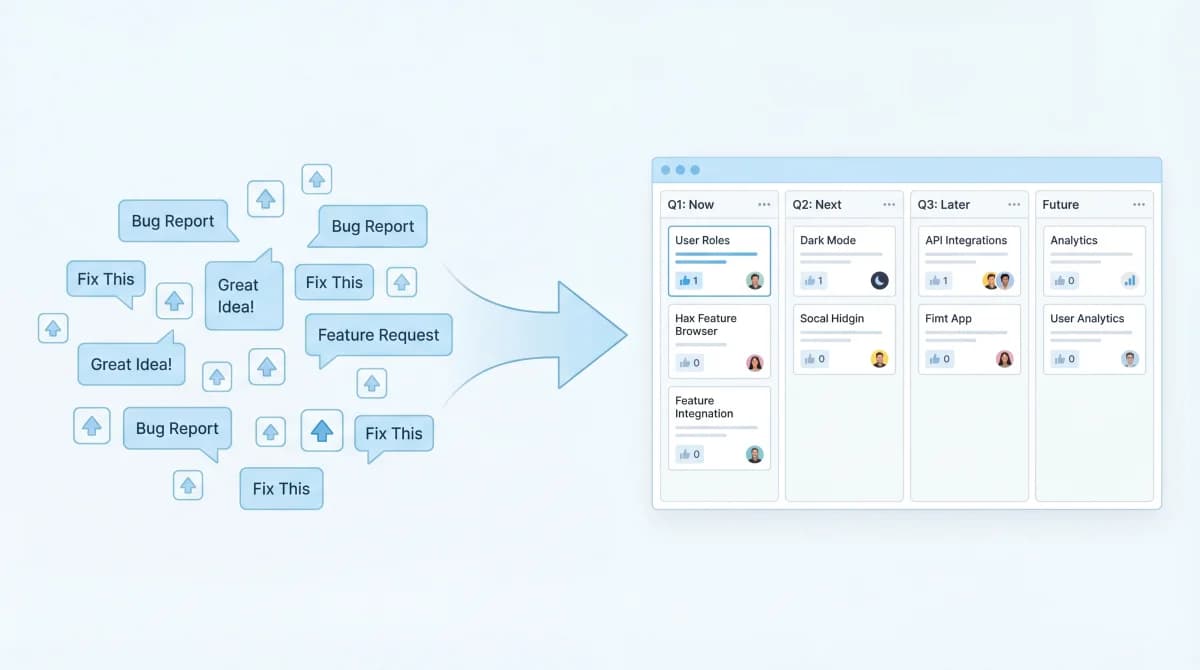
Most product roadmaps are built backwards. A PM decides what to build based on competitive analysis, stakeholder opinions, and gut instinct, then looks for user feedback that validates those decisions. A feedback-driven roadmap reverses this entirely: the feedback becomes the planning input, not a post-hoc confirmation tool.
A feedback-driven roadmap reverses this. User feedback is the input, not the validation. Features earn their place on the roadmap because users asked for them, voted for them, and demonstrated demand, not because someone internally thought they were a good idea.
This approach doesn't mean building everything users ask for. It means using user input as the primary filter for what gets built, what gets deferred, and what gets cut. I've been building Feeqd around this philosophy, and the difference between our gut-instinct roadmap and our feedback-driven roadmap was stark: roughly 70% of items were different. The feedback-driven version produced better outcomes every time.
What Is a Feedback-Driven Roadmap?
A feedback-driven roadmap is a product plan where prioritization is based on quantified user demand rather than internal assumptions. It connects user feedback (requests, votes, support patterns) directly to roadmap decisions through a structured process.
The key difference from a traditional roadmap:
| Aspect | Traditional Roadmap | Feedback-Driven Roadmap |
|---|---|---|
| Input source | Stakeholder meetings, competitor analysis | User votes, feedback boards, support data |
| Prioritization | PM judgment, executive direction | Vote counts + strategic filters |
| Validation | Post-hoc ("users seem to like it") | Pre-build ("147 users requested this") |
| Transparency | Internal document | Often public, with vote counts visible |
| Adaptability | Quarterly review cycles | Continuous as new feedback arrives |
A feedback-driven roadmap isn't anti-strategy. It's strategy informed by data. You still apply strategic filters (revenue impact, technical feasibility, business goals), but you start with what users want rather than what you assume they want.
Why Feedback-Driven Roadmaps Produce Better Outcomes
You build what actually matters
The most common product failure is building features nobody uses. When your roadmap is driven by user feedback, every item has demonstrated demand before you write a single line of code. A feature with 200 votes from active users is a safer bet than a feature an executive sketched on a whiteboard.
When we switched to a feedback-driven approach at Feeqd, our feature adoption rate improved noticeably. Features that users had requested and voted for saw 3-4x higher adoption in the first month compared to features we built from internal assumptions.
You avoid the loudest voice problem
Without structured feedback, product decisions default to whoever communicates most forcefully: the enterprise prospect threatening to churn, the co-founder's pet feature, the designer's "vision." A feature voting board makes demand visible and countable. "142 users want this" is a harder argument to override than "I think this is important."
You reduce planning overhead
Traditional roadmap planning involves weeks of stakeholder alignment, scoring exercises, and debate. When you have voting data, the conversation shifts from "what should we build?" (open-ended, opinion-based) to "should we build the #1 voted feature this quarter or the #3?" (scoped, data-informed). Planning meetings get shorter and more productive.
You build trust through transparency
When your roadmap connects visibly to user feedback, users trust your product direction. They can see their vote on a feature, watch it move through your roadmap status workflow, and get notified when it ships. This loop turns users into advocates. According to Pragmatic Institute, product teams that incorporate structured user feedback into roadmapping report higher customer satisfaction and lower churn.
How to Build a Feedback-Driven Roadmap (Step by Step)
Step 1: Set up a feedback collection system
You can't drive your roadmap with feedback you don't have. Start with:
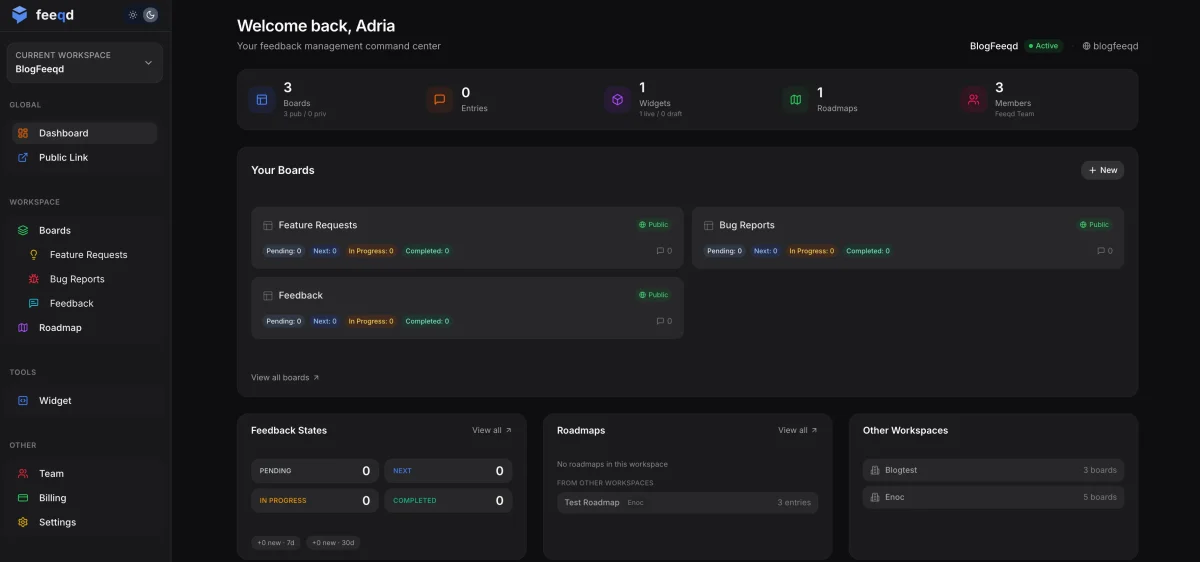
- A feedback board where users submit and vote on requests
- An in-app widget for capturing feedback in context (Feeqd's is 18KB and loads in under 50ms)
- A process for logging requests that arrive through support, email, and sales conversations
The critical requirement is that all feedback flows into one system. If requests live in Slack, email, AND a board, you'll never get an accurate picture of demand.
Step 2: Let demand accumulate
Don't react to individual requests. Wait until you have enough data to see patterns. For most products, 2-4 weeks of active feedback collection produces a meaningful ranking. Look for:
- Features with consistently high vote counts (not just a spike from one user sharing the board)
- Requests that appear independently from multiple user segments
- Patterns in support tickets that align with board votes
Step 3: Apply strategic filters
Raw vote data is your starting point, not your final answer. Filter through:
- Revenue impact: weight votes from paying users higher than free users. 10 votes from $500/month customers outweigh 50 votes from free users for most business models.
- Strategic alignment: does this feature serve your product vision? A high-vote feature that pulls you away from your core value proposition might not belong on your roadmap.
- Technical feasibility: some high-vote features are simple to build. Others require architectural changes. Factor effort into your prioritization framework.
- Urgency: is there a time-sensitive reason to build this now? Regulatory requirements, competitive threats, or integration deadlines can override vote order.
Step 4: Build your roadmap from filtered priorities
Take your top priorities and organize them into a roadmap using dedicated product roadmap software. The Now/Next/Later framework works best for feedback-driven roadmaps because it communicates priority without date commitments:
- Now: top-voted features your team is actively building
- Next: committed features, coming soon
- Later: high-vote features planned but not yet scheduled
Each item should link back to its source feedback, including the vote count. This traceability is what makes the roadmap "feedback-driven" rather than just "feedback-inspired."
Step 5: Make it public
A feedback-driven roadmap gains power when users can see it. Public roadmaps show users that their votes lead to action. They also attract new feedback: users who see your roadmap understand what's already planned and submit more targeted requests for what's missing.
Step 6: Close the loop on every shipped feature
When a roadmap item moves to Completed, notify the users who voted for it. This is the moment that turns your feedback-driven roadmap from a planning tool into a growth engine. Users who see their feedback result in shipped features become your most engaged advocates, submitting more feedback, voting more actively, and recommending your product to others.
Read our full guide on closing the feedback loop for implementation details.
Common Mistakes with Feedback-Driven Roadmaps
Following the loudest voice
A feedback-driven roadmap uses aggregate demand, not individual noise. One passionate user submitting 10 detailed requests doesn't equal 10 different users each voting once. Segment by unique voters, not total submissions.
Recency bias
New requests often feel more urgent than older ones with higher vote counts. A feature requested yesterday with 3 votes is not more important than one from last month with 80 votes. Review the full priority list, not just recent additions.
The feature parity trap
As Teresa Torres argues in her continuous discovery framework, the best product decisions come from understanding underlying needs, not surface-level requests. Users often request features they've seen in competitors: "add what Canny has." Building competitor features doesn't differentiate your product. Use feedback to identify underlying problems, then solve them your way. "Users want Jira integration" might really mean "users want their dev team to see the roadmap," which you can solve differently.
Building without validating
A feature with 50 votes tells you there's demand, but not exactly what to build. Before adding a high-vote item to your roadmap, investigate the underlying need. Talk to a few voters. Read their request descriptions. The voted feature might be a symptom of a larger problem that deserves a different solution.
Never saying no
A feedback-driven roadmap doesn't mean building everything users ask for. It means having the data to make informed decisions about what NOT to build, with transparency about why. Some features won't align with your strategy regardless of vote count, and that's fine, as long as you communicate clearly.
FAQ
What is a feedback-driven roadmap?
A feedback-driven roadmap is a product plan where feature prioritization is based on quantified user demand (votes, requests, support patterns) rather than internal assumptions. User feedback is the primary input for deciding what to build, filtered through strategic criteria like revenue impact, feasibility, and business goals. It connects feedback boards directly to roadmap decisions through a structured process.
How is a feedback-driven roadmap different from a feature-request roadmap?
A feature-request roadmap simply lists what users asked for. A feedback-driven roadmap applies strategic filters to that input: revenue impact, technical feasibility, business alignment, and urgency. Not every request makes it to the roadmap. The "driven" part means feedback informs the direction, not that it dictates every item.
What tools support feedback-driven roadmapping?
Tools that combine feedback collection, voting, and roadmapping in one system work best. Feeqd connects voting boards directly to a Kanban roadmap. Productboard offers a feedback portal with prioritization scoring. Canny provides voting boards with a separate changelog. The key requirement is that your roadmap tool can reference vote data from your feedback system, ideally in one platform rather than two disconnected tools.
How often should you update a feedback-driven roadmap?
At minimum weekly. As new votes arrive and priorities shift, your roadmap should reflect current demand. The advantage of a feedback-driven approach is that it's naturally dynamic: vote counts update continuously, and your weekly review simply reflects the latest data. If your roadmap hasn't changed in a month, either your product is done or you're not actually using feedback to drive it.
Get started with Feeqd for free
Let your users tell you exactly what to build next
Collect feedback, let users vote, and ship what actually matters. All in one simple tool that takes minutes to set up.
Sign up for free