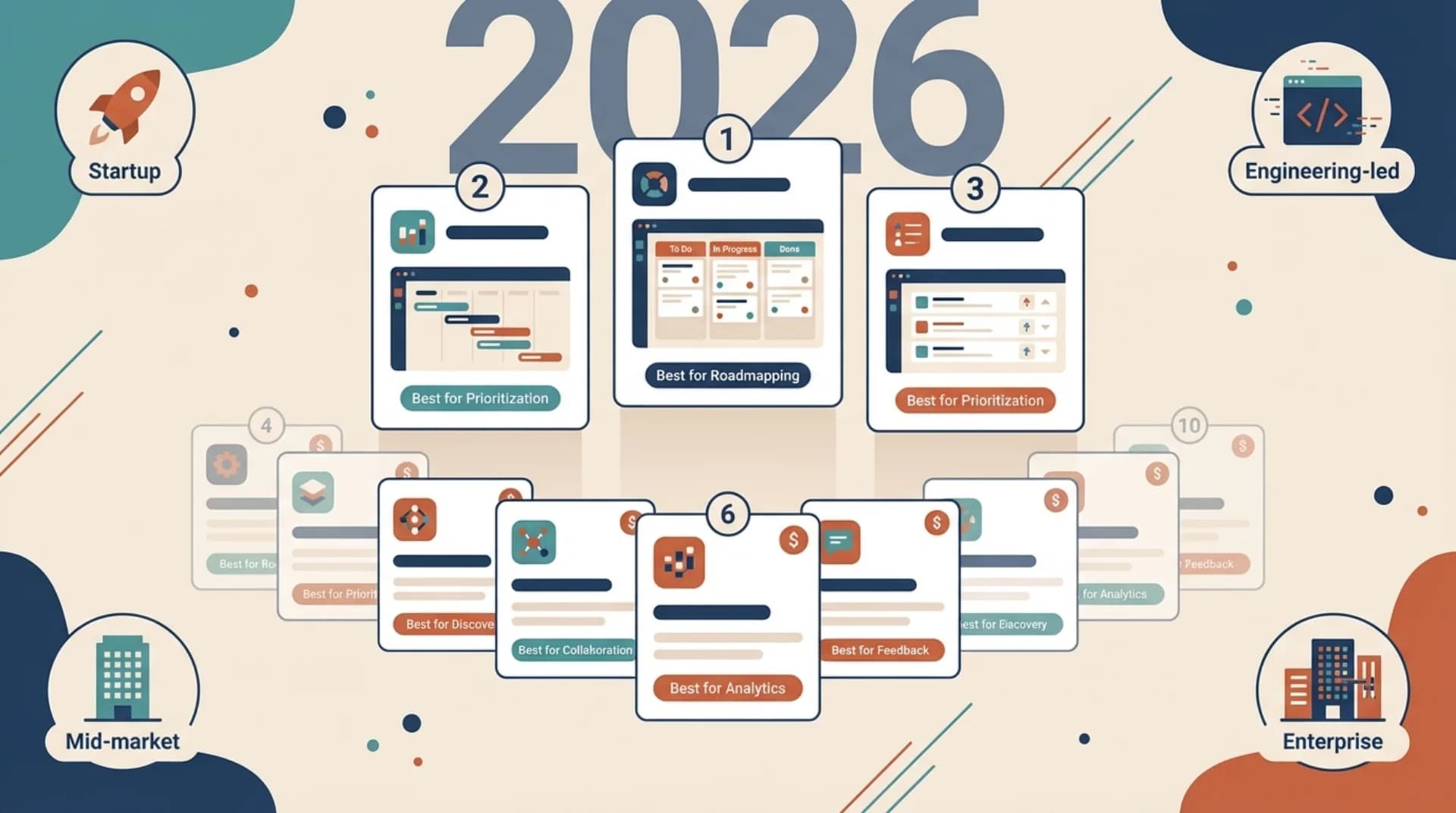
The best product roadmap software for teams in 2026 depends less on the feature count and more on the stack, size, and decision style of the team using it. An engineering-led team already in Jira needs something different from a 3-person startup on Notion. A 200-person org with a dedicated product ops team needs something different again.
This ranking is organized by team profile, not by vendor size. I've been building Feeqd in this space for two years and have used or tested the other tools here at different points. Pricing is current as of April 2026; verify before deciding. For methodology background, Atlassian's agile roadmap playbook is a solid neutral reference, and the ProductPlan examples library is worth a read before picking the tool.
Quick Picks by Team Profile
If you're short on time, here's the shortlist by situation:
| Your team | Best pick | Why |
|---|---|---|
| Startup under 10, tight budget | Feeqd, UserJot, Featurebase | Generous free tiers, full collect-to-roadmap loop |
| Engineering-led, already in Jira | Jira Product Discovery, Aha! Roadmaps | Tight Jira sync is the dealbreaker |
| Mid-market SaaS with PM ops | Productboard | Prioritization depth and feedback synthesis |
| Large enterprise, multi-team | Aha!, SharpCloud | Strategy-to-execution in one stack |
| Feedback-first, public roadmap focus | Feeqd, Canny | Public boards with voting built in |
| Agile teams on Atlassian stack | Jira Product Discovery | Native integration, no sync pain |
The 10 Best Product Roadmap Software Options
1. Productboard · Best for Mid-Market with PM Ops
Productboard positions as the roadmap tool for product teams with dedicated product operations. The prioritization engine is the deepest in the market: custom scoring, segment weighting, objective alignment. Feedback inbox syncs from Slack, Intercom, Zendesk, and a Chrome extension.
Who it's for: product teams of 10 to 50, mid-market B2B SaaS, companies running OKRs seriously. Pricing: Starter around $25/user/mo; Pro and Enterprise priced on request. Where it wins: prioritization framework depth, feedback synthesis, Jira integration. Where it loses: overkill for startups, expensive when you scale seats, public-facing portals feel secondary.
2. Aha! · Best for Enterprise Roadmap + Strategy
Aha! is the roadmap-first tool that added everything else around it: strategy, ideas, releases, launch planning. The full Aha! suite covers product lifecycle end to end.
Who it's for: product orgs of 50+, enterprises with multi-product portfolios, teams that need strategy+roadmap+release in one platform. Pricing: Roadmaps from $59/user/mo; Ideas module separate; Enterprise pricing higher. Where it wins: breadth of capability, customization depth, mature enterprise sales motion. Where it loses: steep learning curve, feature overload for smaller teams, pricing scales aggressively.
3. Jira Product Discovery · Best for Teams Already in Atlassian
Jira Product Discovery (JPD) is Atlassian's native answer to Productboard. If your engineers already live in Jira, JPD removes the sync layer entirely. Ideas become stories inside the same system.
Who it's for: engineering-led teams already on Atlassian, organizations standardized on Jira. Pricing: $10/creator/mo on the standard plan, free for viewers. Where it wins: zero-friction Jira integration, familiar UI for Atlassian teams, affordable. Where it loses: less mature prioritization than Productboard, fewer public-facing roadmap options, weaker feedback collection outside Jira.
4. Feeqd · Best for Startups with Feedback-First Workflow
Full disclosure: I build Feeqd. The product combines an 18KB in-app widget, public feedback boards with voting, and a public roadmap into one stack. The focus is the loop from customer input to shipped feature.
Who it's for: startups, founders, and small product teams that want the collect-to-roadmap loop without enterprise overhead. Pricing: Free plan covers the core stack; paid plans from $19/mo. Where it wins: widget performance (no measurable page-load impact), public roadmap with voting out of the box, price-to-value for early-stage teams. Where it loses: smaller integration ecosystem than Canny or Productboard, fewer enterprise features.
5. Canny · Best for Established B2B SaaS
Canny is the category default for public feedback boards and customer-facing roadmaps. Mature product, large customer base (around 40,000 per BuiltWith), deep integration catalog.
Who it's for: mid-market SaaS, teams that want brand-name safety, companies with budget. Pricing: Free tier limited; paid plans start $79/mo and scale quickly. Where it wins: brand recognition, integration depth, stable mature product. Where it loses: pricing jumps sharply at mid-tiers, feature set feels tool-first rather than workflow-first.
6. Monday Dev · Best for Teams Building Their Own Workflow
Monday Dev is the roadmap-tuned version of Monday.com, letting teams construct their own workflow on top of a flexible building block. Popular with teams that want customization without writing code.
Who it's for: teams already on Monday, teams that want to build their own roadmap pipeline with custom automation. Pricing: Pro plan around $12-16/user/mo; Enterprise higher. Where it wins: configurability, automation depth, Monday ecosystem. Where it loses: not roadmap-specialized out of the box, you build most of it yourself.
7. Roadmunk · Best for Visual Roadmap Presentations
Roadmunk (now part of Tempo) focuses on the visual layer: swimlane roadmaps, timeline views, pretty board-ready output. Used heavily for stakeholder communication.
Who it's for: PMs who need polished visual roadmaps for board decks and external sharing. Pricing: Starter around $19/user/mo; higher tiers add collaboration and integrations. Where it wins: visual polish, export quality, timeline clarity. Where it loses: weaker feedback collection layer, less integrated with engineering workflow than JPD or Aha!.
8. Productlift · Best for Small Teams on Tight Budget
Productlift offers a Canny-style experience at a lower price point. Boards, voting, roadmap, changelog in one. Strong G2 ratings.
Who it's for: early-stage SaaS looking for Canny-equivalent functionality at a third of the price. Pricing: Flat pricing from $19/mo. Where it wins: price-to-functionality ratio, simple onboarding. Where it loses: smaller ecosystem, fewer integrations than Canny or Productboard.
9. SharpCloud · Best for Large Organizations with Portfolio Complexity
SharpCloud positions at the enterprise end: portfolio-level roadmaps, strategic alignment, dependency mapping across business units. Common in larger PMO-style orgs.
Who it's for: enterprises with complex portfolios, multi-business-unit roadmaps, strategy teams. Pricing: Enterprise, quote-based. Where it wins: portfolio view, dependency visualization, strategy alignment. Where it loses: overkill for single-product teams, sales-led buying process, not for startups.
10. Gleap · Best for Support-Embedded Feedback Loops
Gleap bundles feedback widget, bug reporting, public roadmap, and voting. Distinctive because the widget captures screenshots and session info alongside the request, useful for teams that conflate bug reports and feature requests.
Who it's for: product teams that want one widget to cover both feedback and bug reports. Pricing: Free tier available; paid from around $29/mo. Where it wins: rich widget capture (screenshots, session), combined bug+feature flow. Where it loses: less focused on prioritization than Productboard, fewer roadmap views.
Comparison Table
| Tool | Starting price | Free plan | Widget | Public roadmap | Jira sync | Best team profile |
|---|---|---|---|---|---|---|
| Productboard | $25/user/mo | ❌ | Via portal | ✅ | ✅ Deep | Mid-market + ops |
| Aha! | $59/user/mo | ❌ | Limited | ✅ | ✅ | Enterprise |
| Jira Product Discovery | $10/user/mo | ❌ | ❌ | Limited | Native | Atlassian-native |
| Feeqd | $19/mo | ✅ | ✅ (18KB) | ✅ | Via API | Startup + SMB |
| Canny | $79/mo | Limited | ✅ | ✅ | ✅ | Established SaaS |
| Monday Dev | $12/user/mo | ❌ | ❌ | ✅ | ✅ | Build-your-own |
| Roadmunk | $19/user/mo | ❌ | ❌ | ✅ | ✅ | Visual-first |
| Productlift | $19/mo | Trial | ✅ | ✅ | ✅ | Budget-focused |
| SharpCloud | Enterprise | ❌ | ❌ | ✅ | ✅ | Enterprise portfolio |
| Gleap | $29/mo | ✅ | ✅ (rich) | ✅ | ✅ | Bug+feature combined |
How to Pick: The Four-Question Filter
Ten tools is too many to evaluate seriously. These four questions collapse the list to two or three real options.
1. What's your existing stack? Already on Jira? Jira Product Discovery, Aha!, or Productboard (in that order of integration depth). Already on Monday? Monday Dev. Starting fresh? Feeqd, Canny, Productboard, or Productlift depending on budget.
2. What's your budget? Under $30/mo: Feeqd, UserJot, Productlift, or Feature Upvote. Free tiers exist on Feeqd, UserJot, Gleap. $50 to 200/mo: Canny, Productboard Starter, Aha! Ideas. Enterprise: Productboard Enterprise, Aha! full suite, SharpCloud.
3. Do you need a public-facing roadmap? If yes: Feeqd, Canny, Productlift, Gleap, Featurebase all have strong public boards out of the box. If no (internal-only): Productboard, Aha!, Jira Product Discovery are stronger on internal views.
4. Where does feedback come from? In-app: Feeqd, Canny, Gleap (widget). Support tickets: Productboard or Canny (deep Intercom/Zendesk sync). Sales calls: Productboard with its CRM integrations. Community: any tool with a public board.
What "For Teams" Actually Means
The "for teams" modifier is mostly SEO filler in most articles. Real differentiation happens across three axes:
Team size: Solo founders and 3-person teams optimize for price and simplicity (Feeqd, UserJot, Productlift). 20-50 person teams start needing prioritization depth and role management (Productboard, Canny). 100+ people need portfolio views and governance (Aha!, SharpCloud).
Team stack: Jira-native teams almost always end up on JPD or Aha! because sync cost compounds. Monday-native teams default to Monday Dev. Teams with no existing stack pick by price and fit.
Team decision style: Engineering-led teams want APIs and Git-like workflows. Product-led teams want prioritization frameworks. Sales-driven teams want CRM-hooked feedback. Pick the tool whose defaults match how decisions actually happen on your team.
2026 Trends Worth Noting
Three patterns that changed the roadmap software landscape in the last 12 months:
- AI prioritization scoring is table stakes now. Most tools added LLM-backed theme clustering and auto-deduplication in 2025. If a tool still requires manual tagging, it's behind.
- Public roadmap pages became a growth channel. Public-first vendors (Feeqd, Canny, Featurebase) treat the roadmap as customer-facing marketing, not an internal artifact. See public product roadmap for why this shift matters.
- Price compression at the low end. Productlift, UserJot, and Feeqd all offer Canny-class functionality at a third of the price. For startups, this is the biggest change in the category.
Common Mistakes When Picking Roadmap Software
- Choosing by feature count. More features usually means more friction. Pick the tool with the features you'll actually use.
- Ignoring the integration cost. A tool without Jira sync in a Jira shop will cost you an engineer's week every quarter.
- Buying the enterprise tier too early. Productboard and Aha! are excellent, but not at 3-person scale. Start lighter, grow into them.
- Treating roadmap as separate from feedback. Tools that keep both in one system (Feeqd, Canny, Productboard) close the loop by default. Tools that separate them require manual workflow glue.
- Skipping the public-facing view. Customers who see a public roadmap trust you more and submit better feedback. See the roadmap templates for template 8 (public roadmap) as the reference.
For the foundational guide on choosing and using roadmap software end to end, the product roadmap software guide covers the strategy layer. For creating roadmaps from scratch, see how to create a product roadmap. For format inspiration, product roadmap examples walks through nine visual layouts, and feedback-driven roadmap explains the workflow tying voting boards to roadmap items.
Frequently Asked Questions
What is the best product roadmap software for teams?
The best product roadmap software for teams in 2026 is the one that matches your team's stack, budget, and decision style. For startups under 10 people, Feeqd or UserJot give you the full collect-to-roadmap loop on a generous free tier. For mid-market SaaS, Productboard or Canny dominate. For Jira-native teams, Jira Product Discovery removes sync overhead. For enterprise, Aha! or SharpCloud are the safe picks. There is no single winner; pick by fit.
What is the most popular roadmap tool?
Canny and Productboard are the most widely adopted paid tools in the product management space. Jira (including Jira Product Discovery) is the most common by total install base, because Atlassian's share of engineering organizations makes it a default. For public-facing feedback boards specifically, Canny leads in brand recognition. Newer entrants like Feeqd and Featurebase are growing fastest in the startup and SMB segment.
Is there free product roadmap software?
Yes. Four meaningful free options in 2026: Feeqd (free plan with widget, board, public voting), UserJot (genuinely useful free tier), Productlift (trial), and Gleap (limited free plan). For fully open-source roadmap tooling you self-host, the options are thinner but Fider.io covers the feedback-to-roadmap side. Canny, Productboard, and Aha! don't offer meaningful free tiers.
What is the difference between a product roadmap and project management software?
Product roadmap software plans what to build and why at the initiative level, tied to customer feedback and business objectives. Project management software plans how to deliver at the task level, tracking execution, dependencies, and deadlines. They overlap (Jira does both, Monday does both), but they answer different questions. A product roadmap answers "what feature next"; project management answers "is this sprint on track." Most teams end up with both.
Match the Tool to the Team
The best product roadmap software for teams in 2026 is not a single name. It's the tool whose defaults, pricing, and integration surface match how your team already works. Pick by the four-question filter above. Trial two options for two weeks before committing. Watch how non-PM contributors (engineers, support, sales) actually use it, not how it demos.
If you want a free starting point with the widget, public boards, voting, and public roadmap in one stack, try feeqd free. No credit card, no setup call. For teams already on Jira or Monday, start with their native options first; sync cost compounds.
Get started with Feeqd for free
Let your users tell you exactly what to build next
Collect feedback, let users vote, and ship what actually matters. All in one simple tool that takes minutes to set up.
Sign up for free