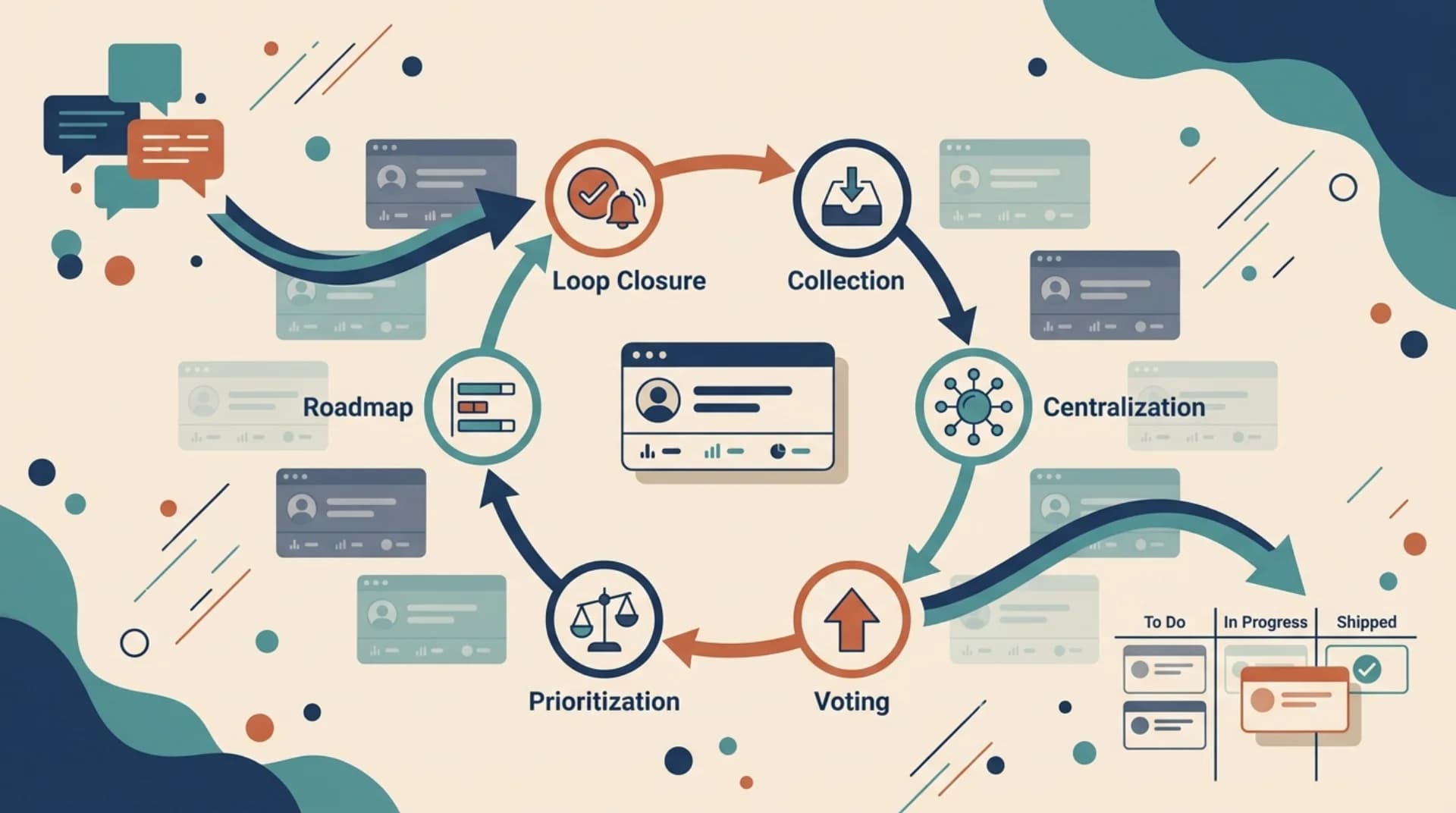
A feature request management tool is software that collects, organizes, prioritizes, and closes the loop on user feature requests. It replaces the mess of Slack threads, support tickets, sales-call notes, and scattered spreadsheets with a single source of truth that connects customer input to product decisions.
This guide is for product managers and founders trying to pick one. I've been building Feeqd in this category for two years, so I know the tools, the capabilities that actually matter, and the tradeoffs nobody surfaces until you're already migrating off your first choice. Below: the six capabilities that separate a real management tool from a fancy suggestion box, the decision framework, 10 tools honestly compared, and the mistakes teams make when picking.
What Is a Feature Request Management Tool?
A feature request management tool is a platform that takes customer requests for new features or changes and routes them through a repeatable process: collect, deduplicate, prioritize, decide, build, and announce. The output is a product decision backed by aggregated user demand, not a gut call from the loudest meeting attendee.
The word "management" is the key. A tool that only captures requests is a ticketing system. A tool that only tracks them is a spreadsheet with a UI. A management tool handles the full loop: from the moment a user submits a request to the moment that user gets notified their feature shipped.
For a broader overview of the category, Atlassian has a solid definition of a feature request and the role it plays in agile workflows.
The 6 Capabilities That Matter
Most tool comparisons rank by feature count. That's the wrong lens. Here are the six capabilities that actually separate tools that produce outcomes from tools that produce dashboards.
1. Multi-channel collection
A useful tool captures requests from every channel your customers use: in-app widgets, public feedback boards, support tickets (Intercom, Zendesk), sales notes, and email-to-board pipes. If your tool only accepts manual entry from one form, your team becomes the bottleneck.
2. Automatic deduplication and centralization
Users will submit the same request five different ways. "Dark mode," "night theme," "eye-friendly UI," "let me use this app at night." A tool without deduplication turns 400 requests into 400 tasks. A tool with semantic deduplication turns 400 requests into 80 distinct themes you can actually prioritize.
3. Voting and demand signal
Voting converts opinion into measurable demand. Without it, prioritization defaults to whoever wrote the longest message or has the biggest account. With voting, 200 users wanting X beats 1 executive wanting Y, or at least forces the tradeoff into the open.
4. Roadmap integration
A request is only valuable once it becomes a roadmap item. Tools that show "in progress" and "shipped" columns on a public board close the loop by default. Tools that keep requests in one system and roadmap in another make the connection manual and fragile.
5. Loop closure (notifications and status)
When a feature ships, everyone who voted for it should get notified. This single mechanism determines whether your feedback pipeline grows over time or silently dries up. Tools without built-in notifications push this work to marketing and it never happens.
6. Prioritization framework
Raw vote counts are a starting point, not the answer. A mature tool lets you weight votes by customer segment (paid vs free, plan tier, account size) or by business signal (churn risk, expansion potential). Features with 50 free-plan votes are not the same as features with 10 enterprise votes.
If your shortlist covers 4 of these 6, you're in good shape. If it covers all 6, you have a real management tool.
How to Choose the Right Tool
Four questions get you from "there are 20 options" to "here are the 2 that fit us."
1. Do you need a public-facing roadmap? If yes, you need a tool with strong public pages (custom domain, branded, status chips, vote counts). Canny, Feeqd, Productboard portal, UserJot, Featurebase, Frill all do this well. Internal-only tools like Aha! can do it but it's not the main use case.
2. What's your budget per month? Free tier sufficient: UserJot, Featurebase free plan, Feeqd free plan, Fider.io (self-hosted). Under $50/mo: Feeqd, UserJot paid, Featurebase paid, Frill, Nolt. $50-300/mo: Canny, Productboard startup, Aha! roadmap-only. Enterprise ($500+/mo): Productboard, Aha!, UserVoice, ProductPlan.
3. What's your existing stack? Already in Jira? Jira Product Discovery or a tool with tight Jira sync (Productboard, Aha!, Canny). Already in Intercom? Tools with native Intercom sync get you 90% of the way.
4. How technical is your team? Non-technical (founders, marketing-led teams): Canny, UserJot, Feeqd, Featurebase, Frill. Clean UX, minimal setup. Engineering-led: Fider.io (open source, self-hosted), Jira Product Discovery, or tools with strong APIs.
10 Feature Request Management Tools Compared
Ten tools, honest positioning, real pricing as of April 2026. I've included Feeqd because it's relevant, not because it's always the right answer. The right answer depends on the four questions above. For a more tracking-focused breakdown of a similar set, see the feature request tracking software comparison.
1. Canny
The category default. Clean public boards, solid voting, widget embed, integrations with most support tools. Free tier is generous; paid plans start at $79/mo and scale to enterprise quickly. Who it's for: teams that want the most established option and are willing to pay for it. Where it wins: brand recognition, mature integration catalog. Where it loses: pricing jumps sharply when you need segment-weighted prioritization or advanced roadmap features.
2. Productboard
The enterprise choice for product ops. Strong on prioritization scoring (custom weights, OKR alignment), deep Jira integration, feedback inbox. Starts around $25/user/mo on the Starter and climbs fast. Who it's for: mid-market and enterprise teams with dedicated PM ops. Where it wins: prioritization framework depth. Where it loses: overkill for startups, steep learning curve, public-facing boards feel secondary.
3. Aha!
Roadmap-first tool that added feature requests later. Massive feature set covers strategy, roadmap, ideas, and releases. Pricing starts $59/user/mo for Ideas and goes up. Who it's for: larger product orgs that need the full roadmap+strategy stack. Where it wins: completeness across the product lifecycle. Where it loses: feature request management is not the core strength; startups will drown in features they don't use.
4. UserVoice
The pioneer. Veteran of the space, strong in enterprise support-to-product loops. Pricing is quote-based and tends toward enterprise. Who it's for: large B2B companies with heavy support-driven feedback. Where it wins: depth of feedback analytics and legacy integration depth. Where it loses: product feels older, onboarding is slower than newer tools.
5. Feeqd
Full disclosure: I build Feeqd. Combines an 18KB in-app widget, public feedback boards, voting, and a public roadmap in one place. Free plan includes the core stack; paid plans start at $19/mo. Who it's for: product teams and founders who want the full collect-to-roadmap loop without enterprise overhead. Where it wins: widget performance (no measurable page-load impact), public roadmap with voting out of the box, honest pricing. Where it loses: smaller ecosystem, fewer native integrations than Canny or Productboard.
6. UserJot
Simple, fast, free forever tier. AI-powered duplicate detection, voting, auto-updating public roadmap. Paid plans start around $29/mo. Who it's for: early-stage teams and indie makers. Where it wins: free tier is genuinely useful, not a teaser. Where it loses: fewer advanced features if you grow into segment analysis or complex prioritization.
7. Featurebase
Modern, fast UI. Covers collection, voting, roadmap, changelog in one. Free tier available; paid around $29/mo. Who it's for: teams that want a Canny-like experience at lower cost. Where it wins: clean UX, changelog built in. Where it loses: younger product, fewer integrations.
8. Fider.io
Open source, self-hosted. Good for teams that need complete data control or are running on a shoestring. Free to use; cost is your own hosting. Who it's for: engineering-led teams, companies with strict data residency requirements. Where it wins: zero vendor lock-in, no monthly fee. Where it loses: you're your own ops team; UX is functional, not polished.
9. Frill
Roadmap-focused tool with announcements and feedback boards. Paid plans from $25/mo. Who it's for: teams that want a tight, opinionated roadmap + announcements flow. Where it wins: beautiful changelog, good for B2C and B2B SaaS. Where it loses: less focus on feedback depth than Canny or Productboard.
10. Nolt
Minimalist feedback board. Widget, voting, basic roadmap. Flat pricing at $25/mo. Who it's for: teams that want the simplest possible public board and nothing more. Where it wins: extremely simple onboarding. Where it loses: limited beyond basic voting and comments.
Quick Comparison Table
| Tool | Starting price | Free plan | Widget | Public roadmap | Segment-weighted prioritization |
|---|---|---|---|---|---|
| Canny | $79/mo | ✅ | ✅ | ✅ | Paid tier only |
| Productboard | $25/user/mo | ❌ | Via portal | ✅ | ✅ |
| Aha! | $59/user/mo | ❌ | Limited | ✅ | ✅ |
| UserVoice | Custom | ❌ | ✅ | ✅ | ✅ |
| Feeqd | $19/mo | ✅ | ✅ (18KB) | ✅ | Paid tier |
| UserJot | $29/mo | ✅ (generous) | ✅ | ✅ | ❌ |
| Featurebase | $29/mo | ✅ | ✅ | ✅ | Paid tier |
| Fider.io | Self-host | ✅ (OSS) | ❌ | ✅ | ❌ |
| Frill | $25/mo | Trial | ✅ | ✅ | ❌ |
| Nolt | $25/mo | Trial | ✅ | Basic | ❌ |
Pricing verified April 2026; check vendor sites for the current figure before deciding.
Free and Open Source Options
For teams with zero budget, three real options exist:
- UserJot free plan: genuinely useful for small teams, not a trial.
- Featurebase free plan: limited seats but covers the basics.
- Feeqd free plan: widget, one board, public voting. No credit card.
- Fider.io: fully open source. You run it yourself; no monthly fee.
Canny's free plan exists but is aggressively limited. Productboard and Aha! don't offer useful free tiers.
Integration Considerations
Your tool needs to live where your team already lives. The three integrations that actually matter:
- Jira or Linear sync: requests become tickets without manual copy-paste. Canny, Productboard, Aha!, Featurebase, and Feeqd all support this in some form. Verify two-way sync vs one-way before picking.
- Intercom or Zendesk sync: support tickets automatically become candidate feature requests. Canny and Productboard have the deepest integration here. UserVoice has legacy depth in Zendesk.
- Slack notifications: new requests, votes crossing thresholds, and status changes surfaced where the team already talks. Almost every tool supports this at the notification level; few support posting feedback directly from Slack.
If your tool doesn't sync with your ticket system and doesn't notify Slack on important events, expect feedback to get dropped within six weeks of rollout.
Common Mistakes When Picking a Tool
Five mistakes I see repeatedly on teams that end up migrating within a year:
- Picking by brand, not by capability. Canny is popular for a reason, but it's not automatically right for a $20/mo budget or for engineering-led teams.
- Ignoring the roadmap side. Feedback without a visible roadmap connection loses trust fast. If the tool treats roadmap as an afterthought, the loop never closes.
- Skipping the widget. If you don't collect in-app, you'll only hear from users willing to click through to a portal. That's a biased sample.
- Over-engineering prioritization. Segment-weighted scoring is powerful, but only useful when you have enough feedback volume to slice. Teams with 20 requests a month don't need OKR-aligned scoring. For teams starting out, a feature request template for collecting structured input is a better first investment than a scoring framework.
- Not planning for loop closure. Every tool advertises it; few enforce it. Ask: when a feature ships, do contributors get notified automatically, or does marketing have to remember?
For the operational side of running feedback with these tools, see how to track feature requests. For the broader category and its relationship to roadmap planning, the feedback management tool guide is the canonical reference.
Frequently Asked Questions
What is feature request management?
Feature request management is the systematic practice of collecting, deduplicating, prioritizing, acting on, and closing the loop on user requests for new features or changes. The goal is converting scattered user input into prioritized product decisions backed by aggregated demand, not gut calls. A feature request management tool is the software layer that makes this practice repeatable across channels and team members. For a deeper workflow, see the feature request tracking guide.
How do you manage feature requests?
Run a repeating six-step loop: (1) collect requests from every channel (widget, board, support, sales, email), (2) centralize into one tool with automatic deduplication, (3) enable voting to surface demand, (4) prioritize with a framework (vote count, segment weighting, business impact), (5) commit to building the top items on a visible roadmap, (6) notify contributors when their requests ship. The full operational playbook is in how to track feature requests. Teams that skip step 6 watch their pipeline dry up within three months.
Who uses Canny?
Canny has around 40,000 customers according to public third-party data (BuiltWith), including CircleCI, MongoDB Realm, ABTasty, and a long tail of SaaS companies. Canny tends to be the default pick for mid-market B2B SaaS teams that prioritize brand recognition and a deep integration catalog over price. Teams with tighter budgets often pick Feeqd, UserJot, or Featurebase instead.
Is there a free feature request management tool?
Yes. Four real options: UserJot's free plan (generous for small teams), Featurebase's free plan (limited seats), Feeqd's free plan (widget + one board + public voting, no credit card), and Fider.io (fully open source, self-hosted). Canny's free plan exists but is aggressively limited. Productboard and Aha! don't offer meaningful free tiers.
How do you prioritize feature requests?
Start with raw vote count as the baseline, then layer in three weighting signals: customer segment (paid plans weighted higher than free), business impact (features tied to churn or expansion prioritized over nice-to-haves), and effort (small features that unblock many users beat large features that unblock few). Most mature tools implement this as a scoring framework. For the full prioritization method, see how to prioritize feature requests.
Pick the Tool That Matches Your Stack
The best feature request management tool is the one your team will still be using in 18 months. That's rarely the tool with the most features. It's the tool whose price, stack fit, and capability depth match your actual workflow.
If your stack is Jira-heavy and you have the budget, Productboard or Aha!. If you want brand-name safety, Canny. If you're a startup or indie maker optimizing for cost and speed, Feeqd, UserJot, or Featurebase. If data residency is non-negotiable, Fider.io self-hosted.
Whatever you pick, plan for loop closure from day one. Tools don't make customers feel heard; processes do. Try feeqd free if you want the widget, boards, voting, and public roadmap in one stack. No credit card, no setup call.
Get started with Feeqd for free
Let your users tell you exactly what to build next
Collect feedback, let users vote, and ship what actually matters. All in one simple tool that takes minutes to set up.
Sign up for free