Product teams lose hours every week to scattered feature requests. Emails, Slack messages, support tickets, spreadsheets, and stray Post-it notes all piling up with no clear system. The right feature request tracking software centralizes this mess into one place, adds voting and prioritization, and connects requests to your roadmap.
This guide compares the 8 best feature request tracking tools in 2026, including free and open source options. For the complete workflow behind these tools, read our feature request tracking guide. I built Feeqd in this space, so I know the category intimately. I've included Feeqd, but I've also listed the competitors fairly, with honest notes on where each one wins. Pricing and features were verified in April 2026; check vendor sites for current information before deciding.
Feature Request Tracking Software Comparison
| Tool | Free Plan | Voting | Public Board | Widget | Roadmap | Starting Price |
|---|---|---|---|---|---|---|
| Feeqd | 3 boards, 60 entries | Yes | Yes (custom subdomain) | 18KB embed | Built-in Kanban | Free / $19/mo |
| Canny | 1 board, 100 users | Yes | Yes | No native widget | Separate changelog | Free / $99/mo |
| Feature Upvote | No | Yes | Yes | No | No | $49/mo |
| Fider | Open source | Yes | Yes | No | No | Free (self-host) |
| Nolt | No | Yes | Yes | No | No | $29/mo |
| UserVoice | No | Yes | Yes | Yes | Yes | $499/mo |
| Productboard | Free trial | Yes | Portal | No | Built-in | $19/mo |
| AnnounceKit | Free tier | Yes | Yes | No | Timeline | $49/mo |
Every tool here solves the core problem of centralizing feature requests. The differences are in pricing, ecosystem fit, and whether voting/roadmapping/widgets are bundled or separate.
Feeqd: best for feedback-driven teams with a free plan
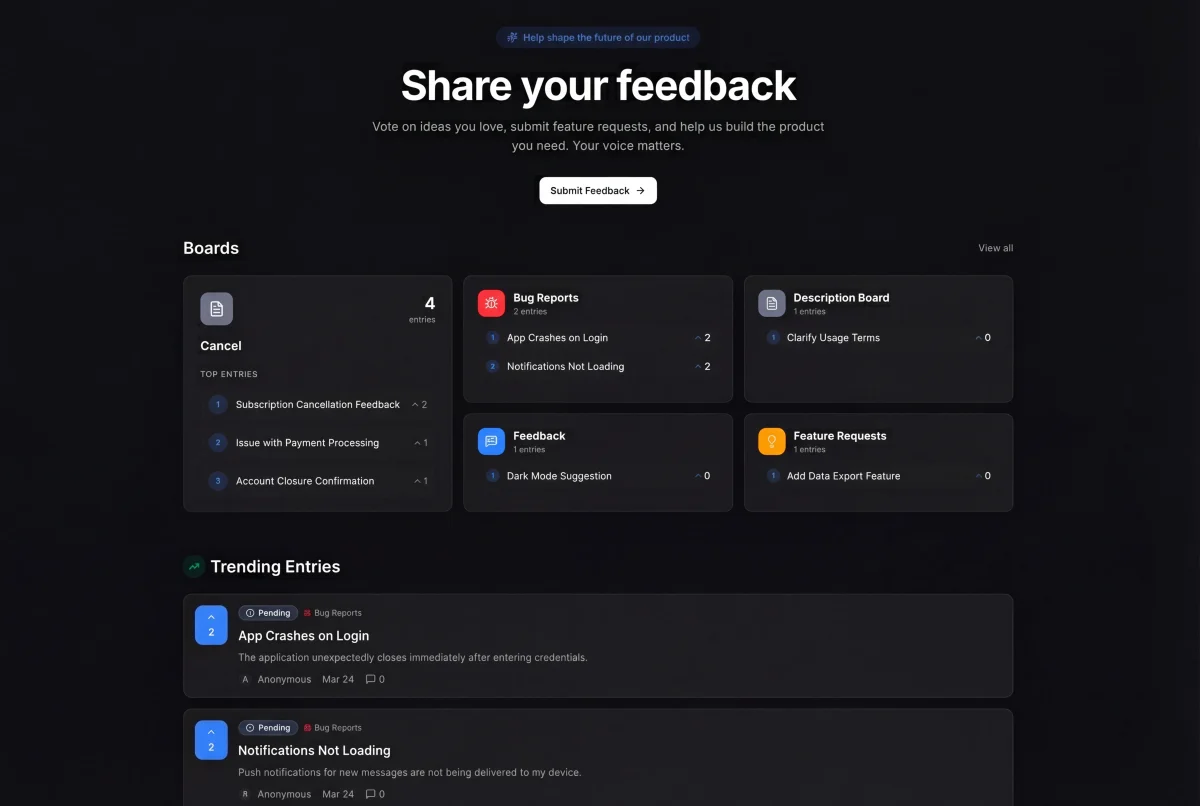
Feeqd combines a public feature voting board, an 18KB embeddable widget, and a Kanban roadmap in one tool. Each workspace gets a custom subdomain (yourcompany.feeqd.com) so your public board has your branding, not Feeqd's. You move top-voted requests to your product roadmap with one click, preserving the vote count.
Best for: teams that want voting + widget + roadmap in a single tool with a real free plan (not just a trial).
Free plan: 3 boards, 60 entries, 1 roadmap, public voting, custom subdomain. Enough to run a real workflow before upgrading.
Canny: the most established player
Canny has been in the feature request tracking space the longest, which shows in their integration ecosystem (Jira, Intercom, Salesforce, Zapier, and more). Their free tier recently improved to include 1 board and 100 tracked users, but most serious teams need the paid plans which start at $99/mo. Canny is used by teams at companies ranging from early-stage SaaS startups to well-known tools like Linear, Retool, and PostHog, which gives a sense of the category it fits.
Best for: teams that already use a major CRM or support tool and need deep integration with it.
Watch out for: pricing jumps significantly between tiers. The free plan is useful for evaluation but not for production use.
Feature Upvote: simple and focused
Feature Upvote does one thing and does it well: public voting boards. No widget, no changelog, no roadmap. If you want a focused voting board without extras, this is the cleanest option. The tradeoff is you'll need separate tools for in-app feedback collection and roadmap visualization.
Best for: teams that only need a voting board and want the simplest possible setup.
Pricing: $49/mo. No free plan, but there is a trial.
Fider: the open source choice
Fider is the best open source feature request tracking tool. It's free to self-host, gives you complete data ownership, and has an active community. The tradeoff is you need engineering resources to deploy, maintain, and update it. For teams that can afford the ops overhead, the data control and zero cost are hard to beat.
Best for: teams with strong engineering resources and data sovereignty requirements.
Setup: Docker-based deployment. Expect 1-2 hours for initial setup, plus ongoing maintenance.
Nolt: affordable and simple
Nolt is a clean, simple voting board tool at a low price point ($29/mo). The interface is minimal, which some teams love and others find too bare. No widget, no roadmap integration, no free plan.
Best for: teams on a tight budget that need a clean voting board and nothing more.
UserVoice: enterprise-focused legacy player
UserVoice is the legacy enterprise option in this category. It has comprehensive features (voting, widgets, integrations, analytics, SSO) but comes with enterprise pricing starting at $499/mo. The UI has shown its age compared to newer tools, but the feature depth and compliance certifications keep it in enterprise procurement processes.
Best for: large enterprise teams with compliance requirements and dedicated budgets.
Productboard: all-in-one product management
Productboard bundles feedback collection, prioritization scoring, roadmapping, and release planning. It's more of a product management platform than a pure feature request tracker. For small teams, the complexity can be overkill. For growing PM teams, the all-in-one approach reduces tool sprawl.
Best for: mid-size product teams that want feedback + roadmap + strategy in one platform.
AnnounceKit: feature requests + changelog
AnnounceKit's differentiator is combining feature request tracking with a changelog/announcements tool. When you ship a requested feature, you announce it in the same platform where users submitted the request. No per-seat pricing is a nice touch for larger teams.
Best for: teams that want feature requests and release announcements in a single tool.
How to Choose Feature Request Tracking Software
Start with your workflow, not the tool
The biggest mistake teams make is picking a tool first and then forcing their workflow to match it. Instead, map out what you need:
- Where do users submit requests? (In-app widget, public board, support tool, all three?)
- Who votes? (Public anyone, authenticated users only, paying customers only?)
- How do requests connect to your roadmap? (Manual, one-click, automatic?)
- How do you notify voters when features ship?
Then match a tool to your workflow. A team that needs in-app collection should skip tools without widgets. A team that wants a public board with custom branding should focus on tools with custom subdomains.
Evaluate the free plan honestly
"Free trial" and "free plan" are very different things. A 14-day trial tells you whether the UI is nice. A real free plan tells you whether the workflow fits your team over weeks of actual use. Among the tools above, Feeqd, Canny, Fider, and Productboard have genuine free or trial options worth testing. Feature Upvote and Nolt require payment from day one.
Consider integration needs
If your team lives in Jira, Intercom, Slack, or Salesforce, integrations matter more than features. Canny and Productboard have the deepest integration ecosystems. Feeqd focuses on the core workflow first, with integrations as a secondary priority.
Don't over-buy
A solo founder or 3-person team doesn't need UserVoice's enterprise feature set. Start with the simplest tool that solves your problem today. Upgrade when you hit real limits, not anticipated ones. Most teams I've talked to overspend on feature request tools by choosing enterprise options when a simpler free plan would work.
Self-Hosted vs SaaS Tradeoffs
Most feature request tracking tools are SaaS, but a few (Fider, some UserVoice deployments) support self-hosting. The choice depends on your priorities:
Choose SaaS if:
- You want zero operational overhead
- You need uptime and updates handled by the vendor
- Your team doesn't have infrastructure expertise
- You can accept vendor lock-in and ongoing subscription costs
Choose self-hosted if:
- Data sovereignty is a regulatory or customer requirement
- You have engineering resources to run the infrastructure
- You want to avoid recurring subscription fees
- You're comfortable with version upgrades and security patches
For most SaaS teams, the SaaS option wins because the overhead of self-hosting outweighs the cost savings at small scale. For enterprises with strict data control requirements or larger teams, the math shifts toward self-hosting. There's no universally right answer.
Migrating from a Spreadsheet
Most teams start with a Google Sheet or Notion table before they realize they need dedicated software. If you're making that switch, the migration is usually simple:
- Export your existing requests as a CSV (columns: title, description, status, requester, vote count if any)
- Import into the new tool using whatever bulk import option it offers (most have one)
- Redirect your collection channels (in-app widget URL, public board link) to the new tool
- Update your team on where to log new requests
The actual data migration takes an afternoon. The behavior change (training the team and redirecting users) takes longer. Start with one collection channel rather than migrating everything at once, and you'll reduce the friction significantly.
Free and Open Source Options
If budget is the main constraint, here are your real options:
- Feeqd free plan: 3 boards, 60 entries, public voting, custom subdomain. The most full-featured free option.
- Fider (open source): Unlimited everything, self-hosted, full data ownership. Requires engineering time.
- Canny free plan: 1 board, 100 tracked users. Enough for early validation but limited.
- GitHub Issues: Free for public repos. Works for open source projects but not for SaaS products with non-technical users.
For most SaaS teams starting out, Feeqd's free plan provides the best balance of features and zero cost. For teams with strict data control requirements and engineering resources, Fider is the right call. Read our full feature request tracking guide for the complete workflow.
Common Mistakes When Evaluating Software
Picking by feature count
More features is not better. The best feature request tracking software is the one your team will actually use consistently. A tool with 20 features that your team ignores is worse than a tool with 5 features your team uses every week.
Ignoring the collection side
Tracking software is useless if you don't have feedback flowing in. Before picking a tool, make sure you have clear collection channels: a public board URL shared in your product, an in-app widget, a prominent link in your help docs, and a workflow for logging requests that come through support.
Underestimating the roadmap connection
Feature requests that don't connect to your roadmap are just a suggestion box. The best tools make it one-click to promote a high-vote request to your roadmap. Tools without this connection force you to maintain two parallel systems.
Skipping the prioritization framework
Voting alone isn't enough. Even with hundreds of votes, you'll need a framework to decide what to actually build. As Mind the Product argues in their prioritization guide, combining vote data with impact and effort scoring produces better decisions than any single signal. Feeqd's approach is to export voting data alongside RICE scoring frameworks so product managers can weight signals appropriately.
Treating the comparison as permanent
The feature request tracking category evolves fast. Pricing, features, and positioning change every few months. A comparison article from 2022 is already stale in 2026. When you evaluate tools, check the vendor websites directly for current pricing and features.
FAQ
What is the best feature request tracking software?
There is no single "best" tool. The best choice depends on your workflow, team size, and budget. For teams wanting a full-featured free plan with voting and roadmap in one place, Feeqd is the strongest option. For teams with deep integration needs (Jira, Intercom, Salesforce), Canny has the broadest ecosystem. For teams needing open source data control, Fider is the choice.
Is there free feature request tracking software?
Yes. Feeqd offers a free plan with 3 boards and 60 entries. Fider is open source and free to self-host. Canny has a limited free tier. For teams just starting, the free options provide enough capacity to validate the workflow before committing to paid plans. See our feature request tracking guide for the full setup process.
What is a software feature request?
A software feature request is a suggestion from a user for new functionality or an improvement to an existing software product. It can range from a simple idea like "add dark mode" to a detailed proposal with use cases. Feature request tracking software centralizes these suggestions, enables voting, and connects them to your product development process. See our guide on what is a feature request for more depth.
How do you manage feature requests at scale?
Centralize all requests in one system (not email or Slack), enable voting so users prioritize for you, categorize by type (features, bugs, general), and define a status workflow (Pending, Next, In Progress, Completed). Review requests weekly, move high-vote items to your product roadmap, and notify voters when features ship. The full workflow is detailed in our guide on how to track feature requests.
Get started with Feeqd for free
Let your users tell you exactly what to build next
Collect feedback, let users vote, and ship what actually matters. All in one simple tool that takes minutes to set up.
Sign up for free