Search "voice of the customer process" and you get ten articles explaining what VoC is. Almost none explain the actual process: who does what, when, with which methods, and what happens to the feedback after you collect it.
That gap is the point of this article. A voice of the customer process is the repeatable operational sequence product teams use to capture customer input and turn it into product decisions. Not a definition. A workflow.
I've been running this process at Feeqd for two years. What follows is the 6-step framework I use, built for product teams who don't have a dedicated customer research function and need VoC to actually produce roadmap items, not slide decks.
What Is the Voice of the Customer Process?
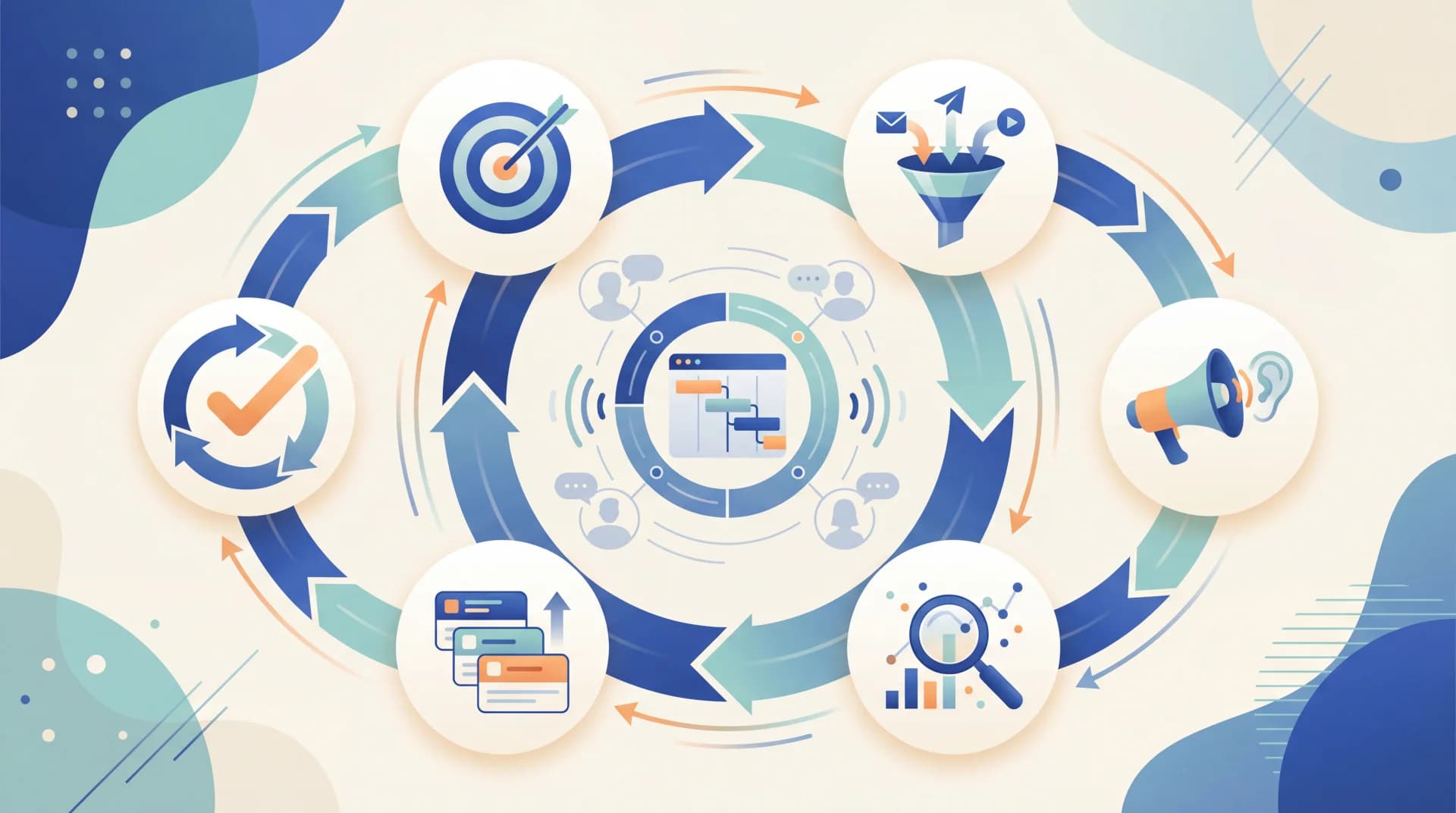
The voice of the customer process is a recurring cycle that moves customer feedback through five states: objectives → collection → analysis → prioritization → action → closure. Each state has an owner, a cadence, and an output.
The process matters more than the tools. Teams with basic tools and a disciplined VoC process ship features users actually want. Teams with enterprise VoC platforms and no process ship beautiful dashboards that nobody acts on.
The distinction from "what is VoC" is sharp:
- VoC = the concept of systematically listening to customers.
- VoC process = the operational steps that make listening produce action.
If you're looking for the concept, Harvard Business School has a solid overview. This article is for teams ready to implement.
Why the Process Matters More Than the Tool
Without a structured process, VoC becomes noise. Feedback piles up in Slack, tickets, emails, and sales calls. Nobody owns it. Nobody acts on it. Customers who took time to share input conclude you didn't listen, because their feedback never reached a product decision.
A defined process solves this by assigning four things to every piece of feedback:
- Where it enters (channel)
- Who owns it next (role)
- When it gets reviewed (cadence)
- What happens after (output)
With those four attributes, no feedback gets dropped. Without them, most feedback gets dropped.
The 6-Step Voice of the Customer Process
Step 1: Define objectives and stakeholders
Before collecting anything, decide what the VoC process is for. Teams skip this step and regret it when they're drowning in unstructured input three months later.
Good VoC objectives are narrow and measurable:
- "Identify the top 10 feature requests driving churn in the next quarter"
- "Reduce time-to-roadmap for high-vote requests from 90 days to 30"
- "Validate 3 new product bets with customer demand data before committing engineering"
Bad objectives are vague: "understand our customers better," "improve CX." These never translate into action.
Then define stakeholders. At minimum, you need:
- Owner: one person accountable for the VoC process itself (usually a PM)
- Collectors: support, sales, CS (whoever talks to customers daily)
- Consumers: the people who use VoC data to make decisions (PM, product leadership, design)
Assign roles explicitly. "The product team" owning VoC means nobody owns it.
Step 2: Identify channels and sources
Feedback arrives through many channels. The VoC process needs to capture all of them without creating duplicate systems.
Map your channels in two categories:
Solicited feedback (you ask):
- Surveys (NPS, CSAT, product-specific)
- User interviews
- Usability tests
- Feedback widgets embedded in the product
Unsolicited feedback (customers initiate):
- Support tickets
- Sales call notes
- Feature request boards
- Social mentions, reviews (G2, Capterra, Reddit)
- Community forums or Discord
The mistake most teams make is treating these as separate streams. A feature mentioned 12 times in support tickets, twice in sales calls, and once on a public board is the same feature. Your process needs a consolidation point where all channels flow into one system. See our user feedback collection strategy for channel selection and our feedback system guide for the operational setup.
At Feeqd we use a single feedback board as the consolidation point. Support tags tickets that include a feature request and creates entries on the board. Sales does the same from call notes. Users submit directly via the widget. Everything lands in one ranked list.
Step 3: Collect feedback continuously
"Continuous" is the critical word. Traditional VoC ran on quarterly survey cycles. Modern VoC is always-on: feedback accumulates as users encounter problems, not when you remember to ask.
Set up collection infrastructure with three requirements:
- Low friction. If submitting feedback takes more than 30 seconds, most users won't. An in-product feedback widget beats a link to a Typeform every time.
- Context-capturing. Know which user submitted, which plan they're on, which feature they were using.
- Voting-enabled. Let other users upvote existing feedback instead of creating duplicates. This is how you convert individual requests into aggregate demand signals.
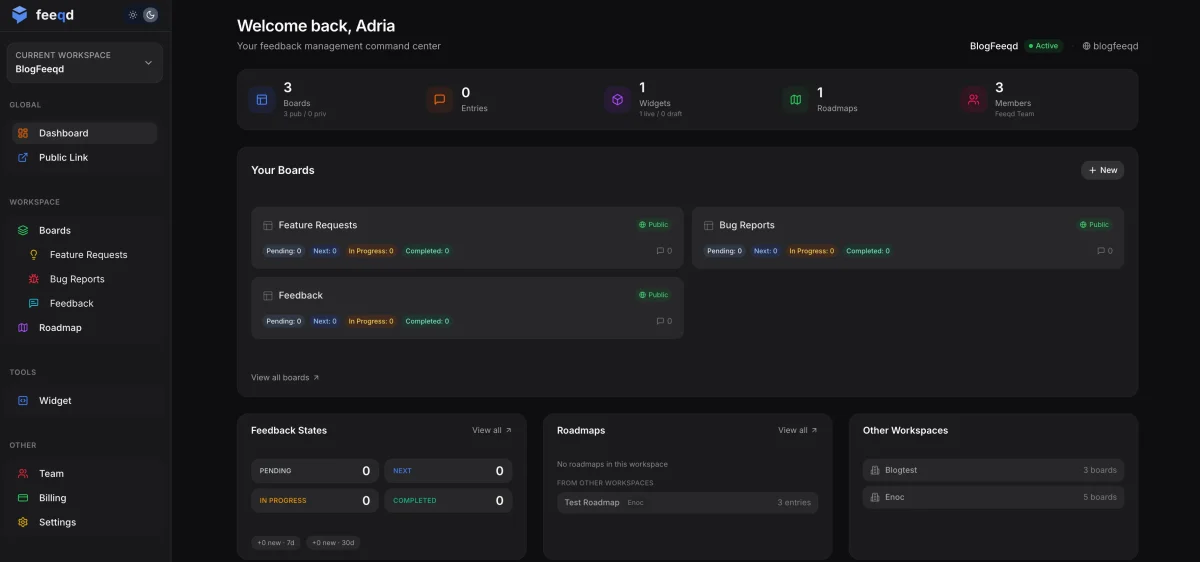
Cadence for this step is continuous, but the review cadence is weekly. Someone (the VoC owner) scans new feedback every week to spot trends early, flag urgent items, and merge duplicates.
Step 4: Analyze and categorize
Raw feedback is noise. Analysis turns it into themes.
For each piece of feedback, capture:
- Theme (onboarding, integrations, performance, etc.)
- Sentiment (positive, negative, neutral)
- Customer segment (free, paid, enterprise)
- Underlying need (what the user is actually trying to do, not the literal request)
That last one is the most important. Users request solutions. Your job is to identify problems. "Add Slack integration" might mean "I need my team to see when feedback arrives." Those are different problems with different solutions.
Run this analysis weekly or biweekly. Tools help here. Feeqd auto-groups similar entries, and dedicated VoC platforms offer NLP theme extraction. But a simple spreadsheet with a categorization column works fine at early stage.
For deeper analysis technique, see how product teams use survey responses for roadmap decisions.
Step 5: Prioritize and act
This is where VoC becomes product decisions. Without this step, you have a feedback archive, not a process.
Use a framework. The one I recommend for product teams:
Demand score = unique voters × segment weight
- Count unique voters per feature (not total submissions; one person requesting 10 times is still one voter).
- Multiply by segment weight (e.g., paid users count 2x, enterprise 3x, if that matches your business).
- Sort descending. Top 10 become roadmap candidates.
Then apply strategic filters:
- Does this align with product direction?
- Can we build it in the current quarter?
- What's the revenue impact?
- Does it create technical debt or unlock future work?
The result is a shortlist of 3–5 features to commit to the next roadmap cycle. See prioritize feature requests for a deeper breakdown of scoring frameworks.
Prioritization runs monthly or every two weeks. Daily prioritization creates whiplash. Quarterly prioritization moves too slow for most product teams.
Step 6: Close the loop
The step every VoC guide forgets. You collected feedback, analyzed it, acted on it. Now tell the customers who asked.
Closing the loop does three things:
- Proves you listened. In my experience, the most common reason customers stop submitting feedback is concluding that nobody reads it.
- Drives re-engagement. Users who see their request shipped become advocates and submit more.
- Builds trust for the items you didn't build. Transparent rejections are better than silence.
The mechanics:
- Status updates on feedback items as they move (planned → in progress → shipped).
- Automatic notifications to users who voted when status changes.
- A public roadmap showing what's committed, what's coming, and what's parked.
- Release notes that reference the feedback that drove the feature.
Read how to close the feedback loop for the full playbook. This step is why VoC with a public roadmap outperforms VoC with internal Airtable boards. Visibility turns one-time feedback into recurring engagement.
The VoC Process Template
Here's the process summarized as a template you can copy into Notion or your team's docs:
| Step | Owner | Cadence | Method | Output |
|---|---|---|---|---|
| 1. Define objectives | PM / VoC lead | Quarterly | Planning session | 2–3 SMART objectives, stakeholder roles |
| 2. Identify channels | VoC lead + support/sales leads | Setup + quarterly review | Channel mapping workshop | Consolidated intake system |
| 3. Collect feedback | All customer-facing roles | Continuous (review weekly) | Widget, boards, support tagging, interviews | Ranked feedback repository |
| 4. Analyze & categorize | PM / research | Weekly or biweekly | Tagging, NLP clustering, manual review | Themed feedback report |
| 5. Prioritize & act | PM + product leadership | Monthly | Scoring framework + strategic filters | Roadmap shortlist (3–5 items) |
| 6. Close the loop | PM / marketing | Continuous + at ship | Status updates, release notes, public roadmap | Customer notifications, roadmap updates |
Copy this table, customize the owners and cadences to your team, and pin it somewhere visible. The process only works if everyone knows their part.
VoC for Product Teams vs Enterprise CX
Most VoC content online is written by CX platforms like Gainsight, Qualtrics, and Salesforce. They target enterprise customer experience teams with dedicated researchers, quarterly survey waves, and seven-figure budgets.
That framing doesn't fit most product teams. A 15-person startup can't run the enterprise VoC playbook. Here's what changes for product teams:
| Dimension | Enterprise CX VoC | Product Team VoC |
|---|---|---|
| Primary channel | Surveys (NPS, CSAT waves) | In-product widget + feedback boards |
| Cadence | Quarterly survey cycles | Always-on continuous |
| Analysis | NLP platforms, research team | PM + lightweight tagging |
| Action target | Customer experience initiatives | Roadmap features |
| Success metric | NPS / CSAT lift | Feature adoption + retention |
| Typical budget | $50K–$500K platform | $0–$200/mo tool |
Product team VoC is lean, continuous, and tied directly to the roadmap. That's the framing this article assumes.
Common VoC Process Mistakes
Treating VoC as a project, not a process. "We're running a VoC initiative this quarter" produces a one-time report that gets ignored. VoC is infrastructure, not an initiative.
Collecting without acting. The fastest way to kill VoC credibility is asking for feedback and never acting on it. At Feeqd we aim to close the loop on at least two-thirds of what we collect; if you can't reach that bar, collect less until your process catches up.
Ignoring aggregate demand. One loud customer isn't a product signal. Ten quiet customers asking independently for the same thing is. Count unique voters, not message volume.
Confusing symptoms with needs. Users ask for features. Your job is to identify the underlying problem. "Add integration X" might mean something different for each user who requested it.
No feedback loop closure. Already covered in Step 6, but worth repeating. If customers don't see what happened to their feedback, they stop giving it.
Tools for the VoC Process
You don't need a VoC platform to run this process. You need something that handles collection, voting, status updates, and roadmap visibility.
- Collection: in-product widget, public feedback board
- Consolidation: a single feedback repository (not spread across tools)
- Analysis: tagging + reporting
- Prioritization: voting + segment weights
- Loop closure: status notifications + public roadmap
Tools that bundle this: Canny, UserVoice, Productboard, Feeqd. Tools that don't: SurveyMonkey, Typeform, Airtable alone. For a full comparison see feedback management tool.
FAQ
What is the voice of the customer process?
The voice of the customer process is the operational sequence product teams use to collect, analyze, prioritize, and act on customer feedback. It moves feedback through six steps: define objectives, identify channels, collect continuously, analyze, prioritize and act, and close the loop. The process turns unstructured customer input into roadmap decisions.
What is the difference between CSAT and VoC?
CSAT is a single metric: customer satisfaction, usually measured by a survey score. VoC is the broader program that captures customer input across all channels (surveys, support, feedback boards, interviews, reviews) and uses it to drive product and service decisions. CSAT is one input to VoC, not a replacement for it.
What is the difference between VoC and VOP?
VoC (Voice of the Customer) captures what customers want and expect from your product. VOP (Voice of the Process) captures what your process actually delivers: its capability and consistency. In Six Sigma, comparing the two reveals the gap between customer expectations and operational reality. Product teams rarely use VOP; the term is more common in quality management.
How long does the VoC process take to set up?
For a product team of 5–20 people, expect 2–4 weeks to set up collection infrastructure (widget, board, tagging), define the process, and train collectors. After that, the process runs continuously with weekly check-ins and monthly prioritization cycles. Enterprise VoC programs take 3–6 months to fully stand up.
Is voice of the customer part of Six Sigma?
Yes. VoC originated in Six Sigma and quality management as the method for capturing customer requirements to feed into process improvement (the Define phase of DMAIC). Outside of Six Sigma, VoC has been adopted by product, CX, and research teams as a broader program for collecting and acting on customer input. The Six Sigma framing still uses VoC alongside VOP (Voice of the Process) and CTQ (Critical to Quality) to align operational delivery with customer expectations.
Get started with Feeqd for free
Let your users tell you exactly what to build next
Collect feedback, let users vote, and ship what actually matters. All in one simple tool that takes minutes to set up.
Sign up for free