Most voice of customer software articles list 20+ enterprise tools and assume you have a six-figure CX budget and a dedicated research team. That list is useless if you're a product team of 10 trying to pick one tool this quarter.
After two years running voice of customer loops at Feeqd for our own product and watching hundreds of customer teams run them on ours, I've found that tier mismatch is the single biggest mistake in software selection. A startup that buys Qualtrics uses 5% of the platform. An enterprise that tries to run on Survicate outgrows it in six months.
This guide fixes that. 13 tools across three tiers (enterprise CX, mid-market AI analytics, product-team feedback), with transparent pricing where vendors publish it, and honest positioning for where each one wins. If you searched for Six Sigma Voice of the Customer (the VoCT matrix or CTQ specifications), that is a different discipline with its own tools; this post covers the CX and product flavor.
TL;DR by tier: Enterprise CX teams (dedicated researchers, low-to-mid six-figure budget) pick Qualtrics or Medallia. Mid-market teams (50 to 500 people, analyzing feedback at volume) pick Chattermill, SentiSum, or Enterpret. Product teams (1 to 50 people, feedback plus roadmap plus voting) pick Feeqd, Canny, or Featurebase. Start with the tier, then the tool.
Quick Comparison Table
| Tool | Tier | Starting price | Best for | Pricing transparency |
|---|---|---|---|---|
| Qualtrics XM | Enterprise | Quote-based (5-6 figures/yr) | Full-stack XM program | Opaque |
| Medallia Experience Cloud | Enterprise | Quote-based | Enterprise customer journey | Opaque |
| InMoment XI | Enterprise | Quote-based | Integrated reporting + action | Opaque |
| Verint VoC | Enterprise | Quote-based | Contact center + digital VoC | Opaque |
| Chattermill | Mid-market | Quote-based (~$1-5K/mo) | AI qualitative analysis | Semi-opaque |
| SentiSum | Mid-market | Quote-based | Support ticket NLP | Semi-opaque |
| Enterpret | Mid-market | Quote-based | Unified AI insights | Semi-opaque |
| Sprig | Product-team | $175/mo | In-product research surveys | Transparent |
| Survicate | Product-team | $99/mo | Lightweight surveys | Transparent |
| Canny | Product-team | $79/mo Starter | Feedback + roadmap | Transparent |
| Featurebase | Product-team | $59/mo | Feedback + changelog | Transparent |
| Frill | Product-team | $25/mo | Roadmap-first feedback | Transparent |
| Feeqd | Product-team | Free, $19/mo Pro | Widget + boards + roadmap | Transparent |
Read the table top to bottom like a tier decision. The enterprise tier is opaque because vendors negotiate per account. The product-team tier is transparent because the buyer is usually a PM with a self-service credit card.
Enterprise CX Platforms
The top of the voice of customer software market is dominated by four vendors. Both Gartner Peer Insights and Forrester consistently place them in the leader quadrants, and their pricing reflects that positioning. Expect a dedicated CX team, a multi-quarter rollout, and contracts that land in the low to mid six figures per year.
Qualtrics XM Platform
The category leader. Qualtrics covers surveys, sentiment analysis, conjoint analysis, driver analysis, and action management in one platform. Best for: Fortune 1000 CX programs with dedicated research analysts.
Price: Quote-based. Public references suggest enterprise contracts start in the low six figures per year, with the XM Discover add-on adding meaningful cost.
Tradeoff: Power comes at complexity cost. I have seen teams buy Qualtrics, use about 5% of the platform, and still pay full price. If you do not have a dedicated CX analyst, most of what Qualtrics does is wasted on you.
Medallia Experience Cloud
Strong in structured and unstructured data across the full customer journey. Particularly strong in retail, hospitality, and financial services.
Price: Quote-based, typically aligned with Qualtrics pricing.
Tradeoff: Implementation timelines are long. Six to nine months to fully deploy is normal. If you need VoC running next month, Medallia is not your tool.
InMoment XI Platform
Known for integrated reporting and action management, less for raw data collection power. Strong focus on closing the loop from insight to customer contact.
Price: Quote-based.
Tradeoff: Less flexible than Qualtrics on survey design. Strong on the "what do we do next" layer.
Verint Voice of the Customer
Verint comes from the contact center world. Strongest when your primary VoC source is voice recordings, chat transcripts, and support interactions. Weaker for product-team use cases.
Price: Quote-based. Bundles with the broader Verint workforce engagement suite.
Tradeoff: Overkill if you are not running a contact center.
If you have a dedicated CX team and a seven-figure program budget, any of these four is defensible. If you do not, keep reading.
Mid-Market AI-Analytics Tools
A middle tier emerged in the last five years as NLP got cheaper and faster. These tools do not try to compete with Qualtrics on survey breadth. They compete on analysis depth: extracting themes, sentiment, and patterns from feedback you already collect.
Chattermill
AI-driven qualitative feedback analysis. Plugs into Zendesk, Intercom, G2, App Store reviews, and NPS responses, then extracts themes and sentiment automatically.
Price: Quote-based. Public references suggest the starting tier lands in the $1,000 to $3,000 per month range.
Best for: Teams with 50 to 500 people that already have feedback volume and need to analyze it faster than a human can read it.
SentiSum
NLP focused specifically on support tickets, calls, and chats. Positions as an AI layer for customer support teams to feed product with theme reports.
Price: Quote-based, similar range to Chattermill.
Best for: Support-led organizations that want to systematize support as a product signal.
Enterpret
Unified feedback intelligence across channels. Claims to consolidate boards, reviews, tickets, and interviews into a single taxonomy.
Price: Quote-based, slightly higher than the above.
Best for: Mid-market teams that want one analysis layer across many input sources.
This tier is rarely the right first purchase. Buy an analysis layer when you have enough volume that humans cannot keep up, not before. For a smaller team, start with simpler collection, analyze manually, and add this tier when you feel the pain.
Product-Team Feedback Tools (often overlooked)
This is the segment that the typical VoC software listicle skips entirely, because most listicles are written by enterprise vendors or analysts who define VoC through a Qualtrics lens. For a product team of 1 to 50, the right tool often looks nothing like Qualtrics.
Feeqd
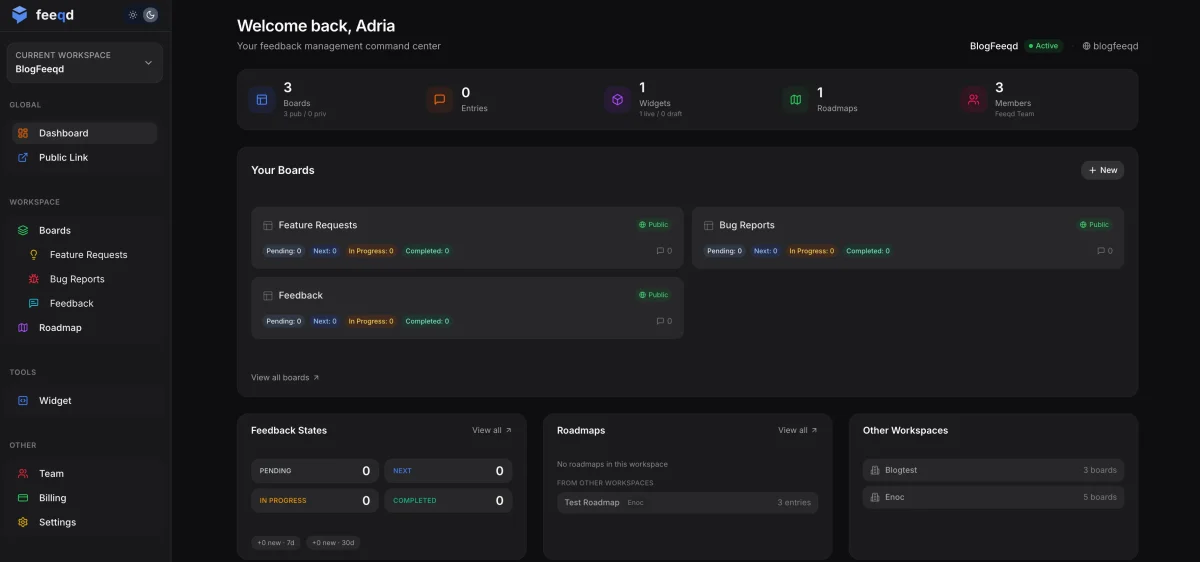
18KB Preact widget plus voting boards plus public roadmaps. Free plan with one board and unlimited feedback, Pro at $19/month, Pro Team at $49/month, Business at $199/month.
Best for: Product teams running continuous feedback loops without enterprise overhead. Founders who want to embed a widget today, not next quarter.
Honest positioning: Feeqd wins on lightweight widget performance (18KB, versus the typical 100KB-plus bundle from enterprise vendors), on pricing transparency, and on bundling widget + board + roadmap in one free tier. It does not compete with Qualtrics on survey breadth or with Medallia on enterprise journey analytics. Different job.
Canny
The category leader for feedback-first product-team tooling. Polished UI, strong integrations, recognized brand. Starter at $79/month.
Best for: Teams that want the most mature feedback UI and have the budget. Canny wins on brand recognition and UI polish. See our Canny alternatives breakdown for where other tools beat it.
Featurebase
Mid-priced alternative with a strong changelog feature bundled. Starting at $59/month.
Best for: Teams wanting feedback plus roadmap plus changelog in a single tool without enterprise complexity.
Frill
Roadmap-focused, with feedback and changelog as supporting features. Starting at $25/month.
Best for: Roadmap-first teams who treat feedback boards as roadmap inputs rather than the central hub.
Sprig
In-product surveys with a research-grade bent. Starting at $175/month.
Best for: Teams running many experiment surveys and wanting statistical confidence, not just "a survey tool."
Survicate
Lightweight survey tool with strong HubSpot and Intercom integrations. Starting at $99/month.
Best for: Teams whose marketing stack is already HubSpot-centric and who want VoC living next to campaigns.
Decision Framework: Which Tier Fits Your Team?
Four questions, in order. Stop at the first yes.
- Do you have a dedicated CX or research team of 3+ people? If yes, the enterprise tier is where you belong. Qualtrics or Medallia.
- Is your annual software budget over $20,000? If yes, the mid-market AI-analytics tier is worth evaluating. Chattermill or Enterpret.
- Do you need feedback collection, voting, and a public roadmap in one system? If yes, the product-team feedback tier is the fit. Feeqd, Canny, or Featurebase.
- Do you just need structured surveys embedded in your app? If yes, Sprig for depth, Survicate for breadth.
Most startups and mid-sized SaaS teams belong in question 3. That is the segment the SERP systematically underserves.
Common Mistakes Choosing VoC Software
Overbuying enterprise. The most common failure mode I have seen. A team buys Qualtrics because the sales cycle was polished, then uses a fraction of the platform for 18 months before quietly renewing at the same price. If you cannot name two analysts who will use the platform daily, do not buy at the enterprise tier.
Ignoring integration needs. Buying a VoC tool that does not push into your Slack, Jira, or Linear is a setup for a tool that nobody checks. Integration path should be a day-one question, not a day-ninety discovery.
No workflow plan. The tool is infrastructure, not strategy. If you cannot describe your voice of the customer process in five steps before you buy, the tool will not create the process for you.
Confusing VoC software with narrower feedback management. VoC is broader: it includes CX analytics, sentiment, and journey data. Feedback management is narrower, focused on feature requests, voting, and roadmap. The right tool depends on which problem you are actually solving.
FAQ
What is the best voice of customer software?
The best voice of customer software depends on team size and budget. Qualtrics or Medallia for enterprise CX teams with dedicated analysts, Chattermill or Enterpret for mid-market with AI-analysis needs, and Canny, Featurebase, or Feeqd for product teams wanting feedback plus roadmap plus voting in one tool. No single tool wins across all tiers.
What is voice of the customer in SaaS?
In SaaS, voice of the customer focuses on product adoption, onboarding success, and feature requests rather than the broader enterprise CX scope. SaaS VoC is continuous rather than quarterly, leans heavily on in-product widgets and voting boards, and ties directly to the roadmap. For the full SaaS framing, see our primer on what voice of the customer means for product teams.
Is VoC software the same as feedback management software?
No. VoC software is broader and typically includes CX analytics, sentiment analysis, journey mapping, and survey programs across many channels. Feedback management software is narrower, focused on collecting feature requests, enabling voting, and turning requests into roadmap items. A product team often needs feedback management more than full VoC software.
How much does voice of customer software cost?
Enterprise VoC platforms (Qualtrics, Medallia, InMoment, Verint) are quote-based and typically land in the low six figures per year for serious deployments. Mid-market AI-analytics tools (Chattermill, SentiSum, Enterpret) typically cost $1,000 to $5,000 per month depending on volume. Product-team feedback tools publish prices transparently and range from free (Feeqd free plan) to $199/month.
How do you build a voice of the customer program?
A voice of the customer program is built in six steps: define objectives, identify channels, collect feedback continuously, analyze and categorize, prioritize and act, then close the loop. The tool is infrastructure, not the program. See our full walkthrough on the voice of the customer process for the operational sequence, owners, and cadences that keep the program from becoming a dashboard nobody opens.
Conclusion
Voice of customer software is not one category, it is three, and the mismatch between tier and team size is what burns budget. Pick the tier first, then the tool.
For the process layer that runs downstream of any tool, see our voice of the customer process and voice of customer techniques. For best practices that apply across tiers, see voice of the customer best practices. For the pillar that ties it all together, see voice of customer analytics. And if your specific question is about in-app tools rather than the broader VoC category, our companion post on in-app feedback tools covers that frame.
If you want a transparent product-team option to try today, Feeqd has a free plan with one board and unlimited feedback. No credit card, no sales call.
Get started with Feeqd for free
Let your users tell you exactly what to build next
Collect feedback, let users vote, and ship what actually matters. All in one simple tool that takes minutes to set up.
Sign up for free