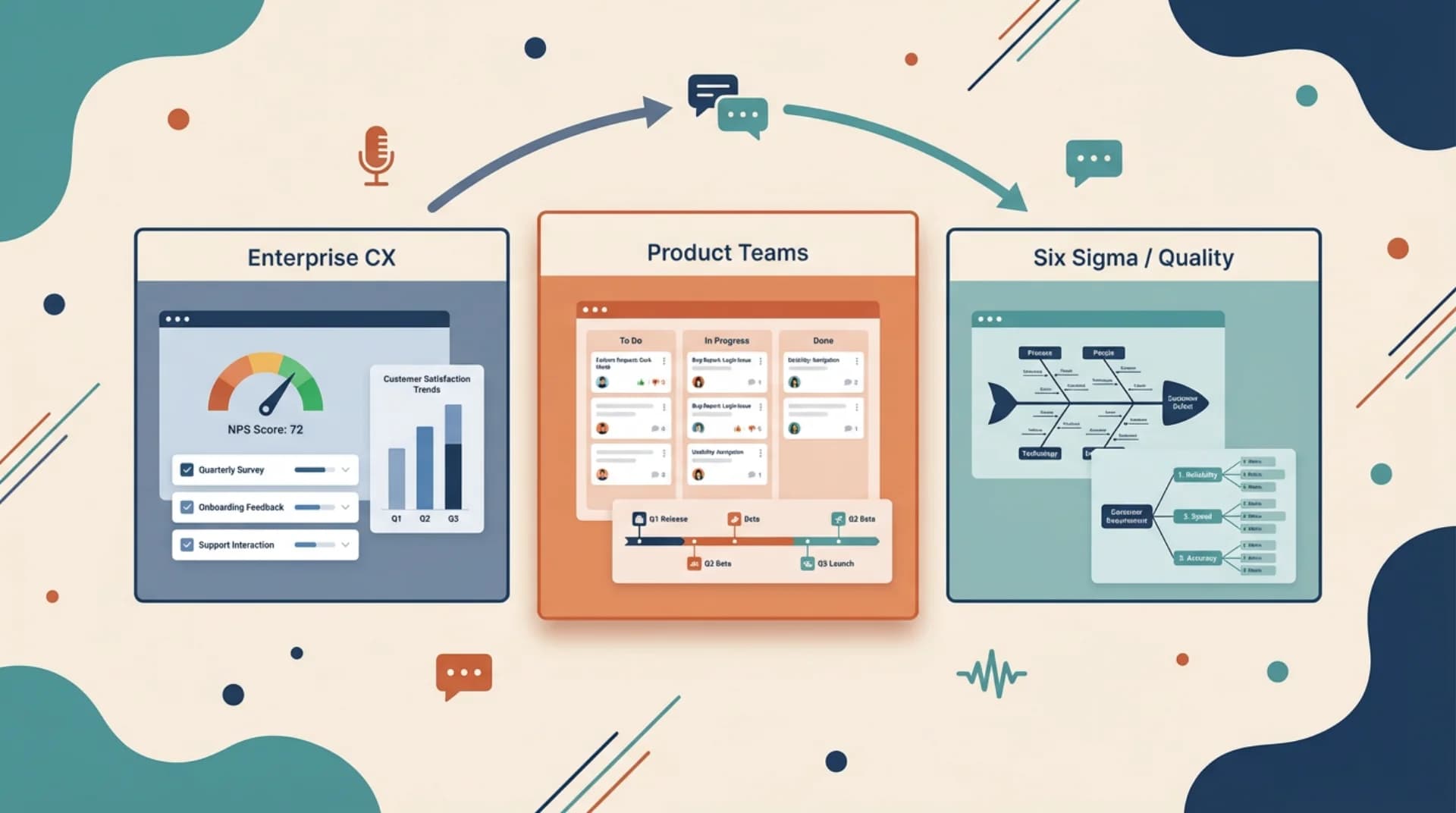
Voice of the Customer (VoC) is the structured practice of capturing, analyzing, and acting on customer feedback, needs, and expectations to improve products and experiences. It combines feedback from surveys, in-app widgets, support tickets, interviews, and community channels into a recurring process that informs product and business decisions.
Search "what is voice of the customer" and you get two flavors of answer: enterprise CX platforms explaining the concept as a prelude to buying their suite, and academic definitions that stop before the operational part. What's missing is a clear product-team answer. How does VoC actually work when you don't have a dedicated research department, and how is it different from the enterprise CX and Six Sigma framings that dominate the first page of Google?
That's what this guide is for. I've been running a VoC program at Feeqd for two years across widgets, public boards, roadmaps, and support conversations. The definition below is accurate for any context. The positioning, methods, and tools that follow are built for product teams.
What Is Voice of the Customer?
Voice of the Customer, abbreviated VoC, is the structured process of listening to customers at scale and translating that input into decisions. It is both a discipline (the practice) and an output (the aggregated signal itself). When someone says "the voice of the customer is telling us to simplify onboarding," they mean the signal. When someone says "we need a VoC program," they mean the discipline. Harvard Business School frames it as a persona representing your understanding of the target customer's goals and pain points, which is a clean way to think about the output side.
Key Components of a VoC Program
Every functional VoC program has four components. Miss one and the program fails silently.
- Collection. Channels that capture feedback at multiple touchpoints: surveys (NPS, CSAT), in-app widgets, public feedback boards, support tickets, interviews, community posts, review sites.
- Analysis. Techniques to turn unstructured input into themes, sentiment, and priority signals. Covered in depth in voice of customer analytics.
- Prioritization. A method to rank signals against business objectives. Voting, weighting by segment, or scoring by impact and effort.
- Action and closure. Converting prioritized signals into roadmap items, and closing the loop with customers who contributed feedback.
A program missing collection is silent. A program missing analysis is noisy. A program missing prioritization is paralyzed. A program missing action and closure is performative.
VoC for Product Teams vs Enterprise CX vs Six Sigma
The first page of Google for this query is dominated by enterprise CX platforms (Qualtrics, Salesforce, Gainsight, Zendesk) framing VoC as a Customer Experience program. A separate tradition, Lean Six Sigma, frames VoC as a quality-management input. Both are legitimate, but neither matches how a product team actually uses VoC in 2026.
Here's the honest comparison:
| Dimension | Enterprise CX | Six Sigma / Quality | Product Teams |
|---|---|---|---|
| Primary goal | Reduce churn, improve NPS | Reduce defects, improve process quality | Inform roadmap, prioritize features |
| Typical team | CX / customer success ops | Quality engineers, process analysts | Product managers, founders |
| Scale | 10k to millions of customers | Regulated manufacturing / service | 100 to 100k users |
| Primary channels | Post-interaction surveys, CRM logs | CTQ trees, customer interviews, focus groups | In-app widgets, public boards, user interviews, support |
| Analysis approach | Sentiment dashboards, NPS drivers | Critical-to-Quality (CTQ) translation, Kano | Theme clustering, vote ranking, segment analysis |
| Output | CX program initiatives | Process change, SPC charts | Roadmap items, closed loops |
| Typical tooling | Qualtrics, Medallia, Gainsight | Minitab, CTQ templates, spreadsheets | Lightweight feedback tools, boards, roadmaps |
For product teams, the enterprise CX playbook is often overkill. The Six Sigma playbook is the wrong shape. What product teams actually need is a focused VoC process that feeds the roadmap. Fewer dashboards, more decisions.
If you're here to decide what VoC looks like on your team, the rest of this guide assumes the product-team framing.
Why Voice of the Customer Matters
Without a VoC discipline, product decisions default to the loudest voice in the room. That voice is usually an engineer, a founder, or a large customer's executive sponsor. Sometimes they're right. Often they're not, and a quieter pattern in the broader customer base gets missed.
VoC matters because it makes product decisions defensible with evidence. Three concrete outcomes product teams report from running a VoC program:
- Fewer wasted sprints. Features built against aggregated demand ship to users who actually asked for them.
- Faster close of the feedback loop. When a theme is tracked from collection to shipping, customers who contributed see their feedback become product, which raises retention.
- Better prioritization defensibility. "We shipped X because 38 paid users from segment Y requested it" beats "we shipped X because it felt right."
The inverse is also true. Teams that collect feedback but skip analysis and closure create a silent trust problem. Customers take time to write feedback, assume nobody read it, and stop writing. The pipeline dries up.
Types of Voice of the Customer Data
VoC data comes in three categories. A mature program uses all three, weighted against the decision being made.
Direct feedback (solicited)
Feedback the customer knows they're giving because you asked. Examples: NPS or CSAT surveys, in-app widget responses, interview transcripts, public feedback board entries, form submissions.
Strength: high intent, structured when designed well. Weakness: skewed toward the customers willing to respond.
Indirect feedback (unsolicited)
Feedback the customer shared outside a direct prompt. Examples: support tickets, reviews (G2, Trustpilot, Product Hunt), social media mentions, community posts, sales call notes.
Strength: reveals pain the customer cared enough to surface unprompted. Weakness: expensive to mine without good tooling, often negative-skewed.
Inferred feedback (behavioral)
Feedback deduced from what the customer does rather than says. Examples: product analytics, feature adoption rates, drop-off in flows, retention cohorts, session replays.
Strength: unbiased by articulation skill or survey fatigue. Weakness: tells you what, not why. Needs pairing with direct or indirect sources to interpret.
A common mistake is over-indexing on one type. NPS-only programs miss behavioral signals. Analytics-only teams miss the why. A balanced VoC stack reads from all three.
How to Build a Voice of the Customer Program
The short version of how a product-team VoC program operates is six repeating steps:
- Define objectives and stakeholders. Narrow, measurable goals. Name an owner.
- Set up collection channels. Widget, boards, surveys, support pipe, interview cadence.
- Centralize and tag. One place where every piece of feedback lands and gets categorized.
- Analyze for themes and priority signals. Vote ranking, theme clustering, segment filters.
- Decide and act. Convert the top signals into roadmap items with clear owners.
- Close the loop. Ship, announce, and reply to the customers who raised the issue.
This is the operational layer. I've covered each step with timing, ownership, and templates in the voice of the customer process. If you're starting from scratch on the collection side, how to build a feedback system walks through the infrastructure before the process sits on top.
Voice of the Customer Methods and Channels
Channels decide what gets heard. The six channels a product team should operate:
- In-app feedback widget. Continuous, contextual, low-friction. Captures feedback at the moment of use. At Feeqd the widget is 18KB and adds no measurable latency, which matters because a heavy widget depresses response rate.
- Public feedback boards. Users post, others vote. Produces aggregated demand signal with zero manual deduplication. Vote count becomes prioritization input.
- Surveys. Targeted NPS, CSAT, or custom research surveys. Best for benchmarking and for deep-dives on specific flows.
- User interviews. Qualitative depth that no survey captures. Usually 5 to 8 per quarter is enough to find patterns.
- Support tickets. The most honest channel. A ticket is a paid customer's time spent telling you something is broken.
- Review sites and community. G2, Trustpilot, Product Hunt, Reddit, Discord. Unfiltered, public, and permanent.
No team runs all six from day one. Start with two, add one every quarter, retire anything that stops producing signal.
Real Voice of the Customer Examples
Three examples of VoC in practice on product teams, drawn from how feeqd and comparable teams operate:
Example 1: Feature prioritization from a public board. A team opens a public feedback board, allows users to submit and vote on requests, and commits to shipping the top 3 items each quarter. Aggregated votes replace gut calls. The roadmap becomes a response to collected demand, visible to customers who voted.
Example 2: Segment-weighted feedback. A SaaS team tags every piece of feedback by customer plan and account size. When prioritizing, they weight feedback from customers in the target segment (paid, over $X ARR) 3x higher than free-plan feedback. The same volume of feedback produces different priorities depending on who said it.
Example 3: Closed-loop public roadmap. A team pipes prioritized feedback items into a public roadmap with status columns: Under review, Planned, In progress, Shipped. When an item ships, the contributors receive a notification. Contributors who see their feedback become product stay engaged and feed more feedback into the system.
The mechanism in all three is the same: a channel, a centralization point, a prioritization rule, an action, a loop closure.
Common Mistakes to Avoid
Five VoC mistakes that consistently sink otherwise functional programs:
- Collecting without closing the loop. Accepting feedback and never responding to the customer who sent it. Reliably destroys response rates within a quarter. The fix is operational, covered in how to close the feedback loop.
- Treating VoC as "the survey tool." A single NPS survey is a data point, not a program.
- Buying an enterprise VoC suite before defining the process. The suite becomes a dashboard that nobody acts on.
- Ignoring inferred feedback. Product analytics is VoC. Pretending only surveys count leaves half the signal on the floor.
- No single owner. VoC programs that belong to "the team" get dropped when every team is busy. One owner, usually a PM, prevents that.
Voice of the Customer Tools for Product Teams
Tooling for a product-team VoC program breaks into three layers:
- Collection. An in-app widget, a public feedback board, survey tools, and a support pipe. Lightweight feedback tools like feeqd combine widget, boards, and public roadmap in one stack. Canny and UserVoice operate in the same category with different trade-offs, covered in the feedback management tool guide.
- Analysis. Theme clustering, sentiment analysis, vote ranking. Covered in VoC analytics techniques.
- Action. A public roadmap and a changelog to close the loop. A public product roadmap is the single most visible signal that a VoC program is real.
Enterprise CX suites like Qualtrics, Medallia, and Gainsight do more than the product-team use case typically needs. They're excellent if your audience is large-CX operations. For product teams, lighter is usually better.
Frequently Asked Questions
What is meant by Voice of the Customer?
Voice of the Customer (VoC) is the practice of listening to and interpreting the needs, wants, and expectations of customers to inform business decisions and improve products and experiences. The goal is converting what customers tell you (directly, indirectly, or through behavior) into decisions that improve their experience and your outcomes.
What is Voice of the Customer in Six Sigma?
In Six Sigma, Voice of the Customer is a process input used to identify Critical-to-Quality (CTQ) requirements. As defined in quality management, VoC captures the customer's explicit and implicit needs, then CTQ translation converts those needs into measurable process characteristics that Six Sigma teams improve. It's the same concept as VoC in product teams, applied to quality-management goals (defect reduction, process capability) rather than roadmap decisions.
Who owns Voice of the Customer?
VoC is a shared responsibility, but it needs a single accountable owner to function. In product teams, that owner is usually a product manager. On larger teams, dedicated CX or research roles take the ownership. Collection involves support, sales, and customer success. Analysis and prioritization tend to concentrate with product. Action happens wherever the roadmap lives. Without one named owner, the program stalls.
How do you get the Voice of the Customer?
Run a recurring process with four parts: collect feedback from multiple channels (widget, boards, surveys, interviews, support, reviews), centralize it in one place, analyze for themes and priority signals, and feed the prioritized themes into the roadmap with loop closure back to the customer. Start with two channels, one owner, and a monthly review cadence. Add channels only when the existing ones produce more signal than you can act on.
Making VoC Work on Your Team
Voice of the Customer is less a tool and more a discipline. The enterprise CX framing treats it as a software category. The Six Sigma framing treats it as a process input. For product teams, it's the recurring habit of listening at scale and letting that input shape what gets built.
The hard part isn't the definition. It's the follow-through: collecting consistently, analyzing instead of accumulating, closing the loop every time. Teams that do those three things ship features users actually want. Teams that skip any of them ship features that feel right to the team and miss the market.
If you want a lightweight VoC stack to start with, try feeqd free. The widget, boards, and public roadmap cover collection, prioritization, and loop closure without the enterprise overhead. No credit card needed.
Get started with Feeqd for free
Let your users tell you exactly what to build next
Collect feedback, let users vote, and ship what actually matters. All in one simple tool that takes minutes to set up.
Sign up for free