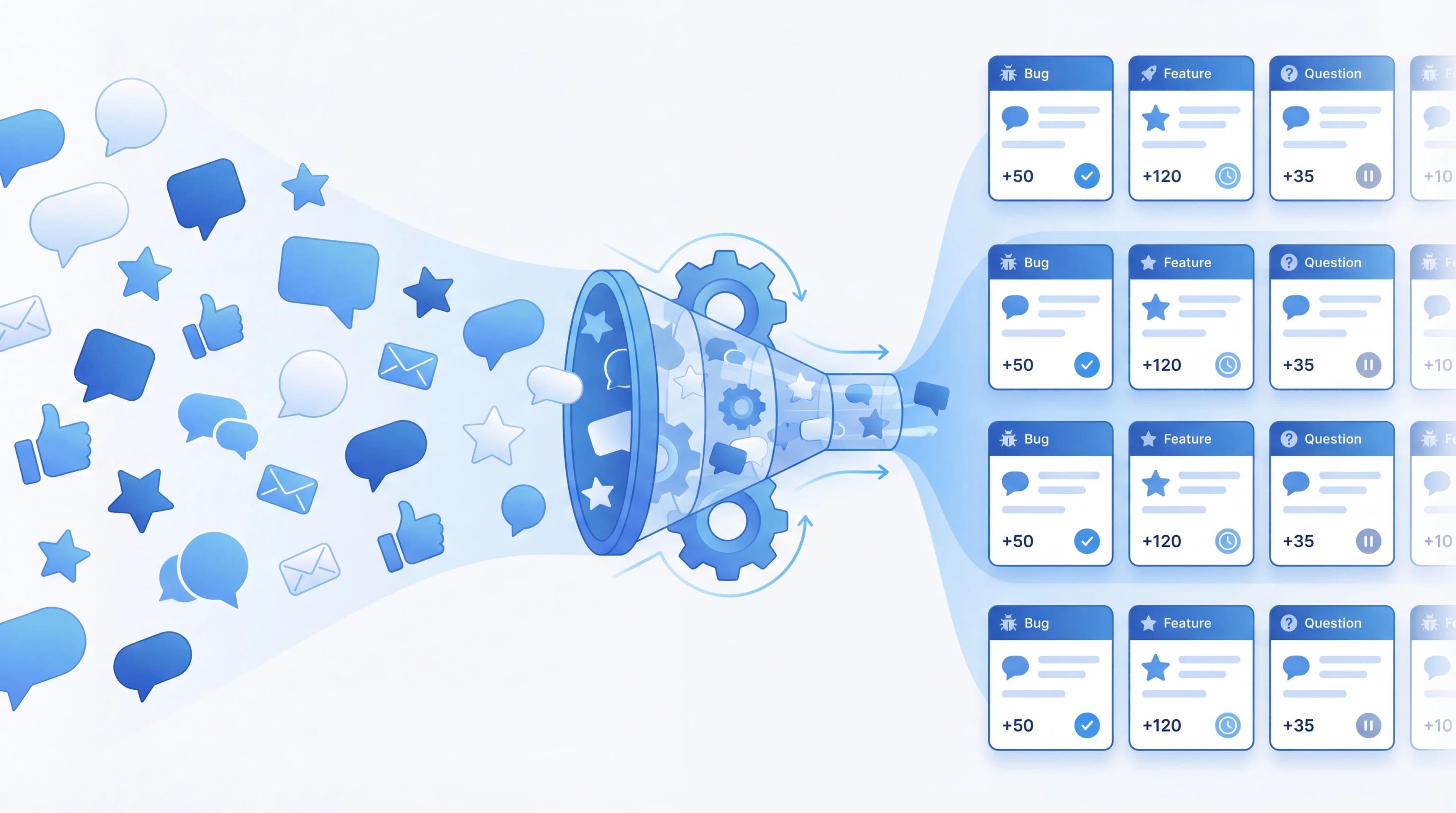
We had feedback everywhere. NPS responses in one tool, support tickets in another, feature requests in a spreadsheet, and bug reports in Slack. Each channel told us something useful. Together, they told us nothing because nobody had time to cross-reference five systems to find patterns.
That's the problem product feedback management solves. Not collecting feedback (most teams already do that) but organizing and acting on it so it actually influences what you build.
What Is Product Feedback Management?
Product feedback management is the systematic process of collecting user feedback, organizing it into actionable categories, quantifying demand through voting or scoring, and connecting it to your product roadmap. It turns scattered user input into structured data that drives development decisions.
The process has four stages:
- Collect. Gather feedback from multiple channels into one system: in-product widgets, public boards, support tickets, surveys, social mentions.
- Organize. Categorize feedback by type (feature requests, bugs, UX issues) and by product area. Structure replaces chaos.
- Prioritize. Quantify demand through community voting so the team knows which requests have the most users behind them.
- Act. Connect prioritized feedback to your roadmap, build it, ship it, and communicate back to the users who asked for it.
Most teams do stage 1 well enough. Stages 2-4 are where feedback management programs succeed or fail.
Why Product Feedback Management Matters
Without a system, feedback is noise. With a system, it's signal.
It prevents building the wrong things. When you build based on assumptions, you risk spending months on features users don't want. When you build based on organized, quantified feedback, the features you ship have a built-in audience of users who already told you they need it. Feature adoption is consistently higher for feedback-driven features.
It reduces churn. Users who submit feedback and see it acted on stay longer. Users who submit feedback into a void leave. A visible feedback management process, where users can see their requests acknowledged, voted on, and moved through a roadmap, is a retention mechanism.
It aligns the team. When product, engineering, and support all reference the same prioritized feedback queue, discussions shift from "I think users want X" to "87 users voted for X." Data replaces opinion. Zendesk's guide on feedback management highlights this alignment as the primary driver of customer-centric product decisions.
The 5 Components of a Feedback Management System
1. Collection Channels
You need at least two complementary channels:
- An embedded widget for in-context feedback. Users submit ideas, report bugs, or share frustrations without leaving your product. Feeqd's widget is 18KB, so it loads without affecting page performance.
- Public feedback boards for out-of-product feedback. Share board links in your newsletter, community, or onboarding emails so users who aren't currently in your product can still contribute.
The key principle: zero friction between "I have feedback" and "it's in the system." Every extra step costs you submissions.
2. Organization Structure
Feedback without structure is just a list. Set up feedback boards organized by type:
- Feature Requests for new functionality ideas
- Bugs & Fixes for quality and reliability issues
- General Feedback for UX observations, confusion points, and suggestions
Each board acts as a structured inbox. When feedback arrives, it goes to the right board automatically based on the submission form, or gets triaged by your team.
3. Demand Quantification
This is where feedback management diverges from feedback collection. Collection captures what users say. Demand quantification measures how many users agree.
Enable voting on your feedback boards. When users can upvote existing entries instead of creating duplicates, you get clean demand data: a sorted list of what users want most, with exact vote counts.
Vote data feeds directly into prioritization. A feature request with 120 votes is objectively more demanded than one with 4. You don't need a meeting to determine that.
4. Roadmap Connection
Feedback that never reaches the roadmap is feedback that was collected and forgotten. The management system must connect to what you actually build.
Add top-voted feedback entries to your roadmap so each planned feature traces back to the user requests that inspired it. A four-column Kanban layout (Pending, Next, In Progress, Completed) gives your team and your users a clear view of what's in flight.
This traceability is what makes feedback management a decision-making tool, not just a data collection exercise.
5. Loop Closure
The system is complete when users who submitted feedback know what happened to it. Status updates, public roadmap visibility, and targeted announcements when features ship.
According to ProductPlan's feedback management overview, closing the loop is what separates mature feedback programs from ones that slowly lose user participation. Users who see results submit more feedback. Users who see silence stop contributing.
How to Set Up Product Feedback Management
Step 1: Centralize your channels
Pick one system and route all feedback into it. Not "most feedback" but all of it. Support agents add feature requests they hear on calls. Product managers add insights from user interviews. The widget captures in-product submissions automatically.
One system, one view, one source of truth.
Step 2: Enable voting immediately
Don't wait until you have hundreds of entries. Enable voting from day one so demand data starts accumulating as soon as feedback arrives. Early voting patterns reveal which issues matter most to your user base.
Step 3: Review weekly, prioritize monthly
- Weekly: Review new submissions, merge duplicates, update statuses on active items
- Monthly: Pull top-voted entries into your planning process, update the roadmap, communicate priorities
This cadence prevents feedback from going stale while keeping the overhead manageable. Read about integrating feedback into product planning for a detailed sprint-level workflow, or see how to implement user feedback for the full pipeline from collection to shipped features.
Step 4: Make it visible
Publish your roadmap publicly so users can check progress without asking. Share your feedback boards so users know where to submit and vote. Visibility builds trust that the system is working.
Common Mistakes
Collecting without organizing. A single "feedback" channel that mixes feature requests, bug reports, and general comments creates noise. Separate by type so each category gets appropriate attention and prioritization.
Organizing without quantifying. Categories help but aren't enough. Without voting, every entry looks equally important. You end up prioritizing based on who complained loudest or most recently, not on actual demand.
Quantifying without acting. The most dangerous failure mode. Users vote, demand data is clear, but nothing changes in the roadmap. Users lose trust in the system and stop participating. If you ask users to vote, you must demonstrate that votes influence decisions.
No ownership. Feedback management needs someone responsible for weekly review, duplicate merging, and status updates. Without ownership, the system decays. It doesn't need to be a full-time role, but it needs to be someone's explicit responsibility.
Feedback Management vs Feedback Collection
These are not the same thing:
| Aspect | Feedback Collection | Feedback Management |
|---|---|---|
| Goal | Capture user input | Drive product decisions |
| Output | List of feedback | Prioritized, actionable backlog |
| Demand signal | None (all items equal) | Vote counts, rankings |
| Roadmap link | None | Feedback entries linked to roadmap items |
| User visibility | Submit and hope | Status updates, public roadmap |
| Loop closure | No | Yes, announce shipped features |
If your current process stops at collection, you're capturing data without extracting value. Management is where the value lives.
FAQ
What are the 3 C's of feedback?
The 3 C's are Collect (gather feedback from users), Categorize (organize by type, priority, and product area), and Close (communicate outcomes back to users). In product feedback management, each C maps to system components: collection channels for gathering, structured boards for categorizing, and public roadmaps for closing the loop.
What are the 5 R's of feedback?
The 5 R's are Receive (accept all feedback), Record (capture it in a structured system), Review (analyze and categorize), Respond (acknowledge to the user), and Resolve (act on it or explain why not). A complete feedback management system handles all five automatically: the widget receives and records, weekly review covers analysis, status updates handle response, and roadmap integration handles resolution.
What is the difference between feedback collection and feedback management?
Collection is capturing user input. Management is the full process: collecting, organizing, quantifying demand through voting, connecting feedback to roadmap decisions, and communicating outcomes back to users. Collection alone produces a list. Management produces a prioritized, actionable backlog that drives what you build. The key difference is whether feedback actually influences product decisions.
How do you measure feedback management effectiveness?
Track three metrics: feedback-backed ratio (what percentage of features in each sprint came from user feedback), feature adoption rate (do feedback-driven features get used more than internal ideas), and loop closure rate (what percentage of addressed feedback entries have updated statuses). Together, these prove whether your feedback management system is driving better product outcomes. See how to track feedback impact for the full measurement framework.
Get started with Feeqd for free
Let your users tell you exactly what to build next
Collect feedback, let users vote, and ship what actually matters. All in one simple tool that takes minutes to set up.
Sign up for free