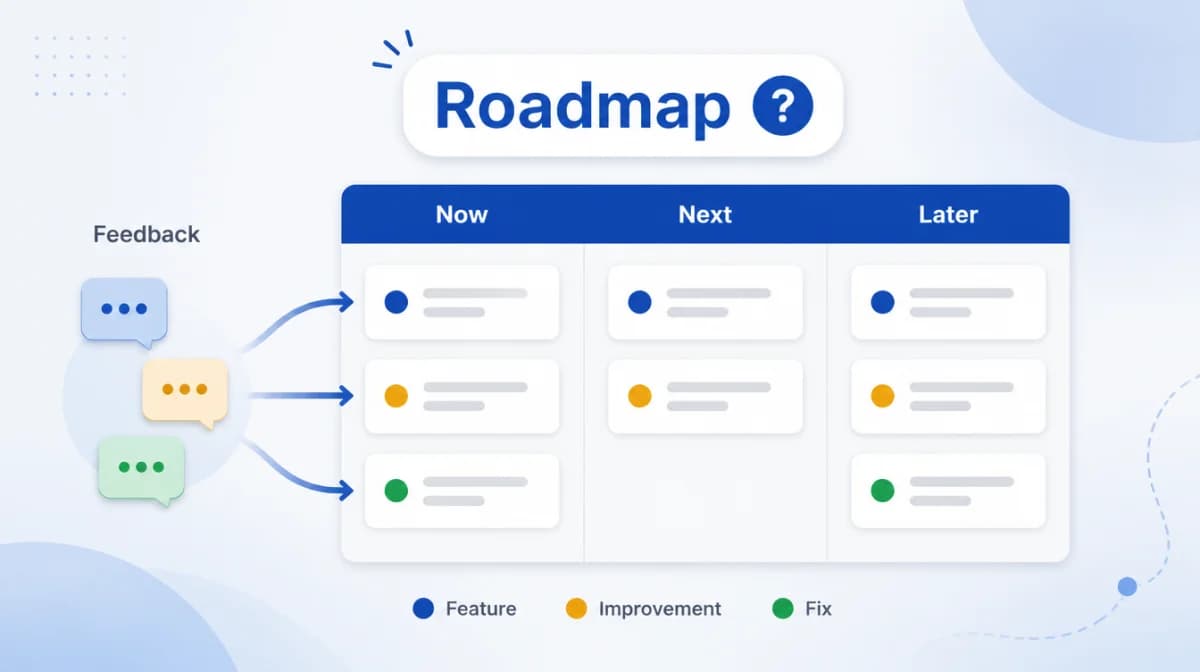
A product roadmap is a high-level, visual document that maps out the strategy, direction, and priorities of a product over time. It tells anyone who reads it three things: what the team is building, why it matters, and roughly when it will ship. The audience is typically internal (engineering, sales, customer success, leadership) and sometimes external (customers, investors).
That definition fits in one sentence. The hard part is what goes inside the roadmap, who decides, and how it stays current as priorities shift. This guide covers all three, with a feedback-driven framework I have used at Feeqd for the past two years and have seen work across dozens of product teams.
Short answer: a product roadmap is a visual summary of what a product team plans to build next, organized by time horizon (now, next, later) or by theme (acquisition, retention, growth). It is not a project plan, not a backlog, and not a list of features promised to specific customers. The best roadmaps stay short, stay current, and tie every item to either a strategic objective or real user demand.
For a deeper commercial comparison of tools that build roadmaps, see our product roadmap software guide. For real visual examples, see our product roadmap examples breakdown. The same definition shows up across the major product-management resources: Atlassian, Pendo, and Marty Cagan all describe a roadmap as a strategic communication artifact rather than a project plan.
Synonyms and related terms
The product roadmap meaning is occasionally confused with other planning artifacts. Here is how it relates to the words that get used interchangeably:
- Product strategy: the high-level direction (where the product is going and why). The roadmap is how you communicate that strategy in artifact form.
- Release plan: a detailed plan for a specific release window with dates and dependencies. A subset of the roadmap, not the whole thing.
- Product plan: often used as a synonym for product roadmap, sometimes for a longer-form strategy document. Context-dependent.
- Feature roadmap: a roadmap focused only on features (as opposed to themes, infrastructure, or strategic objectives). A narrower view, common in early-stage SaaS.
- Tech roadmap: an internal engineering-focused view (refactors, infrastructure, technical debt). Usually a separate document from the product roadmap.
The boundaries blur in practice. The principle: the product roadmap is the strategic, customer-meaningful view; everything else is supporting detail.
Key components of a product roadmap
Most modern product roadmaps include the same five building blocks. Skip any one of them and the roadmap stops working as a communication tool.
- Themes or strategic objectives. What is the team optimizing for this quarter or this half? Common examples: improve activation, reduce churn, expand into a new segment. Themes group roadmap items so stakeholders see the why before the what.
- Items or initiatives. The actual things the team plans to build (features, refactors, integrations, infrastructure). Each item should map back to a theme.
- Time horizons. Either fixed dates (Q1, Q2, Q3) or relative buckets (Now, Next, Later). The bucket approach is more honest for early-stage teams; quarterly dates are more useful for committed enterprise customers.
- Status indicators. Discovery, In Progress, Shipped, Deprioritized. Status tells stakeholders whether an item is firm or still being scoped.
- Success metrics. What does "done" look like? "Improve activation" needs a number ("D7 retention from 22% to 30%"). Without metrics, the roadmap drifts into a feature wishlist.
Many teams add a sixth component: links to user demand. Roadmaps that show vote counts or feedback themes alongside each item give stakeholders an honest answer to "why are we building this and not the other thing?" This is what we mean by feedback-driven roadmap.
What a product roadmap is NOT
The word "roadmap" gets used loosely. Three common confusions worth disambiguating:
- Not a project plan. A project plan tracks tasks, dependencies, and dates for a single initiative. A product roadmap tracks the strategic direction of an entire product over multiple initiatives.
- Not a backlog. A backlog is a long list of every possible thing the team might do, prioritized by the team. A roadmap is the small subset the team has actually committed to working on.
- Not a feature promise. Customers who treat the roadmap as a contract eventually feel betrayed when priorities shift. Modern public roadmaps explicitly call this out: "subject to change based on user feedback and strategic priorities."
The cleanest definition is the inverse of these three: a product roadmap is strategy made visible, not a task tracker, not a wishlist, not a guarantee.
5 types of product roadmaps
Different teams reach for different formats. The five most common, ranked by how often they fit modern SaaS:
1. Now / Next / Later roadmap
Three horizontal columns instead of dates. "Now" is what is in progress, "Next" is what comes after that, "Later" is everything else worth tracking. Fits early-stage teams that ship fast and cannot reliably commit to quarterly dates. Our Now / Next / Later guide covers the format in detail.
2. Kanban roadmap
Like a Trello board: columns for Backlog, In Progress, Shipped. Same idea as Now / Next / Later but with explicit progress states. Common in feedback management tools because it integrates naturally with public feedback boards: a voted-up request moves from Backlog to In Progress to Shipped.
3. Timeline (Gantt-style) roadmap
Items plotted on a horizontal timeline with start and end dates. Familiar to enterprise stakeholders who want to know "will this be ready by Q3?" Risky for product teams because it implies dates are commitments. Best paired with explicit "subject to change" framing.
4. Theme-based roadmap
Items grouped by strategic theme (Acquisition, Retention, Performance, Compliance) instead of by time. Strong for stakeholder communication because it leads with the why. Weak when stakeholders need to know shipping order.
5. OKR-aligned roadmap
Each item maps to a quarterly Objective and a measurable Key Result. The most rigorous format, but the heaviest to maintain. Fits organizations that already run OKRs across the company.
For copy-paste templates of all five, see our sample product roadmap template collection.
Who creates a product roadmap?
The product manager owns the roadmap. That is the short answer. The longer answer is that a healthy roadmap is the output of a conversation, not a one-person decision:
- Product manager: drafts, prioritizes, and maintains the roadmap. Makes the final call on what goes in and what gets cut.
- Engineering lead: validates feasibility and technical sequencing. Catches dependencies the PM cannot see.
- Design lead: contributes user research and flags items that need design discovery before they can ship.
- Customer success / support: surfaces user pain points and feature requests that have hit a critical mass.
- Sales: surfaces commercial constraints (specific customers asking for X, deals blocked on Y).
- Leadership: signs off on the strategic themes that frame the roadmap.
Smaller teams collapse roles. At a 5-person startup, the founder is often PM, designer, and sales lead at once. The principle holds: roadmap quality scales with the diversity of input that shapes it.
How to create a product roadmap (in 5 steps)
The full step-by-step is in our how to create a product roadmap guide. The short version:
- Pick the time horizon. Now / Next / Later for early-stage, quarterly themes for mid-market, multi-year for enterprise.
- Define 3 to 5 strategic themes for the period. Themes are the why behind every item.
- Source candidate items from three places: user feedback (votes, requests), team ideas, and strategic gaps.
- Prioritize ruthlessly. Use a scoring framework (RICE, ICE) or stack-rank by gut + data. Cut to the smallest list you can actually ship.
- Publish and maintain. A roadmap that is not visible to the people who need it is not a roadmap. Update at least monthly.
For prioritization frameworks specifically, see scrum.org's guide to scoring methods covering RICE, ICE, MoSCoW, and Weighted Shortest Job First.
Item 3 is where most roadmaps go wrong. Teams either ignore user feedback (and build the wrong things) or drown in it (and lose strategic direction). The middle path is voting boards: let users surface and prioritize candidate items, then use that signal as one input among three to your roadmap.
The feedback-driven roadmap pattern
Most "what is a product roadmap" articles stop at definition. Here is the pattern that has worked in practice at Feeqd for two years and that I recommend to product teams who ask:
- Public feedback board where users submit and upvote requests. Vote count becomes a demand signal.
- Roadmap items linked to feedback items. When you start work on a request, move the linked feedback item to "In Progress" automatically.
- Public roadmap surface where the same items show up grouped by Now / Next / Later or quarterly. Users see what is being worked on without you having to write a separate update.
- Auto-notification on ship. When an item moves from "In Progress" to "Shipped," users who voted for it get a notification. This closes the feedback loop without extra work.
The result: the roadmap is no longer a document the PM maintains in isolation. It is a live view of what users want, what the team is building, and what just shipped, all on the same surface. For early-stage teams, see our product roadmap for startups framing of this pattern.
Public vs internal roadmaps
A common follow-up question. Two valid models:
- Public roadmap. Everyone (including non-customers) can see what is coming next. Builds trust, sets expectations, doubles as marketing. Used by Linear, GitHub, Cloudflare, Notion.
- Internal roadmap. Only employees and select customers see the roadmap. Lets the team change direction without public backlash. Used by most enterprise SaaS.
Most modern SaaS teams ship a hybrid: a public-facing simplified roadmap (themes + Now / Next / Later) and a richer internal version with dates, owners, and discovery items. We covered the case for transparency in our public product roadmap guide.
How often should you update a product roadmap?
The honest answer: as often as priorities actually change, not on a fixed cadence. In practice, that means:
- Weekly: status updates on items currently in progress.
- Monthly: review the Next bucket. Anything that should move to Now or get cut.
- Quarterly: revisit themes. Are we still optimizing for the right outcomes?
- Ad-hoc: when something major shifts (a competitor launches, a key customer churns, a new constraint emerges), update the roadmap immediately.
Roadmaps that update annually become wishlists. Roadmaps that update daily become noise. Monthly with quarterly themes is the sweet spot for most product teams under 50 people.
FAQ
What is a product roadmap in simple terms?
A product roadmap is a short, visual document that shows what a product team plans to build over the next few months or quarters, why those items matter, and roughly when each will ship. Think of it as the product's GPS: it does not list every street the car will drive on, but it shows the destination and the major turns. The audience is internal teams (engineering, sales, customer success) and sometimes external customers and investors.
What is the main purpose of a roadmap?
The main purpose is to align everyone on the same direction. Engineering needs to know what to build. Sales needs to know what to pitch. Customer success needs to know what to promise. Leadership needs to know whether the team is delivering against strategy. A roadmap is the single document that answers "what are we doing and why?" without forcing every stakeholder to ask the PM directly. When the roadmap stops doing that, the team has either outgrown it or stopped maintaining it.
Can ChatGPT create a product roadmap?
ChatGPT and Claude can draft a roadmap structure if you give them the right inputs (themes, candidate items, time horizon), but they cannot tell you what to prioritize because they do not know your users, your strategy, or your constraints. The useful pattern: feed the model your raw inputs (user feedback themes, strategic objectives, team capacity) and ask it to organize them into a roadmap format. Treat the output as a first draft, not a final answer. The prioritization decision still belongs to the product manager.
Who creates a product roadmap?
The product manager owns and maintains it. The roadmap itself is shaped by inputs from engineering (feasibility), design (user research), customer success (pain points), sales (commercial constraints), and leadership (strategic direction). At smaller startups, one or two people often play multiple roles. The principle: a roadmap should reflect a conversation, not a unilateral decision.
What is the difference between a product roadmap and a project plan?
A product roadmap tracks the strategic direction of an entire product over multiple initiatives, expressed at the level of themes and high-level items. A project plan tracks the tasks, dependencies, and dates for a single initiative inside the roadmap. A roadmap might say "Launch SSO in Q3"; a project plan breaks that into "scope SAML integration", "build admin UI", "QA with two pilot customers", with dates and owners for each step.
How long should a product roadmap be?
For most SaaS teams, the readable horizon is 2 to 4 quarters out. Anything beyond that is speculation; anything shorter is a sprint plan. Within that horizon, the roadmap should be short enough to fit on one screen. If you cannot see the entire roadmap without scrolling, you have too many items for the time horizon and the roadmap has become a backlog.
Get started with Feeqd for free
Let your users tell you exactly what to build next
Collect feedback, let users vote, and ship what actually matters. All in one simple tool that takes minutes to set up.
Sign up for free