Enterprise roadmaps have dedicated PMs, quarterly planning sessions, and tools that cost more per month than most startups spend on hosting. A product roadmap for startups needs to be different: lean, fast to update, and driven by what users tell you they need, not what a strategy document says they should want.
I've built Feeqd's roadmap from zero as a startup founder. Every lesson in this guide comes from making mistakes: building features nobody wanted, committing to timelines we couldn't hit, and eventually learning that a feedback-driven approach produces better results with fewer resources. Here's the framework that works.
Why Startup Roadmaps Are Different
Resources are limited
A startup with 2-5 engineers can't work on 10 features simultaneously. Your roadmap needs to be ruthlessly prioritized. Every item on it should answer: "is this the highest-impact thing we can build with what we have?" If the answer isn't clear, the item doesn't belong on the roadmap.
The plan will change
In the first 18 months, we changed Feeqd's roadmap priorities every 2-3 weeks based on user feedback and usage data. That's not failure. That's working correctly. A startup roadmap is a direction, not a contract. If you're not changing it regularly, you're probably not listening to users.
Speed beats polish
An enterprise PM can spend two weeks designing a beautiful portfolio roadmap with custom swimlanes. A startup founder needs to set up a roadmap in an afternoon and start using it immediately. The format that lets you move fastest is the right format.
How to Build a Product Roadmap for Your Startup
Step 1: Define your vision in one sentence
Before picking features, write why your product exists. This is the filter every roadmap decision passes through.
Bad: "We make feedback management software." Good: "We help product teams build what users actually want by connecting feedback to roadmap decisions."
The vision should be stable for at least 6-12 months. Individual features change constantly, but the vision shouldn't.
Step 2: Collect user feedback from day one
Don't wait until you have hundreds of users. Set up a feedback board the day you launch. Even with 10 beta users, their votes and requests will surprise you. When I set up Feeqd's first feedback board with our initial beta group of 15 users, the top 3 most-voted features were completely different from what we had planned internally.
Channels for early-stage feedback:
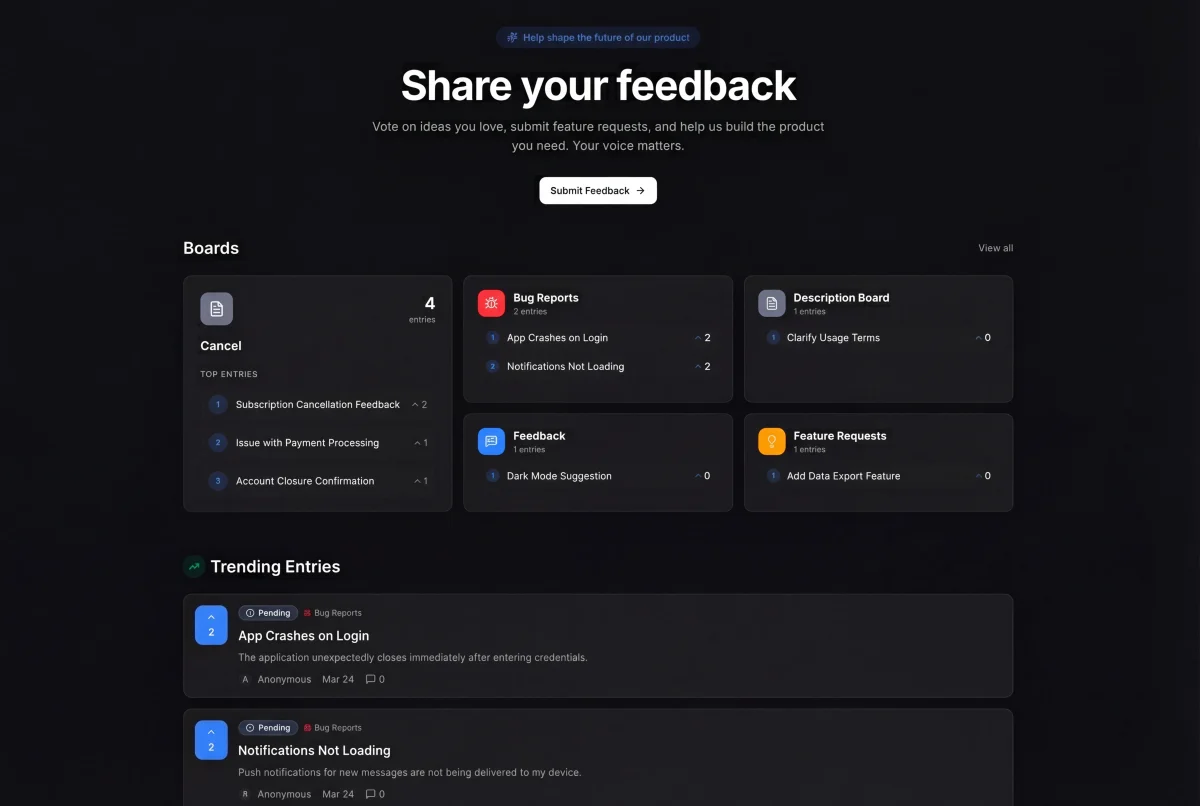
- Public feedback board with voting: users submit and vote on ideas. Even with a small user base, voting patterns reveal priorities. Feeqd's free plan includes 3 boards and 60 entries, enough for any early-stage product.
- In-app widget: catches feedback while users are in your product. Zero friction.
- Direct conversations: at startup scale, you can talk to every user. But log those conversations into your feedback system so they're not lost in Slack threads.
Step 3: Use Now / Next / Later instead of dates
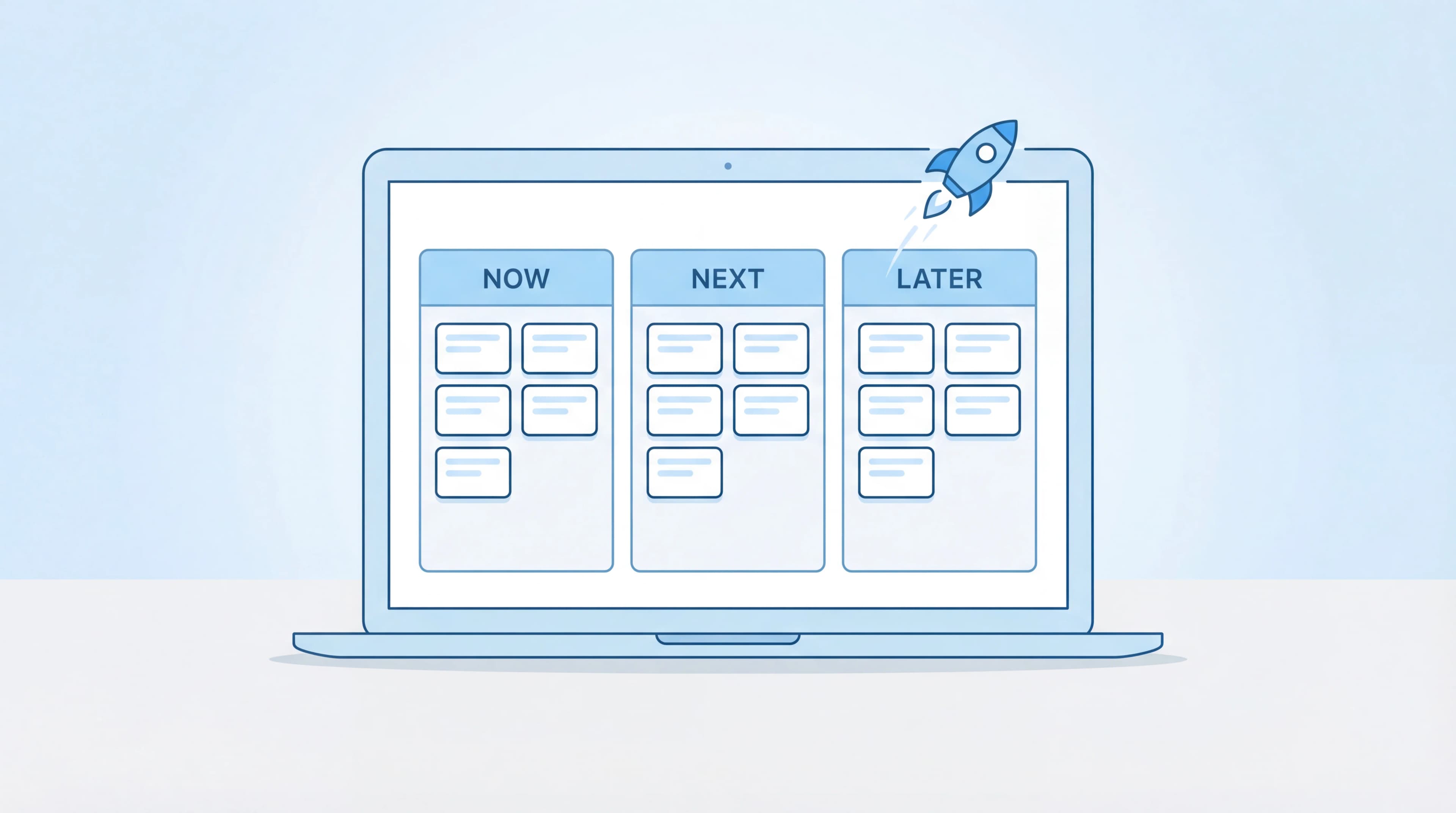
Startups should never put specific dates on a roadmap. You'll miss them, and then the roadmap loses credibility with users and stakeholders. The Now/Next/Later framework communicates priority without creating false promises:
- Now: the 1-3 features your team is building this sprint or month
- Next: 3-5 features committed for the next 1-2 months
- Later: features you're considering but haven't committed to (this quarter or beyond)
This format takes 30 minutes to set up, updates in seconds, and communicates everything your team and users need to know.
Step 4: Prioritize with vote data + strategic judgment
For startups, I recommend a simple 3-factor prioritization:
- User demand: how many users voted for this? (from your feedback board)
- Business impact: does this unlock a new segment, reduce churn, or enable monetization?
- Effort: can we build this in a sprint, or does it require a month?
Formal frameworks like RICE scoring work, but at startup scale a quick gut check against these three factors is often enough. Don't over-process prioritization when you have fewer than 50 requests. The data is too thin for complex frameworks to add value.
Step 5: Make your roadmap public
This is the most counterintuitive advice for startups, and the most valuable. Making your roadmap public:
- Shows users you're actively building (reduces "is this product alive?" concerns)
- Creates accountability that keeps you focused
- Attracts prospects who can see your product is evolving
- Generates organic feedback as users react to planned features
I was nervous about making Feeqd's roadmap public. Competitors might see it. Users might hold us to it. What happened instead: public roadmap visibility became a selling point, not a risk. Read our full guide on how to create a product roadmap for the detailed process.
Startup Roadmap Template
Here's a minimal template you can copy and start using today:
Vision: Help product teams build what users actually want.
Now (this sprint):
- Public feedback board with custom subdomain (147 votes, M effort)
- Widget dark mode support (95 votes, S effort)
Next (next 1-2 months):
- Slack integration for new feedback notifications (40 votes, M effort)
- CSV export for feedback entries (25 votes, S effort)
- Board-level analytics dashboard (strategic, L effort)
Later (this quarter):
- API v2 with webhooks (20 votes, considering)
- Multi-language widget support (15 votes, considering)
Review cadence: Weekly (Monday morning) Public: Yes, on yourcompany.feeqd.com Feedback source: Public voting board + in-app widget
This is close to what Feeqd's actual early roadmap looked like. The key difference from a generic template: every item has a demand signal (vote count or explicit user request). If an item has no user demand and no strategic justification, it doesn't belong on the roadmap. For more on connecting feedback to your roadmap, see our guide on feedback-driven roadmaps.
Common Startup Roadmap Mistakes
Building before validating demand
The classic startup trap. You spend 3 months building a feature, launch it, and nobody uses it. A feedback-driven roadmap prevents this by requiring demonstrated demand (votes, requests) before features earn a spot. As Teresa Torres advocates in continuous discovery, validate assumptions before committing to building.
Committing to specific dates
"We'll ship feature X by March" sounds professional but creates a broken promise 70% of the time at startup pace. Use Now/Next/Later columns instead. If a stakeholder demands dates, push back with: "Here's what we're building first, second, and third. The order is based on user demand data."
Copying the enterprise playbook
Enterprise roadmaps use portfolio views, swimlanes, theme-based planning, and quarterly reviews. A 3-person startup using these tools is spending more time managing the roadmap than building the product. Start with a simple Kanban board (4 columns) and add complexity only when you genuinely need it.
Ignoring feedback from free users
Early-stage startups often dismiss free user feedback because "they're not paying." But free users are your future paying customers. Their feature requests reveal what's blocking conversion. A feature voted by 50 free users might be the unlock that converts 10 of them to paid. Track all feedback, then segment by user type when prioritizing.
Never updating the roadmap
A startup roadmap should change weekly. If yours looks the same as it did a month ago, you're either not collecting feedback, not reviewing it, or not listening to it. The roadmap is a living reflection of what you're learning, not a static plan you wrote during a planning day.
When to Graduate from a Startup Roadmap
At some point, your startup grows past the lean roadmap phase. Signs it's time to formalize:
- Multiple teams are working on the product and need coordination beyond a single Kanban board
- Enterprise customers are requesting delivery dates that Now/Next/Later can't satisfy
- Quarterly planning becomes necessary because the team is large enough that not everyone can be in every conversation
- Stakeholder reporting requires roadmap views tailored to different audiences (engineering vs board vs customers)
When these signs appear, graduate from a simple Now/Next/Later roadmap to a more structured approach, potentially with timeline views, theme-based planning, or portfolio roadmaps. The key is not to formalize too early. As Eric Ries argues in The Lean Startup, premature process is as harmful as premature optimization.
Startup Roadmap Tools
You don't need expensive tools at the startup stage. Here's what works:
| Tool | Best For | Cost | Setup Time |
|---|---|---|---|
| Feeqd | Feedback + voting + roadmap in one tool | Free plan | 30 min |
| Notion | Simple roadmap table for internal use | Free | 15 min |
| Trello | Basic Kanban for tiny teams | Free | 10 min |
| GitHub Projects | Dev teams already in GitHub | Free | 20 min |
| Linear | Dev-first teams wanting speed | Free for small teams | 15 min |
For most startups, Feeqd's free plan is the best starting point because it combines feedback collection, voting, and a product roadmap in one tool. You don't need to maintain a separate feedback inbox and a separate roadmap. The feedback feeds directly into the roadmap. Read our product roadmap examples guide for visual inspiration.
FAQ
What is a startup roadmap?
A startup roadmap is a lightweight product plan that communicates what a small team is building and why, organized by priority rather than dates. Unlike enterprise roadmaps that use quarterly timelines and portfolio views, startup roadmaps use simple formats like Now/Next/Later and are updated weekly as user feedback and business priorities evolve.
How do you start a product roadmap?
Start with your product vision (one sentence), then collect user feedback through a voting board. After 2-4 weeks of feedback, organize the top-voted items into Now (building), Next (planned), and Later (considering). Review weekly. The full process is covered in our guide on how to create a product roadmap.
Can ChatGPT create a startup roadmap?
ChatGPT can brainstorm feature ideas, draft a Now/Next/Later structure, or help prioritize a list of items. But it can't replace real user feedback data. A startup roadmap built on AI suggestions alone is just a fancy guess. Use ChatGPT for formatting and brainstorming, then validate with actual user votes and conversations.
How is a startup roadmap different from an enterprise roadmap?
Startup roadmaps are simpler (Now/Next/Later vs quarterly timelines), faster to update (weekly vs quarterly), cheaper (free tools vs $59+/user/month), and feedback-driven (user votes vs stakeholder meetings). Enterprise roadmaps serve larger organizations with multiple teams, compliance requirements, and fixed delivery commitments that startups don't have yet.
Get started with Feeqd for free
Let your users tell you exactly what to build next
Collect feedback, let users vote, and ship what actually matters. All in one simple tool that takes minutes to set up.
Sign up for free