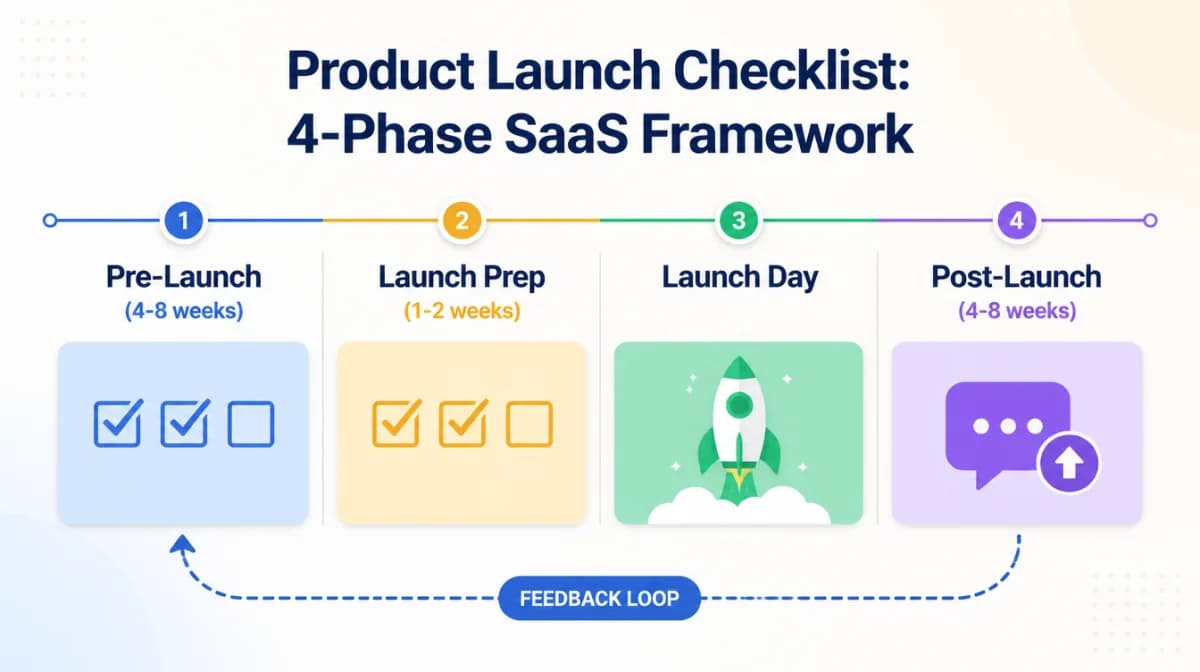
A product launch checklist is a structured list of tasks a team works through to ship a product (or major feature) successfully. Most checklists you find online are 39-step megalists that feel comprehensive and never get used. This one is organized in 4 phases that match how SaaS teams actually launch in 2026, with the items that matter most for B2B SaaS at the top of each phase.
I run Feeqd, a feedback management tool that helps SaaS teams close the feedback loop after launch, so I have spent the last two years watching how teams launch and what falls apart. The pattern below is what works in practice for product teams under 50 people.
Short answer: organize your launch in 4 phases: Pre-Launch (4 to 8 weeks prior) for validation and assets, Launch Prep (1 to 2 weeks prior) for team readiness and final QA, Launch Day for coordinated execution, and Post-Launch (4 to 8 weeks after) for feedback collection and iteration.
For copy-paste templates that complement this checklist, see our release notes template, changelog template, and release notes examples guides.
Quick reference: the 4 phases
| Phase | Timing | Goal | Critical items |
|---|---|---|---|
| Pre-Launch | 4-8 weeks prior | Validate, build assets, align teams | Product validation, market positioning, pricing, beta program |
| Launch Prep | 1-2 weeks prior | Final QA, team readiness, content live | Internal demos, support training, release notes, marketing assets |
| Launch Day | Day 0 | Execute, monitor, respond | Coordinated announcements, real-time monitoring, customer outreach |
| Post-Launch | 4-8 weeks after | Collect feedback, iterate, close the loop | Feedback widget, public roadmap, NPS, retention metrics |
Most launch checklists you read online stop at "Launch Day" and treat post-launch as an afterthought. The teams I have watched succeed treat post-launch as the most important phase. Launching is the start of feedback collection, not the end of the project.
Phase 1: Pre-Launch (4 to 8 weeks prior)
This is where most launches are won or lost. By the time you are 2 weeks out, the strategic decisions are locked in.
Product readiness
- Define the launch scope. What is in, what is out. Document explicitly.
- Identify the primary user persona and their core job-to-be-done.
- Validate with 5 to 10 target users (not friends, not your team, real prospects).
- Run a closed beta with 20 to 100 users. Capture feedback through an in-app feedback widget.
- Define success metrics. "Launch was successful if X."
- Identify and document the top 3 risks (technical, market, operational).
Market positioning
- Write the 1-sentence positioning statement: "For [persona] who [problem], [product] is the [category] that [unique value]."
- Map the top 3 competitors and your differentiation against each.
- Decide on launch tier: soft launch (private beta), Product Hunt launch, full PR launch, or no-fanfare ship-and-blog.
Pricing and packaging
- Lock pricing tiers. Free / Paid / Enterprise. Annual vs monthly.
- Decide on a launch discount or trial extension (optional but increases conversion).
- Set up payments (Stripe, Polar, Paddle) and test the full purchase flow end to end.
- Document refund policy and edge cases.
Beta program
- Recruit 20 to 100 beta users from your existing audience or waitlist.
- Onboard them with a clear "what we want from you" message (feedback, bugs, testimonials).
- Set up a feedback channel: Slack, in-app widget, or public feedback board with voting.
- Collect 5 to 10 testimonial-quality quotes during beta.
Technical foundation
- Production environment provisioned and load-tested.
- Monitoring and alerting in place (Sentry, Datadog, Grafana, or equivalent).
- Backup and rollback plan documented.
- DNS, SSL, CDN configured.
Phase 2: Launch Prep (1 to 2 weeks prior)
Strategic decisions are locked. Now it is execution and team readiness.
Internal alignment
- All-hands launch demo (45 minutes). Everyone in the company sees the product before customers do.
- Sales enablement: pitch deck, demo script, objection handling, FAQ.
- Support training: top 10 expected questions with answers, escalation paths.
- Marketing brief: launch theme, hero message, channels, paid budget.
Content and assets
- Release notes drafted (technical and end-user versions).
- Landing page live (above-the-fold messaging matches positioning).
- Pricing page live and accurate.
- Demo video recorded (under 2 minutes, founder-narrated works well).
- Screenshots and product GIFs ready for press, social, and docs.
- Customer testimonials collected and approved for use.
- Documentation complete for the launch scope (not every feature, just what is launching).
- Email announcements drafted (existing users, waitlist, newsletter).
- Social media posts drafted (LinkedIn, X, founder account).
- Product Hunt assets ready if launching there: gallery, gif, tagline, first comment.
Final QA
- Cross-browser testing (Chrome, Safari, Firefox, Edge on desktop; iOS Safari, Chrome Android on mobile).
- Onboarding flow tested with a fresh account.
- All payment flows verified end to end.
- Error states tested (network failure, expired session, invalid input).
- Email deliverability tested (welcome email, password reset, billing receipts).
- Analytics events firing correctly (sign up, activation, purchase).
Phase 3: Launch Day
The day itself is choreography. The hard work is already done.
Morning (08:00 to 12:00 local)
- Final smoke test in production. All critical flows working.
- Status page updated (everything green).
- Internal Slack channel opened for real-time coordination (#launch-day).
- On-call rotation confirmed for the day.
- Press embargo lifted (if applicable).
- Announcements published in the order: blog post, email to existing users, social media, Product Hunt (if applicable).
- Sales team notified to stop sending "coming soon" replies and start pitching live.
Midday (12:00 to 16:00 local)
- Monitor signup rate, conversion rate, error rate. Compare to baseline.
- Respond to comments on Product Hunt, social media, and Reddit threads in under 60 minutes.
- Triage incoming bug reports. Critical bugs get a hotfix that day.
- Capture early feedback as it comes in (in-app widget, support tickets, social).
Evening (16:00 to 20:00 local)
- Internal recap: signups, conversions, incidents, surprise wins.
- Top 3 bugs prioritized for next-day triage.
- Post a "thanks" update to the community (Product Hunt, social, email).
- Celebrate. Order pizza or buy your team coffee.
Phase 4: Post-Launch (4 to 8 weeks after)
This is the phase most checklists skip. It is the phase that decides whether the launch translates into product-market fit or fades into a one-day spike.
Week 1: capture everything
- In-app feedback widget live on every meaningful page.
- Public feedback board where users can vote on what to build next.
- Daily review of new feedback (15 minutes, every weekday).
- Tag feedback by theme as it comes in (bug, feature request, confusion, praise).
- First-week retention metric tracked. D1, D3, D7 activation rates.
Weeks 2 to 4: triage and ship
- Top 5 bugs from Week 1 fixed and shipped.
- Top 3 feature requests evaluated against the roadmap. Either committed or politely declined with reasoning.
- First post-launch release notes published.
- First post-launch newsletter sent (recap of changes, what is coming next).
- D7 retention reviewed. Below 20% means you have an activation problem to fix before scaling acquisition.
Weeks 4 to 8: close the loop
- Update the public product roadmap with what shipped and what is coming next.
- Notify users who voted for shipped features (this is the feedback loop closure most teams skip).
- Run an NPS survey or CSAT survey on users active for 30+ days.
- Schedule 5 to 10 user interviews with active users to dig into behaviors metrics cannot explain.
- Retrospective with the team: what went well, what would we do differently, what surprised us.
SaaS-specific launch items (do not skip these)
For SaaS specifically, a few items from the general checklist need extra weight:
Onboarding optimization
- Time-to-first-value measured. How long from signup to the user experiencing the core product value? Target under 5 minutes for B2B SaaS.
- Empty states designed. New users land in an empty product; what they see in the first 30 seconds determines activation.
- Activation email sequence (3 to 5 emails) to nudge users through key milestones.
Pricing and billing
- Free trial vs free plan decision documented (free plan generally wins for self-serve SaaS).
- Failed payment recovery flow tested (failed cards retry 2 to 3 times before downgrading).
- Annual vs monthly toggle works correctly.
- Tax handling for international customers verified.
Integrations
- Top 3 integrations documented and tested (Slack, Linear, Jira are common).
- OAuth flows tested end to end.
- Webhook reliability monitored.
Compliance
- GDPR cookie consent live (if EU traffic).
- Privacy policy and terms of service updated and linked from signup.
- Data export and deletion endpoints functional (legal compliance, not optional).
Customer-facing transparency
- Public roadmap live so users can see what is coming next.
- Public feedback board live so users can submit and vote on requests.
- Status page live so users can verify uptime independently.
- Changelog live so users can follow product updates.
Where most launch checklists fail
Three patterns I have seen kill launches that did everything else right:
- No feedback channel on Day 1. Users want to tell you what they think while it is fresh. If your only channel is "email support," you lose 90% of the signal.
- No commitment to update the roadmap publicly. Day 1 momentum dies if Day 14 looks the same as Day 1. A public roadmap with shipping items signals that you are listening and iterating.
- No retention measurement. D1 signups feel great; D7 retention is the actual launch metric. Teams that track only acquisition spend Month 2 wondering why MRR plateaued.
Each of these has a fix, and each is in Phase 4 above. The launch is not done on Launch Day. The launch is done when the feedback loop is running.
Templates and tools
For the items above, you do not need expensive tools. The minimum stack:
- Project management: Linear, Jira, Notion, or even a Google Doc with a shared list.
- Customer feedback: an embeddable feedback widget plus a public feedback board. Free options exist (see our free feedback tools for startups breakdown).
- Roadmap: any of the formats in our sample product roadmap template collection.
- Release notes: copy-paste from our release notes template guide.
- Analytics: PostHog, Mixpanel, Plausible, or Google Analytics, depending on tracking needs.
- Status page: Atlassian Statuspage, Instatus, or a simple Notion page if you are early-stage.
The tools matter less than the discipline of using them consistently. A team running on Google Sheets with weekly updates beats a team with the best tools that nobody opens.
FAQ
What are the 7 steps of a product launch?
The seven steps used most often are: (1) market research and validation, (2) define positioning and target customer, (3) build the product to launch scope, (4) develop the go-to-market plan (pricing, channels, messaging), (5) prepare the team (sales enablement, support training, internal demo), (6) execute the launch (announcements, PR, monitoring), and (7) measure and iterate post-launch. The 4-phase framework above maps these seven steps into Pre-Launch (1 to 4), Launch Prep (5), Launch Day (6), and Post-Launch (7), which works better for SaaS because steps 5 to 7 carry more weight than the linear list suggests.
What is the 39-step product launch checklist?
The "39-step" checklist is a popular long-form template that some PMs reference, originally credited to Sean Ellis and the early growth-marketing community. It covers items at the granularity of "create a product hunt account" and "draft launch tweet." Useful as a memory aid; risky as a primary tool because the list is so long it stops being a checklist and becomes a wishlist. The 4-phase version above captures the same scope at higher abstraction so a team can actually work through it without skipping items.
What is needed for a successful product launch?
Five things, in order of importance: (1) a real product that solves a real problem for a real user (validation), (2) a clear positioning statement (who is it for, what does it do, what is the alternative), (3) a coordinated launch day where announcements, sales, and support are all aligned, (4) a feedback channel live from Day 1 so you can hear what users say while it is fresh, and (5) the discipline to iterate publicly in the weeks after launch. Most failed launches got 1 to 3 right and skipped 4 and 5.
How long should a product launch take?
For most SaaS teams, the timeline from "we have decided to launch" to launch day is 6 to 8 weeks. Less than 4 weeks usually means corners are cut on validation, market positioning, or QA. More than 12 weeks usually means scope is too broad and the team should split the launch into two smaller releases. The first 2 weeks of post-launch are still part of the launch, even though the public sees Day 0 as the milestone.
What are the 6 steps of a product launch plan?
A common 6-step framing is: (1) define the launch objective and target audience, (2) finalize positioning and messaging, (3) prepare the team (sales, support, engineering on-call), (4) coordinate launch-day execution across announcements and channels, (5) monitor in real time and respond to early feedback, (6) measure outcomes and run a post-launch retrospective. The 4-phase framework above maps these directly: steps 1 and 2 fall in Pre-Launch, step 3 in Launch Prep, steps 4 and 5 on Launch Day, and step 6 in Post-Launch. The choice between 6-step and 4-phase is mostly stylistic; the work is the same.
What is the difference between a soft launch and a full launch?
A soft launch ships the product to a limited audience (existing waitlist, beta users, single segment) without broad marketing or PR. A full launch coordinates announcements across multiple channels (Product Hunt, press, social, email) on a single day. Most modern SaaS launches are hybrid: a soft launch to existing users in Week 0 to validate the product is stable, then a full launch in Week 2 once the team is confident. The 4-phase framework above accommodates either path.
What goes wrong most often during product launches?
In my experience watching launches over the past two years, the three most common failure modes are: (1) the team launches before the product can handle production traffic and the launch day spikes break things, (2) the team launches without a clear feedback channel and loses the early-signal feedback that determines whether to double down or pivot, and (3) the team treats Launch Day as the finish line and goes silent in the weeks after, killing the momentum that made the launch matter. Each is preventable with the items in Phase 1 and Phase 4 above.
Get started with Feeqd for free
Let your users tell you exactly what to build next
Collect feedback, let users vote, and ship what actually matters. All in one simple tool that takes minutes to set up.
Sign up for free